Canadian Christians Branded As "UnCanadian" For Traditional Religious Beliefs
 By Jonathon Van Maren/Bridgehead.ca December 06, 2018
Share this article:
Attacks on freedom of religion and freedom of conscience are a near-constant in Canadian news cycles of late, from physicians fighting in court for the right not to refer for procedures they find immoral to religious schools battling the government in court to maintain the independence and integrity of their institutions.
Many religious views have been recast by many progressive politicians and academics (with the obedient acquiescence of the media) as hateful and even vicious, and as such it is open season on those who dare to hold these views and worse, speak of them aloud.
So I am not surprised that a recent study by the Angus Reid Institute in partnership with Cardus, a conservative think tank based out of Ottawa, indicated that only 59% of Canadians say that religious freedom makes our country a better place, leaving a full 41% that presumably feel that religious freedom makes our country a worse place, or at least feel ambivalent about a fundamental freedom. Ray Pennings of Cardus broke it down recently in the Hamilton Spectator:
While a clear majority sees the benefits of religious freedom, it’s curious that more of us aren’t enthusiastic about this fundamental human right. What’s at play here?
There are likely several factors, including a hardcore secularist viewpoint, though this remains a minority view in Canada.
The same survey used a series of measures to classify Canadians among three categories — those welcoming of faith in public life, those who are unsure and those hostile to it. The proponents of public faith are the largest group at 37 per cent, while the other two weigh in at 32 per cent each. Only 31 per cent of the group hostile to public faith say religious freedom makes Canada better. An almost equal proportion says it makes Canada worse.
Clearly, hardcore secularism contains a fervent opposition to religion and its free expression.
Related to that secularism could be prejudice against public displays of faith. Indeed, half of Canadians say they’re uncomfortable with religious garments or symbols in the workplace — something that disproportionately affects Muslims, Jews and Sikhs. Such discomfort may translate into lower support for religious freedom.
Still, that’s not the whole story. Could it also be that some Canadians feel that the Charter of Rights and Freedoms’ guarantee of religious freedom doesn’t adequately protect them? If so, their answer about religious freedom may reflect their judgment on the effectiveness of Charter protections.
Seven in 10 Canadians say they feel the federal government respects their religious community. And almost six in 10 say Canadian society either makes room for their faith and values or has little impact on them…Now the bad news: Christians don’t fare as well. Overall, Catholics and other Christians feel less respected by government and less welcome in society than non-Christians do.
But it’s Canada’s evangelical Protestants who feel especially marginalized. They’re the most likely to say the feds disrespect them, with four in 10 evangelicals saying so. And just over half of this religious minority says society shuts them out. They may not be enjoying all the benefits of religious freedom.
This finding is unsurprising given the news of the last year:
Evangelicals and other Christians bore the brunt of the federal government’s Canada Summer Jobs fiasco, which filtered out grant recipients based on their beliefs. Legal challenges are ongoing but haven’t borne fruit yet.
The evangelical Trinity Western University in B.C. faced discrimination by several law societies opposed to it setting up a law school — discrimination that the Supreme Court of Canada eventually upheld.
And in Alberta, it’s mostly evangelical schools that are threatened with the loss of funding over an ideological disagreement with the provincial government.
But could there also be some amnesia about the fundamental human right of religious freedom?
What many may not realize is that religious freedom is not just for the religious; it benefits everyone. It protects the ability of the religious and non-religious to act according to their deepest beliefs — informing our freedoms of speech, association and assembly. More Canadians need to see and understand this connection.
The fact that they don’t, of course, can be tied to a number of things. Traditional Christian views are now considered to be widely “offensive,” a word now frequently used to justify censorship. People are simply less tolerant of being exposed to ideas they dislike, and less willing to engage in discussion.
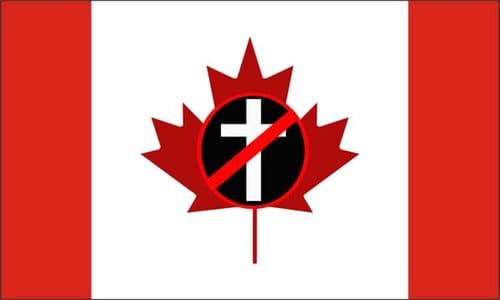
Our current prime minister’s rhetoric doesn’t help: Justin Trudeau has consistently condemned traditional Christian beliefs as “unCanadian,” helping to cement the idea that Canadian Christians are somehow less Canadian because they are Christian.
It is fascinating to me how such an a historical view can be so consistently propagated. Canada was founded on Judeo-Christian principles, and this fact was once widely known and understood.
You cannot drive anywhere in this country without encountering evidence of Canada’s Christian heritage. The aging churches, the moss-covered Celtic crosses in the graveyards, the religious nature of the cenotaphs and memorials to the fallen.
By the new standards of Justin Trudeau and his ideological fellow-travelers, the men and women who built this country are somehow less Canadian than they are because they believed different things about the fundamental nature of life and family. This view cannot be defended, and therefore it is easier for Trudeau and those like him to instead respond to disagreement with sneering and condescension.
In the broad sweep of Canadian history, I would prefer to stand with those indomitable and hard-working men and women of faith who held to the traditions of their ancestors and thousands of years of revealed truth rather than a man who chases the progressive absurdities of the current moment and sneers at the noble generations who believed things he cannot understand.
Originally published at The Bridgehead - reposted with permission.