
Welcome To New York’s Socialist Housing Experiment
 By PNW Staff May 28, 2026
Share this article:
For generations, owning property in America represented more than wealth. It represented stability, freedom, responsibility, and the belief that if you worked hard enough, you could build something that truly belonged to you. That principle is now increasingly under attack -- and few recent examples have alarmed property owners more than the housing agenda being promoted by New York City mayoral figure Zohran Mamdani.
Mamdani's latest housing proposal is being celebrated by progressive activists as "bold reform." But critics see something much deeper and far more dangerous: the normalization of government-directed wealth redistribution disguised as housing justice.
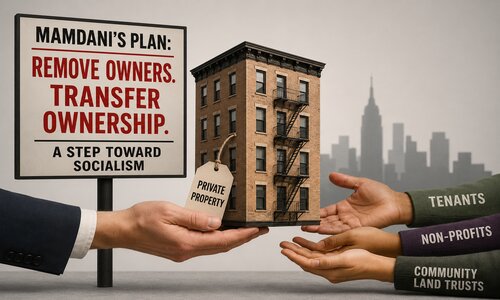
At the center of the controversy is Mamdani's proposal to target buildings deemed to have suffered from "chronic neglect" and transfer ownership away from private landlords to so-called "responsible stewards," including nonprofit organizations, community land trusts, and even tenant groups themselves.
Supporters frame the plan as accountability for bad landlords. But the deeper concern is who gets to define "neglect," who decides when ownership rights are forfeited, and what happens when government gains broad authority to seize or redirect private property.
That is where this debate stops being merely about housing policy and becomes a broader ideological battle over socialism itself.
Throughout history, socialist movements have consistently advanced the idea that private ownership -- especially ownership involving wealth, land, or business -- is inherently unfair or exploitative. The solution, they argue, is redistribution through government action. Sometimes it comes through taxation. Sometimes through regulation. Sometimes through nationalization. And increasingly, in American cities, it comes through housing policy.
The language often sounds compassionate: fairness, equity, stewardship, affordability. But the underlying philosophy remains the same. The state becomes the ultimate authority over property, deciding who deserves to keep it and who does not.
Critics warn that once government gains the power to determine that a building is "mismanaged enough" to justify transferring ownership, no property owner is truly secure. The concern is not merely about punishing slumlords. Existing laws already allow cities to fine negligent landlords, enforce safety standards, and even condemn dangerous buildings through established legal processes.
What alarms many observers is the growing political appetite for bypassing traditional market principles altogether in favor of ideological redistribution.
And this trend is not isolated to New York.
Across America, progressive politicians increasingly promote rent control expansions, eviction restrictions, public ownership models, wealth taxes, and government-managed housing initiatives. In places like San Francisco and Portland, critics argue that years of aggressive anti-landlord policies have discouraged investment, reduced housing supply, and worsened affordability rather than improving it.
Yet despite those outcomes, socialism continues gaining popularity among younger Americans.
Recent polling from organizations including Gallup and Pew Research Center has shown growing openness toward socialism among Millennials and Generation Z. Many younger voters increasingly view capitalism as inequitable, unaffordable, or rigged against them -- particularly after years of inflation, student debt, rising home prices, and economic instability.
That frustration is real. But critics argue socialism repeatedly offers emotional promises while ignoring economic realities.
Housing shortages do not disappear because politicians demonize landlords. Apartments do not magically appear because developers are forced into costly union mandates and restrictive regulations. Construction still requires investment, risk, labor, materials, and profit incentives.
When those incentives disappear, so does development.
History offers countless warnings. From the Soviet Union to Venezuela, governments that aggressively attacked private ownership often created economic stagnation, corruption, shortages, and declining living conditions. While Mamdani's plan is nowhere near those extremes, opponents argue it reflects the same philosophical foundation: government control over private assets in pursuit of ideological equality.
There is also a deeper cultural shift occurring beneath the policy debate.
For much of American history, success was viewed as something to aspire toward. Increasingly, however, political rhetoric paints ownership itself as morally suspicious -- especially when involving housing, wealth, or investment property. The entrepreneur, landlord, or investor becomes the villain, while government redistribution becomes the moral solution.
That mentality fundamentally changes the relationship between citizens and the state.
If ownership exists only so long as government approves of how you manage your property, then ownership becomes conditional rather than protected. Critics argue that this is precisely why so many Americans are increasingly alarmed by proposals like Mamdani's.
The debate over housing affordability is legitimate. New York City's housing crisis is severe, and many tenants live under difficult conditions. But solving those problems by steadily eroding property rights may ultimately create a far more dangerous precedent.
Because once a society accepts the principle that government can transfer private property to politically approved groups in the name of fairness, the definition of "fairness" rarely stops expanding.