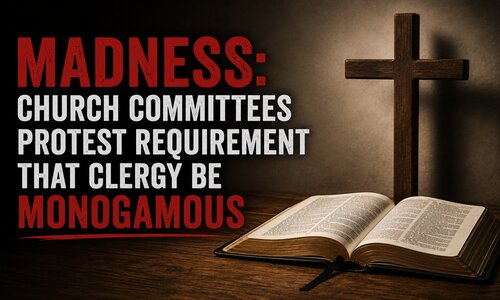
Madness: Church Committees Protest Requirement That Clergy Be Monogamous
 By PNW Staff June 8, 2026
Share this article:
A denomination that spent years revising its teaching on sexuality is now discovering that once biblical authority is untethered from church doctrine, there is no obvious place to stop.
That is the real story behind the current debate in the Presbyterian Church (U.S.A.). The denomination, which has already affirmed same-sex marriage and ordained openly gay clergy, is now considering a proposal known as CON-10 that would require ordained ministers to be in monogamous sexual relationships. The proposal is aimed at stopping polyamory and polygamy, arguing that multi-partner relationships create power imbalances, emotional harm, and spiritual confusion.
What should be a straightforward affirmation of historic Christian teaching has instead become a controversy. Three official church advisory committees have criticized the proposal. One committee warned that requiring monogamy could "risk harm."
Another argued that the measure reinforces systems of privilege. A third suggested the denomination should continue studying "diverse understandings of relationships." Outside activist groups have gone further, describing the proposal as backward and hosting educational events on "faithful polyamory."
The irony at the center of the dispute
The striking feature of this debate is not that a secular institution is questioning monogamy. It is that a church is struggling to defend it.
For nearly two thousand years, Christian teaching on marriage was remarkably consistent: sexual intimacy belongs within a covenant union between one man and one woman, marked by fidelity and exclusivity. Whatever disagreements Christians have had on other issues, the expectation that church leaders model sexual faithfulness has been foundational.
Yet the current debate frames even the requirement of monogamy as potentially oppressive. According to the committee statements, asking clergy to live within clear sexual boundaries may reinforce shame or regulate private lives in harmful ways.
But this raises an unavoidable question: if a church cannot tell its pastors that they must be sexually faithful to one spouse, what moral standard can it still meaningfully uphold?
The logic of endless revision
Supporters of the proposal argue that polyamory creates practical and pastoral problems. Multiple romantic partnerships often involve unequal commitments, competing loyalties, financial complications, and emotional instability. Even many secular relationship experts acknowledge the difficulties of sustaining multiple intimate relationships over time.
But the deeper issue is theological. Once the church treats historic sexual ethics as flexible, every remaining boundary becomes negotiable. The arguments now being used against monogamy requirements sound familiar because they echo the language used in earlier debates over sexual morality: traditional standards are said to cause harm, exclude people, or reflect cultural privilege rather than divine revelation.
That is why critics of the denomination see this controversy as a warning rather than an isolated dispute. They argue that abandoning Scripture as the final authority inevitably turns moral questions into political negotiations. What was once a matter of obedience becomes a matter of committee process, social analysis, and competing claims of identity.
Why leadership standards matter
The proposal is specifically about ordained leadership. Churches routinely require leaders to meet standards that go beyond what is expected of the surrounding culture. Ministers are entrusted with teaching, counseling, and spiritual authority. Their lives are meant to be examples of the faith they proclaim.
In that context, requiring monogamy is not an unusual intrusion into private life. It is a minimal expectation of sexual fidelity. The New Testament repeatedly links church leadership with moral character, self-control, and faithfulness in family life. Historic Christian traditions have understood those qualifications as applying not only to doctrine but also to conduct.
That is why many observers find the committee objections so startling. The debate is not over whether pastors should be celibate, or whether they should abstain from exploitative relationships. It is over whether they should be limited to one partner.
A denomination at a crossroads
The Presbyterian Church (U.S.A.) will vote on the proposal at its General Assembly. Whatever the outcome, the controversy exposes a deeper struggle within the denomination: whether biblical teaching sets the agenda for the church, or whether the church continually rewrites its moral framework in response to cultural pressure.
For conservative Christians, the answer is clear. Marriage is not a social experiment to be endlessly redefined. It is a covenant instituted by God, ordered toward fidelity, permanence, and exclusivity. Church leaders should not merely affirm that standard in theory; they should embody it in practice.
That is why many believers are watching this debate with disbelief. A church once known for proclaiming the authority of Scripture is now arguing over whether monogamy should be expected of its clergy. The fact that official church committees can describe such a requirement as potentially harmful reveals how far the conversation has shifted.
The tragedy is not that a church is debating polyamory. The tragedy is that defending monogamy now requires a formal proposal at all.
Christians who care about biblical authority should pray not only for the outcome of this vote, but for a broader recovery of confidence in Scripture. Without that foundation, every moral boundary eventually becomes negotiable, and every historic doctrine becomes subject to revision. The current controversy is less a beginning than a symptom of a much longer journey away from the church's historic understanding of marriage and sexual ethics.
And if monogamy itself is now controversial, the question facing the denomination is no longer where the line should be drawn. It is whether any line grounded in biblical authority remains.