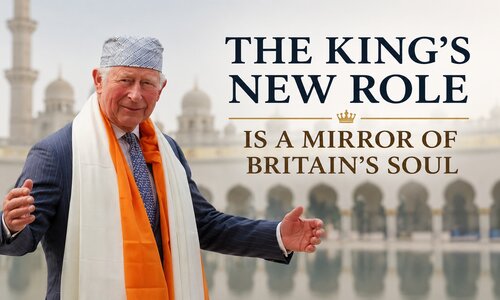
The King's New Role Is A Mirror Of Britain's Soul
 By PNW Staff June 29, 2026
Share this article:
Sometimes a nation's spiritual decline isn't announced with revolution, military defeat, or economic collapse.
Sometimes it arrives with a few carefully chosen words buried in an official government report.
That is exactly what has happened in Britain.
For centuries, the British monarch has stood as one of the world's most recognizable public symbols of Christianity. Kings and queens were not merely constitutional rulers--they were the "Defender of the Faith" and Supreme Governor of the Church of England, a visible reminder that Britain's identity was inseparable from the Christian faith that shaped its laws, culture, and history.
But something has changed.
According to the newly released Sovereign Grant Report, King Charles III is now officially described as someone who "protects the space for Faith within the multi-faith nation."
At first glance, the wording seems harmless--even gracious. After all, every citizen should enjoy the freedom to worship according to his or her conscience. Christians have long defended religious liberty because genuine faith cannot be forced by governments or monarchs. God desires willing hearts, not coerced religion.
Yet this subtle change tells a much larger story.
It reflects a nation that no longer sees Christianity as its defining foundation, but as one faith among many.
The King's new role is, in many ways, a mirror of Britain's soul.
Britain was not built upon vague spirituality or generic religious values. It was built upon Christianity.
This is the nation that gave the world the English Bible through the sacrifices of men like William Tyndale, who was executed for translating God's Word into the language of ordinary people. It is the nation of John Wycliffe, Thomas Cranmer, John Wesley, George Whitefield, Charles Spurgeon, William Wilberforce, and countless missionaries who carried the Gospel from Britain's shores to Africa, Asia, the Pacific, and the Americas.
Its legal traditions, universities, hospitals, charitable institutions, and even many of its concepts of liberty and human dignity were profoundly shaped by biblical truth.
No nation has ever been perfect, and Britain certainly has its share of historical failures. Yet there is no denying that Christianity formed the bedrock upon which the nation stood.
Today, that foundation is steadily being redefined.
King Charles has spoken for decades about fostering understanding between religions, often referring to Britain as a "community of communities." His desire to promote peaceful coexistence is understandable in an increasingly diverse society.
Christians should never oppose treating people of other faiths with dignity, kindness, and respect.
But there remains an important distinction between protecting everyone's freedom to worship and removing Christianity's unique place in a nation's identity.
Christianity has never claimed merely to be one option among many.
Jesus Christ declared, "I am the way, the truth, and the life. No one comes to the Father except through Me."
That exclusive claim has always distinguished Christianity from every other religion. It is not simply another path up the same mountain. It proclaims that salvation is found in Christ alone.
When a nation that was once openly Christian begins presenting all faiths as equally representative of its identity, it signals far more than political inclusivity. It reveals a profound shift in worldview.
History teaches us that civilizations rarely abandon their foundations all at once.
The change is gradual.
The language softens.
The symbols evolve.
The traditions are quietly redefined.
Eventually the culture itself no longer remembers what once gave it life.
Britain has already witnessed much of that transformation.
Magnificent cathedrals that once overflowed with worshippers often serve more tourists than congregants. Biblical literacy has plummeted. Church attendance continues to decline, while an entire generation grows up knowing little of the faith that shaped the nation they inherited.
The King's revised role does not create this reality.
It simply acknowledges it.
For Christians, however, there is another lesson that should not be missed.
As sobering as it is to watch Britain's Christian identity fade, perhaps there is also something healthy about separating genuine faith from ceremonial religion.
For generations, many have confused cultural Christianity with biblical Christianity.
Being born in a Christian nation does not make someone a Christian.
Being baptized as an infant does not guarantee salvation.
Attending church on Christmas or Easter is not the same as following Christ.
History is filled with nations that outwardly honored Christianity while inwardly drifting far from God.
The New Testament never places our hope in governments, monarchs, or established churches.
It places our hope in Jesus Christ.
The Church has often flourished most powerfully when it possessed the least political influence.
That reality should encourage believers.
Our confidence has never rested in Buckingham Palace.
It rests in an empty tomb.
Still, Christians should not dismiss what this moment represents.
National symbols matter because they reflect national priorities.
When the official role of the monarch evolves from publicly defending the Christian faith to protecting the space for all faiths equally, it tells us something about the spiritual direction of the country itself.
The crown has become a mirror.
And the reflection is sobering.
Yet Britain's story is not finished.
This is, after all, the land where God repeatedly poured out remarkable revivals.
When eighteenth-century England appeared morally exhausted, God raised up John Wesley and George Whitefield to preach the Gospel in fields, streets, and coal mines. Tens of thousands were converted. Entire communities were transformed. Crime declined. Charitable work flourished. Missionary movements exploded, and the spiritual awakening eventually reached around the world.
Later generations witnessed fresh movements of God's Spirit that once again reminded Britain that revival comes not from government but from heaven.
That is precisely what Britain needs today.
Not merely a return to Christian symbols.
Not simply the restoration of historic titles.
Not a nostalgic longing for a cultural Christianity that may have lacked genuine faith.
Britain needs another Great Awakening.
It needs churches that boldly proclaim the whole counsel of God.
It needs believers whose lives make the Gospel attractive through holiness, compassion, and truth.
It needs Christians who pray with the same urgency as those who came before them.
The King's updated role may accurately reflect the Britain of 2026.
But it does not have to define Britain's future.
The same God who brought revival to England before has not changed.
He still transforms hearts.
He still restores nations.
He still answers prayer.
Perhaps the King's new role is indeed a mirror of Britain's soul.
If so, may it also become a wake-up call for the Church.
Because history reminds us that while nations drift slowly from God, revival can begin with a single generation willing to seek Him once again.