
Canada's New Ministry of Truth? Why Christians Should Be Paying Attention
 By PNW Staff July 06, 2026
Share this article:
There was a time when governments claimed they needed more access to our data to fight terrorism, organized crime, or foreign espionage. Canadians were assured that extraordinary powers would only be used in extraordinary circumstances.
Now comes the next question: once government has greater access to your information, what will it do with it?
The answer should concern every Canadian.
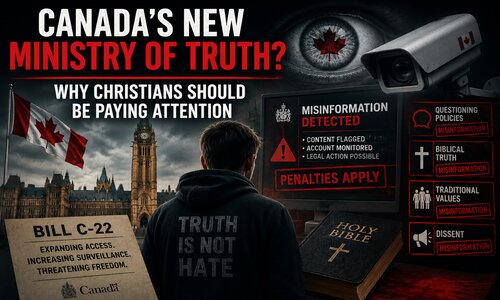
In recent weeks, the federal government has found itself at the center of two separate but deeply connected controversies. First came Bill C-22, which significantly expands Canada's lawful-access framework by requiring electronic service providers to be capable of complying with judicial orders and creating new mechanisms for obtaining digital information.
Government officials insist the legislation merely modernizes existing investigative powers rather than creating new surveillance authorities. Critics, however, argue it expands the state's practical ability to collect and access Canadians' digital information while raising significant privacy concerns.
Then came reports from internal government documents, obtained through Access to Information requests, showing officials exploring legal action against Canadians who post what the government determines to be "false and misleading information" on social media. According to the reported documents, the objective is not simply responding to objectionable content but moving toward "prevention and early detection."
Taken separately, each initiative raises legitimate questions.
Taken together, they paint a far more troubling picture.
The obvious question is one Canadians themselves have already asked: who decides what qualifies as misinformation?
That question is no longer theoretical.
History has repeatedly demonstrated that "misinformation" is often defined by those holding power. During COVID, Canadians watched scientific opinions evolve dramatically. Ideas once condemned as conspiracy theories--including debates surrounding vaccine effectiveness, lockdown policies, school closures, and the possibility of a laboratory leak--later became accepted topics of legitimate public discussion.
If governments had possessed even broader authority to silence those views during their earliest stages, would the truth ever have emerged?
That is precisely why free speech exists--not to protect popular opinions, but unpopular ones.
Government officials naturally insist these measures are intended to combat foreign disinformation campaigns, fraud, and harmful online manipulation. Those are worthy goals. But granting government the authority to determine truth while simultaneously expanding its ability to monitor digital activity creates an inherent conflict of interest that should concern Canadians of every political persuasion.
Christians, in particular, should recognize where this road can lead.
The Bible has never promised believers cultural approval. Quite the opposite. Scripture repeatedly warns that truth will increasingly be labeled error while error is celebrated as truth.
Today, biblical convictions regarding sexuality, gender, marriage, abortion, or religious exclusivity are increasingly described as harmful, hateful, or dangerous. While Canada still maintains constitutional protections for freedom of religion and expression, cultural pressure has already demonstrated how quickly orthodox Christian beliefs can be portrayed as socially unacceptable.
If future governments determine that certain biblical teachings constitute "misinformation" or contribute to societal harm, what prevents regulatory mechanisms from eventually targeting Christian ministries, churches, podcasts, or individual believers?
Perhaps today's government has no intention of doing so.
But laws rarely remain confined to the intentions of those who first pass them.
Every expansion of governmental authority eventually lands in someone else's hands.
Canadians have already witnessed how extraordinary powers can be used during moments of national crisis. Many still remember the Freedom Convoy protests, where emergency measures extended beyond protesters themselves to include financial actions against participants and supporters. Whether one supported the convoy or opposed it politically, the episode reminded the nation that governments possess enormous leverage once exceptional powers are available.
That experience permanently changed how many Canadians think about state authority.
Now imagine combining greater digital access with government-directed determinations of acceptable speech.
That is a combination deserving far more scrutiny than it has received.
Privacy advocates, civil liberties organizations, and cybersecurity experts have likewise warned that aspects of Bill C-22 could weaken privacy protections, increase opportunities for government access to digital information, and even create broader implications for encryption and secure communications if improperly implemented.
None of this means Canada has suddenly become an authoritarian state.
It does mean Canadians should pay close attention whenever governments seek additional surveillance capabilities while simultaneously positioning themselves as arbiters of acceptable public discourse.
Free societies depend upon an independent citizenry capable of questioning authority without fearing legal consequences for expressing unpopular opinions.
For Christians, the issue extends beyond politics.
Jesus warned His followers that the truth would often be rejected by the world. Throughout history, governments have repeatedly attempted to regulate ideas before eventually regulating people.
The church's calling has never been to speak only when government approves.
It has been to speak truth faithfully, graciously, and courageously--even when doing so carries a cost.
Whether these recent proposals ultimately become sweeping enforcement mechanisms or are significantly revised remains to be seen. Canadians should debate them vigorously and insist upon meaningful safeguards, judicial oversight, and clear limits.
Because once government claims both the power to watch and the authority to decide what may be said, liberty no longer rests upon the rights of the citizen.
It rests upon the restraint of the state.
History suggests that is not a place free people should ever be comfortable living.