
The Global War On Homeschooling Continues-Now With Prison Time For Parents
 By PNW Staff July 15, 2026
Share this article:
When did raising your own children become a crime?
That question is no longer hypothetical in Brazil.
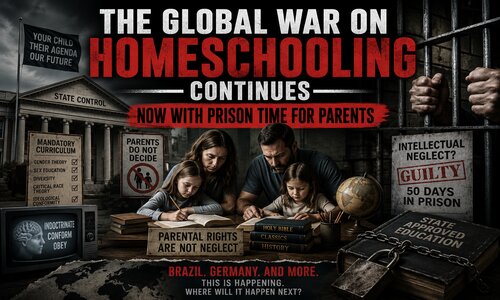
In what is believed to be the country's first criminal conviction of homeschooling parents, Audato and Ieda Denardi were sentenced by a court in São Paulo to 50 days in prison for what was described as "intellectual neglect."
Their daughters were not illiterate, isolated, or academically behind. Quite the opposite. The girls speak multiple languages, study Latin, play piano at an advanced level, and read dozens of classic books every year. Even Brazil's own prosecutor concluded there was no evidence of educational neglect and recommended acquittal. The judge convicted them anyway.
The ruling has shocked homeschool advocates around the world—not simply because parents face jail, but because of why.
The court criticized the family's curriculum for not including state-approved instruction on gender and sex education, tolerance and diversity, and Afro-Brazilian cultural studies. It also faulted the girls' preference for sacred and classical music rather than mainstream Brazilian genres such as funk and trap.
Whether one agrees with every aspect of the family's educational choices is almost beside the point. The larger question is far more significant:
Who ultimately owns a child's education—the parents or the state?
For centuries, Western civilization largely answered that question in favor of parents. Governments established schools to assist families, not replace them. Today, however, that relationship increasingly appears reversed.
Brazil's case is particularly striking because prosecutors themselves found no evidence that the children had been intellectually abandoned. Yet the court still concluded that because the education did not sufficiently reflect government-approved cultural priorities, criminal punishment was appropriate.
This is not merely a debate over homeschooling. It is a debate over whether parents retain the freedom to shape their children's worldview when that worldview differs from prevailing educational orthodoxy.
Nor is Brazil alone.
Germany has long maintained one of the strictest anti-homeschooling regimes in the democratic world. Families who homeschool have faced substantial fines, repeated court orders, and even the removal of children from parental custody. The well-known Romeike family fled Germany seeking asylum in the United States after authorities repeatedly penalized them for homeschooling based on their Christian convictions. Although their asylum claim was ultimately denied, Germany's prohibition on homeschooling remains firmly in place.
Another widely discussed German case involved the Wunderlich family, whose children were temporarily removed by authorities after the parents refused to send them to public school. While some legal rulings later favored the family on procedural grounds, Germany continues to enforce compulsory school attendance rather than recognizing a broad parental right to homeschool.
These examples illustrate an important distinction. Around much of the world, homeschooling is not viewed as an educational alternative. It is viewed as an exception the state may narrowly permit—or prohibit altogether.
Contrast that with the United States.
Homeschooling has experienced extraordinary growth over the past several years. Following the COVID-19 pandemic, millions of American parents reconsidered traditional education. Many discovered that their children flourished in home-based learning environments, while others became increasingly concerned about curriculum, school safety, declining academic performance, or simply desired greater flexibility.
Today homeschooling has become one of America's fastest-growing educational movements, crossing political, racial, and economic lines. It is no longer a fringe phenomenon but an increasingly mainstream educational choice.
Yet Americans should resist the temptation to assume these freedoms are permanently secure.
Several states have seen renewed efforts to increase oversight of homeschooling. Maine, for example, already requires notices of intent, annual filings, and instruction in specified subject areas, while lawmakers continue to debate additional reporting and accountability measures. Supporters argue such regulations protect children's educational welfare. Critics worry they represent incremental steps toward expanding state control over family education.
History suggests that freedoms are rarely lost all at once.
They are usually narrowed gradually—one regulation, one reporting requirement, one mandatory curriculum, one prohibited topic at a time.
That is why Brazil's case deserves international attention.
It demonstrates how rapidly disagreements over educational philosophy can become matters for criminal courts rather than parental discretion.
Christians, in particular, have long viewed parents as bearing primary responsibility for raising children in the instruction and discipline of the Lord. Governments undoubtedly have legitimate interests in ensuring children receive a meaningful education. But there is an enormous difference between ensuring literacy and mathematics and requiring ideological conformity as a condition of avoiding prosecution.
The Denardi family's appeal will determine their immediate future. But the broader issue reaches far beyond one Brazilian courtroom.
Around the world, a growing struggle is emerging over who forms the next generation's moral and intellectual foundations.
Parents? Or the state?
Americans who homeschool today still enjoy freedoms that millions of parents elsewhere can only dream about. The experiences of families in Brazil and Germany should serve as a reminder that educational liberty cannot simply be assumed. Like every other liberty, it survives only so long as citizens remain willing to defend the principle that parents—not governments—bear the primary responsibility for directing the upbringing and education of their own children.





