
Why Is America Buying Japanese Yen? The Bigger Story Nobody Is Talking About
 By PNW Staff August 03, 2026
Share this article:
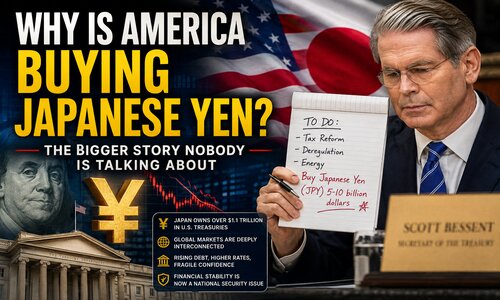
A single photograph from President Donald Trump's recent Cabinet meeting may have revealed more about the state of the global financial system than months of carefully worded statements from central bankers.
Captured by Reuters, the image showed Treasury Secretary Scott Bessent's handwritten to-do list. Among the notes was one line that immediately caught the attention of economists: "Buy Japanese Yen (JPY) 5-10 billion dollars." Reuters later confirmed the authenticity of the image, bringing an otherwise private discussion into public view.
On its face, it seems like an obscure financial detail. Why should the average American care whether the U.S. Treasury is considering buying Japanese currency?
Because that simple note points to a much larger story--one that exposes how interconnected, fragile, and dependent today's global financial system has become.
A Currency Purchase Is Never Just A Currency Purchase
Governments do not normally intervene in foreign exchange markets without good reason. While central banks routinely monitor currencies, coordinated intervention is relatively rare and is usually reserved for periods of unusual market stress or when officials believe excessive volatility threatens broader financial stability.
The United States has intervened alongside allies before, but seeing the Treasury Secretary contemplating billions of dollars in yen purchases is a reminder that financial markets are no longer operating in isolated national silos.
When policymakers begin discussing direct currency intervention, it usually means they are concerned about consequences that extend well beyond exchange rates.
Why The Japanese Yen Matters To Americans
At first glance, Japan's currency seems like someone else's problem.
It isn't.
Japan remains one of America's closest allies and one of the largest foreign holders of U.S. Treasury securities, owning well over $1 trillion in American government debt. That means the financial health of Japan is deeply connected to the financial health of the United States.
If Japan experiences severe financial instability, the ripple effects would not stay in Tokyo.
They could influence:
- U.S. mortgage rates
- Retirement accounts
- Stock markets
- Federal borrowing costs
- Consumer confidence
Most Americans never think about the Japanese yen. Yet events unfolding halfway around the world can eventually affect what they pay for a home loan or how much their retirement portfolio is worth.
The Hidden Danger Of Global Debt
The bigger issue is not the yen itself.
It is debt.
For decades, governments around the world have accumulated extraordinary amounts of sovereign debt while benefiting from historically low interest rates.
That environment is changing.
As rates rise globally, governments face rapidly increasing borrowing costs.
The United States now spends enormous sums simply servicing its national debt.
Japan faces its own challenges with one of the highest government debt-to-GDP ratios in the developed world.
Europe continues to wrestle with sluggish growth while attempting to manage inflation and energy costs.
Each country has different circumstances, yet all share one common problem:
The modern financial system has become increasingly dependent on confidence.
Confidence that governments can continue borrowing.
Confidence that currencies will remain stable.
Confidence that investors will continue buying sovereign debt.
When officials begin discussing interventions to stabilize major currencies, it suggests preserving that confidence has become an increasingly important policy objective.
Financial Wars Are Replacing Traditional Ones
Much attention today focuses on military conflicts in the Middle East, Ukraine, or the Pacific.
Yet another battle is quietly taking place.
Instead of tanks and aircraft, governments increasingly wield:
- tariffs
- sanctions
- reserve currencies
- export controls
- interest rates
- currency intervention
Economic leverage has become a strategic weapon.
The freezing of Russian reserves following the invasion of Ukraine demonstrated that financial systems themselves can become geopolitical battlegrounds.
Trade disputes between the United States and China have likewise shown that economic competition increasingly resembles strategic conflict.
Currency intervention belongs within that larger picture.
America Cannot Ignore Its Creditors Forever
One uncomfortable reality has become harder to dismiss.
The United States depends heavily on investors--both domestic and foreign--to finance its growing debt.
Japan has long been among America's largest creditors.
That does not mean Japan controls American policy or that some dramatic liquidation of Treasury holdings is imminent. Financial relationships are far more complex than that.
But it does illustrate an important truth.
As America's debt grows larger, maintaining confidence among those willing to finance that debt becomes increasingly significant.
The larger the debt burden becomes, the more sensitive markets become to shifts in confidence, interest rates, or investor behavior.
That is not a prediction of collapse.
It is simply how debt markets work.
Extraordinary Measures Becoming Ordinary
Perhaps the most striking aspect of the Reuters photograph is not the potential intervention itself.
It is how increasingly extraordinary actions have become almost routine.
Only a generation ago, many of today's financial tools would have seemed remarkable.
Massive quantitative easing.
Emergency lending facilities.
Coordinated global central-bank actions.
Trillions of dollars in pandemic stimulus.
Repeated market interventions.
Now the possibility of purchasing billions of dollars of foreign currency barely generates headlines.
Each intervention may be justified on its own merits.
But together they reveal a financial system requiring ever-greater management simply to maintain stability.
That should cause thoughtful observers to ask an important question:
Are we solving problems--or merely postponing them?
Confidence Is The World's Most Valuable Currency
Gold has value.
Oil has value.
Factories produce value.
But modern fiat currencies ultimately depend upon something less tangible:
Confidence.
Confidence that tomorrow's dollar will still buy goods.
Confidence that governments will honor their obligations.
Confidence that central banks remain capable of maintaining stability.
History reminds us that confidence can erode gradually--then suddenly.
That does not mean America is standing on the edge of financial collapse.
It does mean that increasingly frequent interventions suggest policymakers recognize vulnerabilities that many ordinary citizens never see.
The Reuters photograph offered an unusually candid glimpse behind the curtain.
What appeared to be an ordinary handwritten reminder may instead reveal how much effort now goes into preserving stability in a financial system carrying unprecedented debt and facing mounting geopolitical uncertainty.
A Biblical Perspective
Scripture repeatedly warns against placing ultimate trust in wealth, political power, or human institutions.
"Some trust in chariots and some in horses, but we trust in the name of the Lord our God" (Psalm 20:7).
The Bible does not tell us when today's financial order will change.
But it does remind us that every earthly kingdom and every economic system is temporary.
Whether the current monetary order lasts another five years or another fifty, one lesson remains timeless: nations that continually rely on debt, financial engineering, and extraordinary intervention are building on a far less secure foundation than they often imagine.
The Treasury Secretary's handwritten note was a reminder that behind the headlines--and behind the confidence markets depend upon--leaders are working harder than ever simply to keep the world's financial machinery running.
And that may be the biggest story nobody is talking about.