
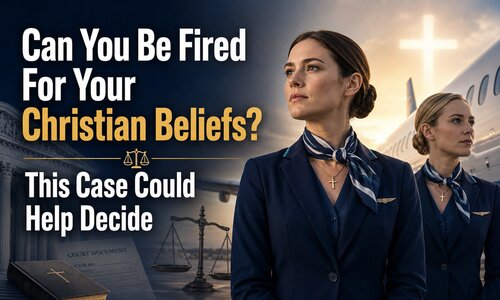
Can You Be Fired For Your Christian Beliefs? This Case Could Help Decide
 By PNW Staff August 10, 2026
Share this article:
Two flight attendants questioned their employer's political advocacy.
They lost their jobs.
Now, years later, their case is headed toward trial--and the outcome could carry implications far beyond Alaska Airlines.
Lacey Smith and Marli Brown were fired after criticizing or questioning Alaska Airlines' support for the Equality Act, legislation designed to expand federal civil-rights protections involving sexual orientation and gender identity.
The women contend that their dismissals amounted to religious discrimination. Alaska Airlines and their union dispute that claim.
A federal appeals court has now determined there is enough evidence for a jury to hear the case.
That distinction matters. The court has not ruled that Alaska Airlines discriminated against the women. A trial will determine the merits of those allegations.
But even before a jury reaches a verdict, the case raises a much larger question:
How much room remains in the modern workplace for employees whose religious beliefs conflict with their employer's social values?
When Diversity Includes Disagreement
Corporations routinely tell employees that diversity should be celebrated.
But diversity becomes much more complicated when it includes deeply held religious beliefs.
According to the case, Alaska Airlines announced its support for the Equality Act and invited employee feedback.
Smith responded with a simple question:
"As a company, do you think it's possible to regulate morality?"
Brown went further, arguing that the legislation could threaten religious liberty, parental rights and protections for women.
Those comments clearly challenged the company's position.
But that is precisely what makes this case significant.
If employees are invited to provide feedback, are they genuinely allowed to disagree?
Or does "inclusion" increasingly mean employees are welcome to participate only as long as their beliefs remain within acceptable ideological boundaries?
That question extends far beyond one airline.
Believe What You Want--But Don't Say It?
American workplaces increasingly find themselves navigating disputes that once would have been considered deeply personal or political.
Pronouns. Gender identity. Sexuality. Abortion. Race. Religious expression. Political activism.
Companies are no longer merely determining wages, schedules and working conditions. Many now take explicit positions on some of society's most divisive moral questions.
That creates an unavoidable conflict.
The moment an employer adopts a position on morality or sexuality, some employees will disagree--sometimes because of religious convictions they consider non-negotiable.
What happens then?
There is an enormous difference between requiring employees to treat coworkers and customers respectfully and requiring employees to affirm every belief embraced by corporate leadership.
The first is a reasonable workplace expectation.
The second moves much closer to the territory of conscience.
And that distinction may become one of the defining religious-liberty battles of the modern workplace.
When Disagreement Becomes "Unsafe"
One of the most revealing elements of the Alaska Airlines dispute is the language reportedly used to describe Smith's comments.
According to court filings, some employees said her statements made them question whether they could "fly safely" with her.
That language deserves attention.
Traditionally, workplace safety referred to physical danger, threats, harassment or genuinely dangerous conduct.
Increasingly, however, words such as "unsafe," "harmful" and "threatening" are also used to describe ideological disagreement.
That changes the rules dramatically.
Once an opinion is categorized not simply as wrong or offensive but as a threat to someone's safety, disciplinary action becomes much easier to justify.
The question then becomes:
Can expressing a traditional religious belief itself be treated as creating an unsafe workplace?
If the answer becomes yes, religious liberty could theoretically remain intact on paper while becoming far narrower in practice.
You would remain free to believe.
You simply might not be free to say what you believe when it conflicts with prevailing institutional values.
The "Opposite Sex" Question
Another allegation from the litigation illustrates how fundamental these conflicts have become.
First Liberty says an Alaska Airlines executive testified that use of the term "opposite sex" could violate company discrimination policy because it implies there are only two sexes.
That is not a minor disagreement over terminology.
For millions of Christians, Jews and Muslims, belief in the biological distinction between male and female is intertwined with their understanding of creation, marriage, sexuality and human identity.
A corporation may adopt a different view.
But when corporate policy and religious doctrine directly contradict each other, something eventually has to give.
That is why cases like this matter.
The conflict is no longer simply between conservative and progressive employees.
It is increasingly between institutional orthodoxy and individual conscience.
The Religious-Liberty Battle Is Moving To Work
Americans often think about religious liberty primarily in terms of churches.
Can pastors preach freely?
Can religious schools maintain their beliefs?
Can churches operate without government interference?
Those questions remain important.
But for ordinary believers, the more immediate battles may increasingly occur somewhere else:
At work.
A Christian employee may never face a government official demanding that he renounce his faith.
He may instead face an employer asking him to use language he believes is false.
A teacher may encounter policies involving gender identity.
A medical professional may face procedures conflicting with conscience.
A counselor may confront demands involving sexuality.
A corporate employee may be encouraged to endorse political or social causes.
And most people cannot simply walk away from their careers without consequences.
That makes workplace conscience protections increasingly important.
A Case Worth Watching
The Alaska Airlines case will ultimately turn on specific evidence, employment law and the facts presented at trial.
Perhaps the airline will persuade jurors that its decisions were based on legitimate workplace concerns rather than hostility toward religion.
Perhaps Smith and Brown will convince them that their religious convictions played an unlawful role in their dismissals.
That remains to be decided.
But the larger cultural conflict is already here.
Corporate America often tells employees to bring their "whole self" to work.
For religious Americans, the question is whether that invitation includes the parts of themselves that disagree with corporate orthodoxy.
True pluralism cannot simply protect different identities.
It must also leave room for different convictions.
Employees should be expected to treat one another with dignity. Harassment and genuine discrimination should not be tolerated.
But disagreement is not the same thing as discrimination.
And an unpopular religious belief is not automatically an unlawful one.
If religious liberty protects people only when their convictions remain private and unspoken, it becomes a very thin form of liberty indeed.
That is why this case matters far beyond two former Alaska Airlines flight attendants.
It represents an emerging struggle over a question millions of Americans may eventually face themselves:
When your employer's values conflict with your deepest religious convictions, which one are you expected to leave at the office door?