
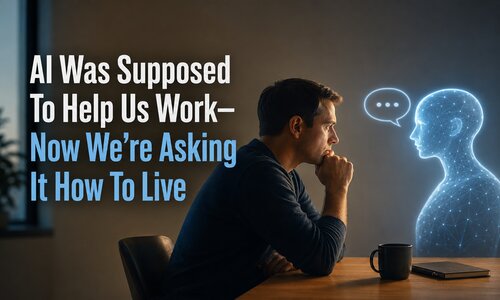
AI Was Supposed To Help Us Work - Now We’re Asking It How To Live
 By PNW Staff August 26, 2026
Share this article:
For years, Americans have been told that the artificial intelligence revolution would transform the workplace. AI would write reports, analyze spreadsheets, generate computer code, automate customer service and potentially eliminate millions of jobs.
All of that may still happen. But something quieter--and potentially far more consequential--is already taking place.
AI isn't merely entering our workplaces. It is entering our private lives.
New research from the AI Observatory examined more than 23,000 anonymized conversations with major AI chatbots and found that nearly half--48 percent--were not related to work. People were talking to artificial intelligence about health, relationships and other deeply personal subjects.
That should get our attention.
The biggest AI revolution may ultimately have less to do with whether a machine replaces your accountant and more to do with whether it replaces your counselor, confidant, pastor--or eventually, your conscience.
From Tool To Adviser
There is an enormous difference between asking artificial intelligence, "Can you summarize this report?" and asking it, "Should I divorce my husband?"
One is assistance. The other is counsel.
Yet the transition between the two can happen almost imperceptibly.
Someone begins using AI to compose emails. Then he asks for career advice. Soon he is discussing an argument with his wife, worries about his children, questions about his health, or doubts about his faith.
The attraction isn't difficult to understand.
AI is available at 2 a.m. It doesn't appear impatient. It doesn't become offended. It can respond sympathetically and immediately, and there is none of the embarrassment that might accompany admitting something painful to another human being.
But convenience can slowly become dependence.
The progression could look something like this:
AI as tool -> AI as adviser -> AI as confidant -> AI as counselor -> AI as authority.
And that final step should especially concern Christians.
We Are Creating A "Thought History"
There is another dimension to this transformation that deserves much more attention: privacy.
For years, people have worried about their search histories. Google searches can reveal interests, medical concerns, political questions and purchasing intentions.
Social media reveals something different: what we want other people to see about us.
But conversations with AI can potentially reveal something much deeper--how we actually think.
Imagine several years of conversations with a highly personalized AI assistant.
It could potentially know about your marriage problems, financial fears, medical worries, political opinions, religious doubts, sexual temptations, family conflicts, ambitions and insecurities.
It might know what makes you angry.
It might know what frightens you.
It might even know which arguments are most likely to persuade you.
We are moving from the age of the search history toward the age of the thought history.
That could become one of the richest collections of personal information ever created.
The danger is not necessarily that someone is sitting somewhere reading everyone's conversations. The larger concern is that society is rapidly normalizing the creation of extraordinarily detailed digital portraits of human beings without fully considering what such information could eventually mean.
The Ultimate Persuasion Machine?
That leads to an even more unsettling possibility.
Traditional advertising attempts to categorize people. You are male or female, young or old, conservative or liberal, wealthy or struggling. Advertisers then determine which messages might appeal to someone like you.
Social media made that process considerably more sophisticated by tracking what people click, watch and share.
But personalized AI could potentially go much further.
After thousands of conversations, an AI system could theoretically understand not simply what you believe, but why you believe it.
Does fear persuade you? Statistics? Emotional stories? Religious arguments? Financial concerns? Appeals involving your children?
The machine that knows you best could eventually become the machine best equipped to persuade you.
That possibility becomes particularly concerning when AI systems are controlled by corporations that determine their rules, training methods and acceptable boundaries.
AI doesn't descend from heaven possessing perfect neutrality.
Someone builds it. Someone trains it. Someone establishes its parameters. Someone decides what it should refuse to say and what perspectives it should emphasize.
That matters tremendously when people begin asking machines moral questions.
Christians Cannot Outsource Discernment
For Christians, there is an important distinction between using AI to obtain information and allowing AI to determine truth.
Asking, "What are the major interpretations of this biblical passage?" can be useful.
Asking, "What should I believe?" is something very different.
AI can summarize theological arguments, locate historical information, compare translations and explain difficult concepts. Those can be valuable tools.
But artificial intelligence cannot replace Scripture, prayer, the Holy Spirit, mature Christian counsel or the fellowship of believers.
Proverbs repeatedly emphasizes the importance of godly wisdom and counsel. The New Testament tells Christians to test what they hear and exercise discernment.
The danger is that AI makes bypassing those processes incredibly easy.
Why approach a pastor about a difficult moral issue when a chatbot will answer instantly?
Why discuss a troubled marriage with mature Christian friends when AI will listen without embarrassment?
Why wrestle through Scripture when a machine can provide an immediate conclusion?
Over time, convenience can quietly transfer authority.
Christians who would never consciously say, "I want Silicon Valley deciding my theology," could nevertheless find themselves consulting AI every day about relationships, morality, sexuality, parenting, politics and Scripture.
Eventually the question changes from "What information can AI give me?" to "What does AI think I should do?"
That is a very different relationship.
A Tool Must Remain A Tool
Artificial intelligence is not inherently evil. Like countless technologies before it, it can be used productively or destructively.
The warning is about something more subtle.
We are creating machines capable of speaking with remarkable confidence, empathy and apparent wisdom. At the same time, millions of people are increasingly willing to tell those machines things they may not tell another human being.
The AI revolution therefore isn't simply about automation.
It is about authority.
Who will advise us? Who will interpret our problems? Who will help define right and wrong? And who--or what--will we increasingly trust when making life's most important decisions?
Christians should use powerful new tools without becoming dependent upon them.
Because there is an enormous difference between having artificial intelligence in your pocket and allowing artificial intelligence to become your conscience.