
Apple Says It Isn't Recording You — But Its AI Is Still Listening
 By PNW Staff September 14, 2026
Share this article:
Imagine sitting across from a friend at lunch. You talk about your marriage, your health, something happening at work, or perhaps a financial problem you haven't told many people about.
There is no recorder sitting on the table. Nobody has pulled out a phone. Nobody has asked permission to capture the conversation.
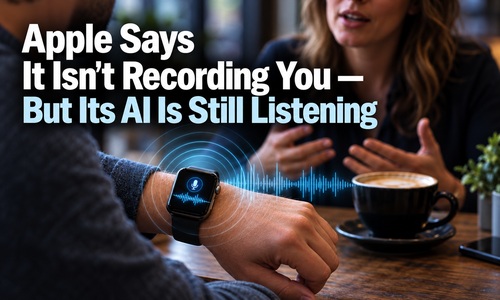
But the watch on your friend's wrist may be listening anyway.
Welcome to the next stage of artificial intelligence.
Apple's newly announced Apple Watch Series 12 and Apple Watch Ultra 4 introduce what the company calls "Audio Intelligence" — a collection of features capable of continuously processing sounds and conversations occurring around the person wearing the device.
One feature, Live Rewind, allows users to double-press the Digital Crown and retrieve a text snippet of what was said during the previous 15 seconds. Another, Siri Recap, can listen to conversations and use artificial intelligence to generate summaries that users can review later.
Apple describes the purpose innocently enough: helping people remember something they missed, recall an important conversation, or remain engaged in the moment without constantly taking notes.
And there is little doubt that millions of people will find it useful.
But something much bigger is happening here.
We are rapidly normalizing a world in which artificial intelligence doesn't merely wait for us to ask it a question.
It listens to our lives.
When did we decide it was normal for the computers attached to our bodies to listen to the conversations happening around us?
"We're Not Recording You" Isn't Quite As Comforting As It Sounds
Apple can technically say there isn't a recording because the raw audio isn't preserved as a conventional audio file.
But consider what the technology is actually capable of doing.
The microphone hears words. A computer analyzes them. Speech can be converted into text. Artificial intelligence determines what was important. A summary can be generated. That summary can then be saved for future reference.
To the person sitting across the table, the technical distinction between "recording" and "continuously processing" may not feel terribly reassuring.
If you tell someone something at lunch and an artificial intelligence system later produces a written summary of what you discussed, the fact that the original sound waves were deleted doesn't change the fundamental reality:
A machine was listening.
And you may never have agreed to it.
The Person Being Listened To Didn't Buy The Watch
This may become the most uncomfortable part of the entire experiment.
The Apple Watch owner chose to purchase the device. The owner chose to enable Siri Recap.
Everyone else in the room did not.
Imagine the implications in a doctor's office, counseling session, business meeting, classroom, church gathering, restaurant, family argument, political discussion or private conversation between friends.
Someone else's wearable computer may increasingly become an invisible third participant in the conversation.
Live Rewind at least announces its activation with a chime and visual indicator. Siri Recap, however, is designed to operate according to the settings chosen by the watch owner. Apple tells users to be mindful of people around them, but the technology itself illustrates how quickly our traditional expectations of privacy are changing.
The smartphone introduced the possibility that nearly everyone carries a camera and recording device.
Wearable AI takes another step.
You no longer have to deliberately pull out the recorder.
The recorder — or more precisely, the listening computer — is already attached to your body.
The Age Of Ambient AI
This is where Apple's announcement becomes much more important than one new smartwatch feature.
Artificial intelligence is escaping the computer screen.
For years, we interacted with AI by deliberately typing something into a box. We provided information, asked a question and received an answer.
That model is disappearing.
The emerging AI assistant wants context.
Where are you?
What are you looking at?
Who are you talking to?
What did someone tell you three hours ago?
What appointments do you have tomorrow?
What does your heart rate look like?
What conversations have you had today?
To provide increasingly personalized assistance, AI systems need increasingly comprehensive awareness of the person they are assisting.
That means microphones. Cameras. Location. Biometrics. Personal communications. Purchasing history. Search history. Digital identity. And eventually persistent memory capable of connecting all of it together.
Each capability can be extraordinarily useful on its own.
Combined, they begin to resemble something humanity has never possessed before:
A digital observer accompanying a person throughout everyday life.
Surveillance Is Becoming A Consumer Product
There was a time when building a surveillance society required enormous resources.
Governments needed informants, investigators, wiretaps, cameras, intelligence agencies and enormous databases. Someone had to collect the information, someone had to examine it, and someone had to decide what mattered.
Artificial intelligence changes the economics of surveillance.
Machines can potentially examine information generated by millions — eventually billions — of sensors simultaneously. They can transcribe conversations, recognize faces, identify objects, detect patterns, correlate locations and search enormous amounts of information in seconds.
And increasingly, governments don't even have to install all the sensors.
We are installing them ourselves.
We put microphones in our homes.
Cameras on our doorbells.
Location trackers in our pockets.
Internet connections in our cars.
Biometric sensors on our wrists.
And increasingly, artificial intelligence behind all of them.
The great technological revolution of our generation may not be that Big Brother forced a surveillance device into every home.
It may be that consumers lined up to buy one because it was incredibly convenient.
The Prophetic Implications Are Becoming Harder To Ignore
Christians should recognize the extraordinary technological environment being constructed around us.
Revelation describes a future system capable of exercising unprecedented control over economic participation — determining who can buy and sell. Previous generations could understand the theological meaning of that warning while struggling to imagine how such comprehensive control could practically function across entire populations.
Our generation doesn't have nearly as much difficulty imagining it.
Digital identity can establish who you are. Biometrics can authenticate you. Digital currencies and payment networks can control transactions. Smartphones can reveal where you are. Cameras equipped with facial recognition can identify you. Artificial intelligence can analyze enormous populations in real time.
And now the devices attached to our bodies are learning to listen to the world around us.
The technological building blocks for a society capable of unprecedented identification, surveillance and economic control are no longer science fiction. They are increasingly ordinary features of everyday life.
And perhaps the most sobering part is how they are arriving.
Not primarily through coercion.
Through convenience.
Every new device promises to make life easier. Every new sensor offers another useful feature. Every additional piece of information makes artificial intelligence more helpful.
Until one day we may discover that we have constructed an infrastructure capable of knowing where we go, what we buy, what we see — and increasingly, even what we say.
Apple says its new watch isn't recording you.
Technically, that may be true.
But its artificial intelligence is listening.
And the larger question is whether we are becoming comfortable living in a world where machines are always within earshot.