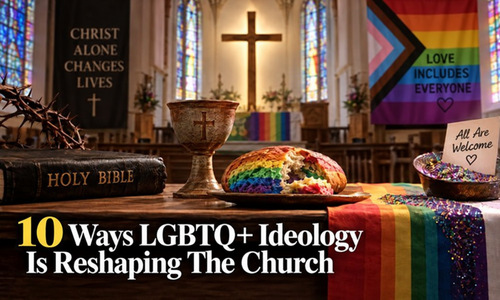
10 Ways LGBTQ+ Ideology Is Reshaping The Church
 By PNW Staff September 14, 2026
Share this article:
Walk into certain churches today and you may encounter something that would be almost unrecognizable to Christians who worshiped in the same denominations only a generation ago.
Rainbow flags surround the sanctuary. Pastors preach in Pride-colored vestments. Worship services feature queer hymns and transgender themes. Glitter replaces traditional ashes. Rainbow bread appears at Communion. Special ceremonies celebrate transgender name changes, while Pride Month brings its own sermons, liturgies and church celebrations.
These aren't simply changes in decoration or attempts to make visitors feel welcome. Taken together, they reveal how deeply LGBTQ+ ideology has worked its way into the worship and theology of parts of the modern church.
Christianity already has its own worship, hymns, sacraments, symbols, sacred language and understanding of identity. Increasingly, each is being reworked through the lens of sexuality and gender.
Here are ten of the clearest examples.
10. Transgender Worship Leaders And Bands
The worship platform has become one of the most visible places for churches to demonstrate LGBTQ+ affirmation. Transgender and nonbinary worship leaders are sometimes deliberately celebrated as representatives of a congregation's commitment to queer inclusion.
The issue reaches beyond who is holding the microphone. Worship traditionally directs attention toward God. When gender identity itself becomes part of the message communicated from the platform, the purpose of that platform begins to change.
9. Queer Hymns And Trans-Inclusive Worship Songs
Even the songs are being rewritten.
LGBTQ+-affirming hymn collections and worship resources now include songs celebrating queer identity, same-sex relationships and transgender experiences. Traditional Christian language surrounding male and female, marriage, sexuality and identity can be altered to reflect modern gender theology.
Music has always taught theology. What a congregation repeatedly sings eventually helps shape what it believes.
8. Glitter Blessings
Few examples capture the transformation as vividly as "Glitter Ash Wednesday."
Ash Wednesday traditionally confronts Christians with mortality, repentance and the need for forgiveness: "Remember that you are dust." Yet some progressive churches have incorporated glitter into ashes or blessings as an expression of LGBTQ+ affirmation.
A solemn Christian practice associated with repentance becomes an opportunity to celebrate identity.
7. Rainbow Communion
Even the Lord's Supper has received a Pride makeover.
Rainbow-colored Communion bread, Pride-themed Communion tables, rainbow altar coverings and LGBTQ+ imagery have appeared in affirming churches.
Communion was given to point Christians toward the broken body and shed blood of Jesus Christ. When Pride symbolism surrounds—or becomes part of—the sacrament itself, the symbolism competing for the congregation's attention is impossible to ignore.
6. Transgender Renaming Ceremonies
Some churches now conduct special ceremonies recognizing the new names and gender identities of transgender members.
These services can include prayers, blessings, congregational responses and declarations celebrating a person's new identity. The language can resemble themes Christians traditionally associate with baptism, belonging and receiving a new identity.
Christianity proclaims that believers receive a new identity in Christ. These ceremonies raise a profound question about what now defines the person standing before the congregation.
5. Pride And Trans-Themed Sermons
The transformation inevitably reaches the pulpit.
Pride sermon series, transgender-focused messages and queer theology increasingly interpret Scripture through the lens of sexual orientation and gender identity. Biblical passages concerning sexuality, marriage and male and female are reinterpreted, minimized or sometimes rejected as incompatible with contemporary understandings.
At that point, the debate has moved far beyond hospitality. It has become a debate over who gets to define Christian truth.
4. Rainbow Symbols Throughout The Sanctuary
Sometimes you don't need to hear the sermon to understand what a church is proclaiming.
Rainbow flags hang from sanctuary walls. Pride banners appear around altars. Churches illuminate their buildings in rainbow colors. LGBTQ+ symbols appear on church signs, windows and Communion tables—sometimes within sight of the cross itself.
Christians have always understood the power of symbols. The cross communicates something. The empty tomb communicates something. And the rainbow flag communicates something too.
3. Rainbow Clergy Vestments
Pastors themselves have become part of the visual transformation.
Rainbow stoles, Pride-themed robes, pronoun pins and other LGBTQ+ symbols are worn by some clergy during worship. Vestments historically used to communicate Christian seasons, offices and theological truths now become another vehicle for proclaiming sexual and gender identity.
Before the pastor opens the Bible or preaches the first sentence, the congregation has already received a message.
2. Queering The Bible
This transformation reaches much deeper than flags and clothing.
Queer theology can reinterpret Scripture through LGBTQ+ categories, challenge historic Christian understandings of sexuality and gender, reconsider biblical relationships through a queer lens and alter traditional language concerning God.
Once Scripture itself must be reconstructed to accommodate the ideology, everything built upon Scripture can be reconstructed with it: marriage, sexuality, identity, worship, preaching and eventually the Gospel itself.
1. Pride Has Become A Church Season
Christmas. Easter. Pentecost.
Now some churches effectively add Pride Month to the calendar.
June brings Pride Sundays, rainbow decorations, LGBTQ+-themed sermons, special liturgies, Pride marches, concerts and celebrations. Some congregations devote weeks to emphasizing sexual and gender identity in their preaching and worship.
Look at the complete picture.
There is queer worship. Queer hymnody. Glitter blessings. Rainbow Communion. Renaming ceremonies. Pride sermons. Rainbow vestments. Pride symbols. Queer theology. And an annual season devoted to celebrating it.
This is no longer simply a debate about whether Christians should welcome LGBTQ+ people through the church doors. Christians are commanded to love their neighbors, and the Gospel invitation is open to everyone because every one of us comes to Christ as a sinner in need of grace.
But the Gospel does not invite us to remake Christianity around ourselves.
Jesus calls people to repentance, transformation and a new identity in Him. The church's message was never supposed to be that every desire, identity or cultural movement must be affirmed. It was that every one of us must ultimately surrender ourselves to Christ.
That is why the rainbow flag in the sanctuary is only the most visible part of a much larger transformation.
The greater danger comes when the church becomes so determined to affirm the culture that it eventually creates a Christianity in the culture's image.