
From The Ends Of The Earth: Israel's Unlikely Christian Allies In The Pacific
 By PNW Staff October 05, 2026
Share this article:
At a time when Israel faces growing hostility in capitals, universities and international institutions across the Western world, something very different is happening thousands of miles away.
Scattered across the Pacific Ocean are some of the smallest nations on earth. They possess little military power, limited economic influence and populations smaller than many American cities.
Yet some have emerged as remarkably steadfast friends of Israel.
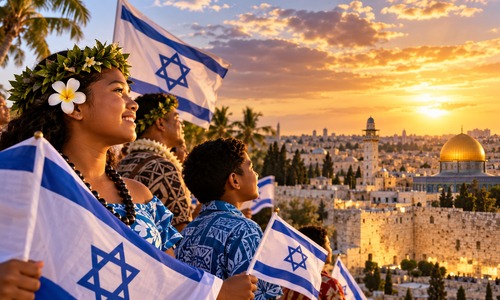
They vote with Israel at the United Nations. Their churches fly Israeli flags. Christians travel thousands of miles to visit the Holy Land. Their leaders openly speak about the God of Israel, the Bible and the Jewish people's connection to Jerusalem.
And now three Pacific nations have taken an extraordinary diplomatic step: Papua New Guinea, Fiji and Nauru — officially known as Naoero — have established embassies in Jerusalem.
For many of these nations, the explanation isn't difficult to find.
It begins with Christianity.
When Papua New Guinea became the first Pacific nation to open an embassy in Jerusalem in 2023, Prime Minister James Marape was remarkably candid about the reasoning.
His government described the decision as based upon Papua New Guinea's "Christian principles and worldview." Marape said his country recognized Jerusalem in acknowledgement of its Judeo-Christian worldview and declared that Papua New Guinea finds part of its Christian heritage in Israel.
This was not diplomatic language designed to hide religious motivation. It was the opposite.
Marape explicitly connected foreign policy with the Bible.
Fiji followed in September 2025. Prime Minister Sitiveni Rabuka inaugurated his nation's Jerusalem embassy while describing a "very close religious and cultural connection to the Holy Land." Fiji's government also pointed to faith and common values as forces strengthening the relationship.
Then came Nauru.
In September 2026, the island nation of roughly 12,000 people became the third Pacific country to establish an embassy in Jerusalem.
Vice President and Foreign Minister Lionel Aingimea called the move "a message to the world of where we stand." He also revealed something remarkable about Nauru's diplomatic record: the country had supported Israel in 71 percent of relevant United Nations votes, while the Federated States of Micronesia stood at 88 percent.
Aingimea has been even more explicit about what motivates that friendship: "Our motto is God first, and Israel always has a special place in our hearts."
This pattern extends beyond embassies.
For decades, tiny Pacific states including Micronesia, the Marshall Islands, Palau and Nauru have repeatedly appeared beside Israel and the United States in extraordinarily small minorities at the United Nations.
One UN vote concerning Jerusalem, for example, passed 157-6. The six opposing votes were Israel, the United States, Marshall Islands, Micronesia, Nauru and Palau.
Four of Israel's five companions were Pacific island nations.
That is difficult to explain through geopolitical power alone.
These countries have relatively little trade with Israel. They aren't protecting massive investments or military alliances comparable to those of major world powers.
What they do possess is deeply Christian cultures in which biblical Israel remains very real.
Samoa offers another striking example.
At his 2025 inauguration, Prime Minister Laaulialemalietoa Polataivao Fosi Schmidt wore a Jewish prayer shawl alongside a Christian cross and prayed for blessing from "the God of Israel, the God of Abraham, the God of Isaac, the God of Jacob."
Religion permeates Samoan society. More than 400 churches serve a population of roughly 220,000, and about 90 percent regularly attend church, according to reporting by Australia's ABC.
Across parts of the Pacific, Israel isn't simply another country on a map.
It is the land people have heard about since childhood.
Jerusalem is the city of David. Bethlehem is where Christ was born. Galilee is where Jesus ministered. The Mount of Olives is associated with His ascension and promised return.
And the Jewish people are the people whose history fills the Old Testament and through whom Christianity itself emerged.
Some Pacific communities go even further, maintaining traditions that connect their ancestry with the Lost Tribes of Israel. Such claims are matters of tradition rather than established historical fact, but they demonstrate just how deeply identification with biblical Israel has penetrated parts of Pacific culture.
Support also appears at the grassroots level.
Pacific Christians have organized pilgrimages to Israel, churches have displayed Israeli flags, and Christian organizations have spent decades cultivating relationships between Pacific believers and the Jewish state.
The relationship is becoming practical as well. Israel and Pacific governments are expanding cooperation in agriculture, water technology, medicine, education, disaster resilience and food security. Fiji has sought expanded Israeli assistance in agriculture and information technology, while Papua New Guinea has pursued Israeli expertise in agriculture, education and infrastructure.
Some of Israel's most dependable friends are not powerful Western governments.
They are tiny nations scattered across the world's largest ocean.
Perhaps the biggest question is why these countries sometimes see Israel differently than increasingly secular Western societies do.
For many Pacific Christians, Israel is not encountered first through geopolitics, colonial theory or United Nations resolutions.
They encounter Israel in Genesis.
Then Exodus.
Then the Psalms and the prophets.
Then the Gospels.
Then Romans.
Then Revelation.
And when they read God's promise to Abraham — "I will bless those who bless you" — many still believe those words mean something.
That conviction is now producing consequences far beyond Sunday morning worship.
It is shaping votes at the United Nations, relationships between governments and even determining where nations plant their flags.
From some of the smallest islands at the ends of the earth, a remarkably clear message is traveling all the way to Jerusalem:
Israel still has friends.