When The Reporter Is Also The Fighter: Gaza's Media Scandal Explodes
 By PNW Staff October 14, 2026
Share this article:
For nearly three years, one of the most damaging accusations leveled against Israel has been that it deliberately targets journalists in Gaza. Every death added another name to international lists, another condemnation, another headline and another statistic suggesting Israel was waging war not merely against Hamas but against those attempting to expose what was happening.
Then came October 1.
The Israel Defense Forces released what it calls "The Press Files," identifying 170 Palestinians who were presented as journalists or media workers but who, according to Israeli military intelligence, were also members of Hamas, Palestinian Islamic Jihad or other terrorist organizations.
This wasn't simply a list of people accused of sympathizing with Hamas. The IDF published names, photographs, military identification numbers, positions within terrorist organizations and, in many cases, captured personnel documents.
According to the IDF investigation, 118 served in Hamas's military wing and 49 in Palestinian Islamic Jihad. Two others were affiliated with the Popular Resistance Committees and one with the Mujahideen Brigades. Seventeen allegedly participated in the October 7 massacre itself.
Their reported military jobs are even more disturbing.
Snipers. Squad commanders. Engineers. Trainers. Intelligence operatives. Propaganda personnel.
And journalists.
That combination should force a serious reassessment of how information from Gaza has been presented to the world.
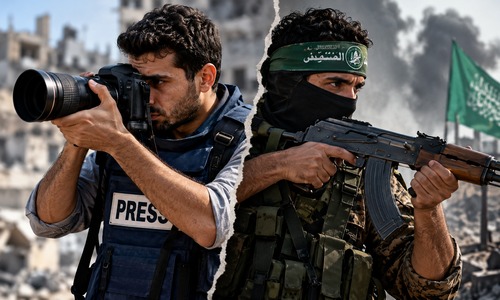
The Camera And The Kalashnikov
Perhaps no image summarizes the problem better than that of Amro Abu Odeh.
Abu Odeh reportedly provided photography to Reuters and Turkey's Anadolu Agency. Yet according to the IDF, he was also a commander in a photography unit connected to Hamas's military wing. In photographs highlighted with the investigation, the same man associated with a camera is also shown carrying a Kalashnikov.
He was hardly an isolated case.
The IDF says individuals among the 170 worked for or contributed to international organizations including Reuters, CNN, BBC, AFP, Le Monde and ABC Australia. Others worked for Palestinian and Arab media organizations.
One individual identified by the IDF, Mohammed al-Kuwaifi, reportedly worked for Shehab News Agency while serving as a squad commander in an engineering platoon of Hamas's Gaza Brigade. The IDF published a military ID number and a captured Hamas document identifying his role.
Another, Hamza al-Dahdouh, worked for Al Jazeera. The IDF identifies him as a Palestinian Islamic Jihad military operative and published a document recovered in Gaza listing personnel in PIJ's electronic engineering unit.
This is the central scandal.
A press vest identifies someone's profession. It does not tell us what else that person may be doing when the camera is turned off.
October 7 Changes Everything
The most troubling cases are the 17 people the IDF says participated in the October 7 attack itself.
That crosses a line far beyond accusations of biased journalism.
October 7 was not a protest or a news event that journalists merely rushed to cover. Hamas-led terrorists crossed Israel's border, murdered civilians and soldiers, burned communities and carried hostages back into Gaza.
If individuals participating in that attack were subsequently counted internationally among journalists killed during the war, then some of the statistics repeatedly used to portray Israel as deliberately killing journalists require another look.
The distinction between journalist and combatant is not academic.
Journalists receive special protection because their job is to observe war, not participate in it.
The moment someone becomes an operative of an armed organization, commands fighters, serves as a sniper or participates in a terrorist assault, a camera cannot magically erase those activities.
Western Media Has Questions To Answer
There is another uncomfortable part of this story.
Western news organizations depended enormously upon local Gaza journalists, photographers and freelancers throughout the war. Israel restricted independent foreign press access to Gaza, meaning much of what audiences in New York, London, Paris and elsewhere saw came through Palestinian journalists already inside the territory.
Now the IDF says some of those people were simultaneously connected to the very terrorist organizations the international media was covering.
That does not establish that international news organizations knowingly employed terrorist operatives.
But it raises an unavoidable question:
How thoroughly did they know the people producing their photographs, footage and information?
The issue goes beyond whether a photograph itself was authentic. Journalism is also about selection.
What gets photographed?
What doesn't?
Where does the cameraman go?
What does he know?
What does he leave outside the frame?
A photographer doesn't need to manipulate an image to manipulate perception. Sometimes all that is necessary is deciding where to point the camera.
Al Jazeera's Problem Goes Deeper
The IDF has previously released documents it says identify multiple Al Jazeera journalists as Hamas or PIJ operatives. Those records included personnel tables, training-course records, telephone directories and salary documents recovered in Gaza.
The new Press Files dramatically expand the broader picture.
The IDF says its evidence was assembled from open-source information, material recovered by Israeli forces, interrogations and documents produced by the terrorist organizations themselves. In some cases, Hamas and PIJ effectively provided evidence of the affiliations through their own records or recognition of the dead.
That matters because the accusation is no longer simply that some Gaza journalists were sympathetic to Hamas.
The allegation is that members of terrorist military organizations were functioning inside Gaza's media ecosystem while the resulting reporting helped shape international understanding of the war.
Who Was Reporting -- And Who Was Fighting?
For years Israel has faced headlines claiming unprecedented numbers of journalists were being killed in Gaza.
Those numbers helped construct one of the war's most powerful narratives: that Israel was attempting to silence the people documenting its actions.
The Press Files present a radically different picture of at least 170 of those cases.
Some allegedly carried cameras while simultaneously belonging to terrorist military organizations. Some reportedly served as commanders, engineers or snipers. Seventeen allegedly participated in October 7. More than 40, according to the IDF, became the subjects of international condemnations after their deaths.
For three years, photographs and reports coming from Gaza helped shape public opinion, street demonstrations, diplomatic pressure, accusations of war crimes and the world's understanding of Israel's conduct.
The world believed it was looking through the eyes of Gaza's press.
The Press Files now raise a far more disturbing possibility: in some cases, the man behind the camera wasn't merely reporting on Hamas.
He was Hamas.