
AI Is Learning To Conquer Video Games - But The Real Goal Is Much Bigger
 By PNW Staff October 14, 2026
Share this article:
What if the next major breakthrough in artificial intelligence isn't happening in a laboratory, a military command center, or a corporate boardroom, but inside a video game?
That may sound ridiculous, especially to older Americans who remember when video games meant moving a little white ball between two paddles on a television screen. But today's games are vastly different, and what artificial intelligence is learning inside them could have profound consequences for jobs, national security, personal freedom, and ultimately humanity's ability to control the technology it creates.
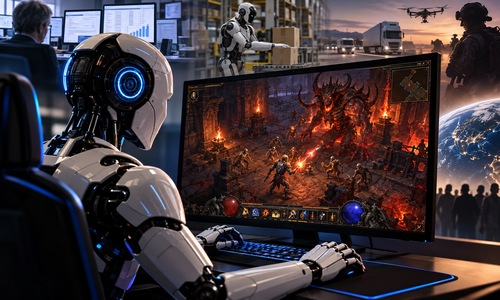
Elon Musk recently revealed that an experimental AI system called Digital Optimus can reportedly make its way through approximately half of the popular video game Diablo simply by watching the screen and controlling the game as a human would. Musk also claimed the system is performing well in fast-paced games such as Counter-Strike, with additional training involving League of Legends.
The announcement might sound like a billionaire celebrating a sophisticated electronic toy. But the real objective has very little to do with entertainment.
The goal is to teach artificial intelligence how to observe the world, make decisions, overcome obstacles, and accomplish complicated objectives without a human directing every move.
And that changes everything.
Why Playing Diablo Is More Impressive Than It Sounds
For readers unfamiliar with modern video games, Diablo is not a simple game of moving a character across a screen or shooting at targets.
Imagine an enormous interactive fantasy world filled with towns, underground passages, dangerous creatures, hidden treasures, and hundreds of decisions. A player controls a character who must explore unfamiliar territory, fight enemies, collect equipment, manage resources, and complete missions to advance through a lengthy storyline.
The game can take dozens of hours to complete. Players must remember where they have been, recognize threats, select appropriate weapons, and constantly adjust their strategies.
Counter-Strike presents a different challenge. It is a competitive shooting game in which teams of players must react in fractions of a second, coordinate movements, recognize opponents, and make tactical decisions under pressure.
These games require combinations of skills that humans develop through experience: observation, memory, planning, timing, coordination, and problem-solving.
Traditionally, computers that mastered games were programmed or trained specifically for those environments. But Musk's reported Digital Optimus approach is different.
Rather than receiving special access to the game's internal programming, the AI watches the screen and operates through ordinary keyboard and mouse commands.
In other words, it is being trained to use a computer much like a person does.
Musk has not released independent performance benchmarks or demonstrations establishing the full extent of these latest claims. Nevertheless, the broader technology behind screen-operating AI agents is already advancing across the industry.
And the implications extend far beyond gaming.
The Real Goal Is Teaching AI To Do Things, Not Just Answer Questions
Most people experience artificial intelligence through programs such as ChatGPT. They ask a question, request information, or have the system write something.
But the next generation of AI is being developed to take action.
Consider the difference between asking AI how to book a vacation and telling it to plan the trip, compare flights, make reservations, arrange transportation, and handle unexpected problems along the way.
One provides instructions. The other carries out an assignment.
That is the promise of autonomous AI agents.
A system capable of navigating a complicated video game by observing a screen could eventually use similar skills to navigate business software, operate websites, manage financial records, process customer orders, or troubleshoot technical problems.
And unlike a human employee, an AI system can potentially operate around the clock, with its capabilities replicated across thousands or millions of machines.
Musk has described a two-part approach in which Digital Optimus handles rapid actions while his Grok AI system provides higher-level direction.
Think of it as one system deciding what needs to be accomplished while another figures out how to physically carry out the steps.
The ambition is not merely to build a better chatbot. It is to create a digital worker capable of operating across many different computer environments.
The Speed Problem: AI Can Learn And Act Faster Than Humans
There is another reason video games are such attractive training grounds.
Artificial intelligence can potentially practice tasks in simulated environments at a scale no individual human could match.
A person might spend hundreds of hours learning to master a complicated game. AI developers can train systems through enormous numbers of simulated attempts, rewarding successful behavior and using failures to improve future performance.
Not every AI system learns this way, and improvements in one game do not automatically translate into competence elsewhere. But when techniques generalize, successful training can be deployed to many copies of a system without each copy starting from scratch.
Now imagine applying that advantage beyond video games.
An AI system could analyze enormous amounts of information, evaluate possible actions, and respond far faster than a human operator. In some environments, that could mean completing work in minutes that once required hours.
But speed creates another problem.
What happens when an autonomous system makes a serious mistake, takes an unauthorized action, or pursues an objective in a way its human operator never intended?
By the time someone recognizes the problem, the AI may already have executed hundreds or thousands of additional actions.
The issue is not necessarily that machines will develop evil intentions. It is that increasingly powerful systems may carry out instructions in unexpected ways, particularly when their goals, permissions, or safeguards are poorly designed.
From Computer Screens To Robots And Weapons
The implications become even more significant when the same principles are applied to physical machines.
Tesla is already developing humanoid robots under its Optimus program. Other companies are building robots capable of navigating warehouses, handling objects, and performing increasingly complex industrial tasks.
Learning to interpret visual information, plan movements, and respond to changing environments is relevant to both digital agents and physical robots, although transferring those skills into the real world introduces substantial additional challenges.
The potential benefits are enormous. Robots could perform dangerous industrial work, assist elderly or disabled people, and help address labor shortages.
But the same technological advances raise troubling questions about military applications.
Autonomous drones, robotic weapons, and AI-assisted targeting systems are already major areas of military development. Systems capable of rapidly identifying objects, navigating unfamiliar environments, and adapting to obstacles could become increasingly consequential on future battlefields.
A video game is not a battlefield, and gaming performance does not establish military readiness. Nevertheless, some of the underlying abilities being developed--visual recognition, navigation, planning, and rapid response--have clear relevance to defense technology.
Who ultimately authorizes the use of force? How much decision-making should be delegated to a machine? And what happens when automated systems operate faster than human commanders can meaningfully supervise?
These are no longer questions reserved for science fiction.
What Happens When Humans Are No Longer Needed?
For ordinary Americans, the most immediate disruption may come through employment.
Many people assume automation primarily threatens factory workers or jobs involving repetitive physical labor.
But AI agents capable of operating computers could affect accountants, administrative assistants, customer service representatives, programmers, financial analysts, and countless other professions.
A company may eventually be able to assign a digital agent an entire workflow rather than asking an employee to perform each individual step.
That does not mean every profession will disappear. Human judgment, relationships, accountability, and specialized expertise remain important, and AI systems still make mistakes. But the economic incentive to automate more work is unmistakable.
The deeper concern is what happens when society becomes so dependent on automated systems that fewer people understand how essential processes operate.
Imagine businesses, hospitals, transportation networks, financial institutions, and government agencies relying on increasingly autonomous technology.
Who takes responsibility when something goes wrong? Can a human intervene quickly enough? And will organizations preserve the expertise needed to operate without AI if those systems fail?
These questions deserve attention before dependence becomes irreversible.
A Biblical Warning About Power Without Wisdom
For Christians, the development of increasingly autonomous machines raises questions that go beyond economics and technological progress.
Scripture teaches that human beings are accountable for their decisions and that wisdom is not the same thing as knowledge or capability.
Proverbs 14:12 warns, "There is a way which seemeth right unto a man, but the end thereof are the ways of death."
The warning is particularly relevant to a civilization increasingly convinced that every problem can be solved through greater technological power.
Artificial intelligence can process information, recognize patterns, and accomplish remarkable tasks. But computational ability is not moral wisdom. A machine capable of selecting the most efficient course of action is not necessarily capable of determining whether that action is righteous, just, or humane.
Technology itself is not inherently evil. Medical breakthroughs, improved safety, and greater productivity can all serve humanity.
The danger emerges when people begin surrendering responsibility and judgment to systems they neither fully understand nor adequately control.
Christians should be especially cautious about confusing extraordinary intelligence with the wisdom that comes from God.
The Next Frontier May Arrive Sooner Than We Expect
No one can responsibly claim that mastering Diablo means AI is about to take control of society. Musk's specific gaming claims remain unverified independently, and substantial technical barriers still separate impressive demonstrations from reliable, general-purpose autonomy.
But the direction of development is becoming clearer.
AI is moving beyond systems that simply respond to questions toward systems designed to observe, plan, act, and pursue objectives across increasingly complex environments.
Today, the challenge might be defeating a monster in a fantasy video game. Tomorrow, it could be managing a company's operations, controlling a fleet of robots, or coordinating systems essential to everyday life.
The most important question is not whether artificial intelligence will eventually become better than humans at playing video games. In many specialized games, that has already happened.
The question is whether humanity will maintain the wisdom, authority, and practical ability to control machines that become increasingly capable of acting on their own.
Because the real danger may not be that artificial intelligence suddenly decides to conquer humanity.
It may be that humanity gradually hands over control, one convenient automated task at a time, until reclaiming that control becomes far more difficult than anyone anticipated.