The Cost Of Selective Christianity: A Congregation Applauds A Polygamous Pastor
 By PNW Staff October 27, 2026
Share this article:

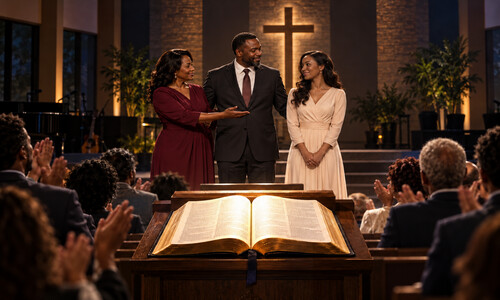
A Cleveland-area congregation applauded as its pastor’s first wife introduced his second wife from the church platform. The scene was startling, but the deeper issue is familiar: when leaders treat Scripture as a collection of passages to accept or set aside at will, almost any conclusion can be presented as God’s will.
At LifeWorks Church in Wickliffe, Ohio, Pastor Lydia Ford introduced Minister Shakayla Ford as her husband Israel Ford’s second wife and her “sister in marriage.” The Fords described their relationship as polygynous—a marriage in which one man has more than one wife. Israel Ford, who calls himself a prophet, later said the belief that a man should have only one wife is “unbiblical.” Shakayla told the congregation the arrangement reflected God’s will.
The congregation applauded.
A Bible verse is not a blank check
The Bible does describe men with multiple wives. But describing something is not the same as commanding it—or presenting it as God’s ideal. Scripture also records deception, violence, betrayal and family turmoil without endorsing them.
Ford cited Exodus 21:10, a law addressing a man who takes another wife and requiring him to continue providing for the first wife. That passage regulates a situation within ancient Israel’s law. It does not instruct Christian pastors to take additional wives, nor does it erase the New Testament’s expectations for church leadership.
In 1 Timothy 3 and Titus 1, Paul says an overseer or elder must be “the husband of one wife.” Christians debate the precise meaning of that phrase, but it has long been understood as a standard of marital faithfulness and singularity for church leaders. Jesus, when questioned about marriage, points back to Genesis: a man leaves his parents, is joined to his wife, and the two become one flesh.
That word—two—matters. The Bible’s marriage pattern is not something leaders can redraw simply by finding an Old Testament passage that mentions another arrangement.
The same road to acceptance
The church’s acceptance of same-sex marriage followed a similar pattern of reasoning. It often began with an appeal to compassion and sincerity: these people love each other, so how can the church deny their relationship? From there, biblical passages that set boundaries were reinterpreted, treated as culturally limited, or set aside. The conclusion came first; Scripture was then made to fit it.
The underlying move is strikingly similar: human judgment becomes the final authority, while biblical teaching is accepted only when it supports the desired conclusion.
That raises an unavoidable question for Christians who defend same-sex marriage on the grounds of love, commitment and consent: If those principles are enough to set aside the traditional biblical definition of marriage, why would they not also justify a consensual polygynous marriage? If the answer is that Scripture still sets limits, then which limits—and why should those passages govern one debate but not the other?
Some Christians who support same-sex marriage may reject polygamy. But if they do, they need to explain the biblical principle that draws that line. Otherwise, their rejection risks sounding less like a consistent scriptural standard and more like a preference: one redefinition is welcomed, another condemned. That is the charge of hypocrisy they will have to answer.
When the rules keep changing
This controversy exposes a broader problem in modern Christianity. Some churches have recast biblical teaching on marriage and sexuality around the slogan “love is love.” Others now defend polygamy by appealing to selected Old Testament laws. The arguments differ, but the danger is similar: Scripture becomes a tool for validating a conclusion already chosen.
If a passage is welcomed when it appears to support a desired position and dismissed when it challenges one, then the Bible no longer has final authority. The interpreter does.
That changes the church’s answer to a basic question: Is the church called to submit to God’s Word, or can its leaders declare new permissions and call them revelation?
The applause matters
The responsibility does not rest only with pastors. Congregations help decide what their churches will accept. The applause at LifeWorks was more than a reaction to an unusual announcement; it showed people publicly affirming the leaders’ claim. Christians are called to test teaching, not simply follow the person on the platform.
The answer cannot be that any arrangement is acceptable if the people involved say they love one another. Nor can it be that every practice recorded in the Old Testament is therefore approved for the church. Christians must read Scripture as a whole, taking seriously Jesus’ teaching and the New Testament’s instructions for church leaders.
The cost of selective Christianity is that no biblical boundary remains firm. One congregation can redefine marriage in the name of love; another can redefine it in the name of an isolated proof text. And when the congregation applauds, the church sends a message that Scripture’s authority ends wherever its leaders’ preferences begin.