The Road To The False Prophet May Be Paved With Promises Of Peace
 By PNW Staff November 03, 2026
Share this article:

What if the greatest religious deception in history doesn't begin with an attack on Christianity, but with an invitation to unite in the name of peace?
Imagine a world where religious leaders stand together, promising to end hatred, division and war. Christians, Muslims, Hindus, Buddhists and others are encouraged to set aside their differences for the greater good.
It sounds like a noble cause. But what happens when the price of that unity is abandoning the truth that Jesus Christ is the only way to God?
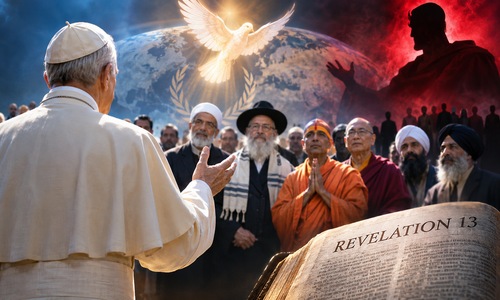
That question has taken on renewed significance following Pope Leo XIV's message to a major interfaith gathering in Assisi, Italy, on October 27, where hundreds of religious representatives came together around a shared commitment to peace.
The Pope declared, "There is no such thing as a holy war: only peace is holy."
But for Christians familiar with the warnings of Revelation, the pursuit of religious unity raises a troubling possibility: Could the world's longing for peace eventually become the very instrument through which the False Prophet leads humanity into its greatest spiritual deception?
When Peace Becomes More Important Than Truth
Christians should seek peace. Jesus blessed the peacemakers, and the Apostle Paul instructed believers to live peaceably with others whenever possible.
But the claim that there is no such thing as a holy war is difficult to reconcile with Scripture.
Throughout the Old Testament, God specifically commanded Israel to engage in warfare for His purposes, including the conquest of Canaan under Joshua. And Revelation 19 describes Jesus Christ returning in judgment against the forces of evil, declaring that "in righteousness he doth judge and make war."
Certainly, men have repeatedly abused religion to justify bloodshed. No Christian today has authority to declare a war holy simply because it advances a religious cause.
But God's righteous judgment is not the same as man's religious violence. Scripture does not permit us to erase one because humanity has abused the other.
More importantly, the Bible never teaches that peace should come at the expense of truth.
Jesus Christ did not claim to be one of many legitimate paths to God. He declared in John 14:6, "I am the way, the truth, and the life: no man cometh unto the Father, but by me."
That declaration is not compatible with the idea that all religions ultimately lead to the same destination.
Christians can respect people of other faiths, defend their freedom and cooperate with them in humanitarian efforts. But Christianity cannot surrender the exclusive claims of Jesus Christ without surrendering the Gospel itself.
And that is precisely where the pursuit of global religious unity becomes spiritually dangerous.
The False Prophet: Revelation's Warning About Religious Unity
We tend to imagine the Antichrist's religious system emerging through intimidation, persecution and open hostility toward Christianity. But what if its initial appeal is exactly the opposite?
What if the foundations are laid through promises of peace, acceptance and unity?
A world exhausted by conflict might eagerly embrace a religious leader who promises to end division, especially if the only sacrifice demanded at first is the abandonment of doctrines considered too exclusive or offensive.
Revelation 13 describes a terrifying future in which the world comes under the authority of a powerful political ruler commonly identified as the Antichrist.
But this ruler has an accomplice.
A second figure, later identified as the False Prophet, emerges with extraordinary religious influence. He performs deceptive signs and directs the inhabitants of the earth to worship the first beast.
Revelation 13:12 says he "causeth the earth and them which dwell therein to worship the first beast."
Think about what that means.
The Bible warns of a coming religious deception so persuasive that people from across the world will be drawn into worshiping a leader who stands in direct opposition to God.
This is not merely a political dictatorship. It is a spiritual counterfeit, backed by supernatural deception and ultimately connected to a system controlling economic participation.
For prophecy-minded Christians, that raises an unavoidable question: What kind of religious environment would make such a deception possible?
Could a world increasingly conditioned to believe that religious differences are unimportant become more receptive to a universal spiritual authority?
Could a future religious leader exploit humanity's desperate longing for peace to persuade people that traditional doctrines must be abandoned for the greater good?
And could Christians who refuse to compromise eventually be portrayed as enemies of world unity?
These are possibilities, not declarations that today's interfaith gatherings fulfill Revelation 13. Scripture does not identify Pope Leo as the False Prophet, and participating in interfaith dialogue is not proof of prophetic deception.
But the warning itself is unmistakable: religious authority, worldwide popularity and promises of peace are no guarantee that a movement comes from God.
The Coming Religion Of Peace And Acceptance?
Imagine a world devastated by war, economic upheaval and international instability.
People are frightened. Governments are desperate for order. Religious leaders are called upon to unite humanity around a common spiritual message.
The invitation would be irresistible to many: stop fighting over doctrine, stop insisting your religion alone is true, and embrace a shared faith in peace, love and human brotherhood.
But what happens to Christians who insist that salvation is found exclusively in Jesus Christ?
What happens when biblical convictions are labeled divisive, intolerant or dangerous to the new global harmony?
A religious system capable of embracing nearly every belief except the exclusive claims of Christ would not be a triumph of Christianity. It would be a rejection of its foundation.
The Apostle Paul warned that a time would come when people would proclaim "Peace and safety" before sudden destruction (1 Thessalonians 5:3). Jesus warned that false prophets would arise with extraordinary power to deceive (Matthew 24:24).
Those passages should not be used to condemn every peace initiative. But neither should Christians ignore their warning that deception can arrive wrapped in reassuring language.
The most dangerous spiritual deception may not come openly attacking Christianity.
It may come promising to include Christianity, provided Christians surrender the very truths that make their faith unique.
A Church That Cannot Discern Will Be Easily Deceived
The issue is not whether Christians should seek peace with Muslims, Hindus or Buddhists. Of course they should.
The issue is whether the Church will continue proclaiming that Jesus Christ is the only way to salvation when that message becomes increasingly unwelcome.
Revelation warns that a future religious leader will persuade the world to follow a counterfeit savior. That should make believers particularly alert to movements that elevate unity above doctrine and acceptance above truth.
The Church does not need a Gospel broad enough to satisfy every religion. It needs the courage to proclaim the Gospel Christ actually gave us.
The coming great deception may not demand that Christians stop talking about Jesus. It may simply demand that they stop insisting He is the only way.
And that is why believers must be careful about any movement that promises unity while asking them to compromise the truth.
Because the road to the False Prophet may not be paved with threats of persecution at first. It may be paved with promises of peace.