The Church Iran Tried To Silence Is Still Growing
 By PNW Staff November 23, 2026
Share this article:
A Christian broadcast can become evidence of espionage. A prayer meeting can cost someone his business. A church that has served worshippers for generations can be taken from its congregation.
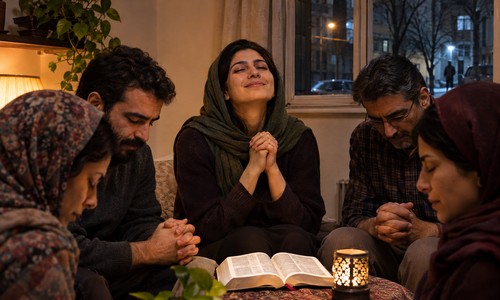
Iran’s rulers have tried to drive Christianity out of public life. Yet the church has not disappeared. In the face of arrests, threats, and shuttered churches, people continue to turn to Jesus—often quietly, knowing the cost.
That contrast should make comfortable Christians stop and think. In Iran, believers risk their freedom to follow Christ. In the West, where churches are open and Bibles are easy to obtain, faith can become one more thing crowded out by convenience. Persecution does not make faith easy. But it can strip away the distractions that make faith feel optional.
Iran’s rulers understand that Christianity challenges more than religious custom. The Islamic Republic demands allegiance to a system in which the Supreme Leader’s interpretation of Islam takes precedence over individual rights. Its ruling theology links the ayatollah’s authority to preparing for the return of the Mahdi. The Revolutionary Guard and its Basij militia help enforce that order.
A convert who places his trust in Jesus answers to someone the regime cannot command. That is why the authorities treat converts as potential enemies of the state.
Ali, an Iranian Christian who had fled the Revolutionary Guard, later returned to Iran and joined the anti-regime movement. He kept his faith secret and ran a gym. Quietly, he encouraged members to join him in prayer in the mountains. The authorities eventually shut the gym down.
The pressure reaches far beyond one man’s story. In July 2026, Iran’s Ministry of Intelligence named evangelical broadcasters Sat-7, Nejat, Seven, and Mohabat TV among organizations it called “hostile.” The ministry warned that cooperating with those outlets—even by sending photos or videos—could bring prosecution under an espionage law passed after the 2025 war with Israel.
Watching Christian broadcasts has reportedly become a crime. Open Doors says at least five Christians have been charged under the law, with sentences totaling more than 40 years.
The regime wants to control what Iranians hear, where they worship, and whom they trust. But it has not been able to silence the church.
The buildings can be seized. The faith remains.
That same month, authorities took control of St. Peter Evangelical Church in central Tehran. Founded by American missionaries in 1876, the compound included a church, homes, schools, and offices serving Christian organizations. About 20 Assyrian and Armenian families were evicted, many with only two weeks’ notice. Church leaders faced threats of arrest if they resisted.
United Nations human rights experts also said a Presbyterian church in Mashhad was demolished in June. Iran once had about 50 Protestant churches, many offering services in Persian. Today, they said, effectively none remain.
A church building can be taken. A congregation can be scattered. A pastor can be threatened. But none of that answers the questions that lead people to faith: Where can I find forgiveness? Is there hope beyond fear? Is there a God who sees me?
The estimates of Iran’s Christian population vary, and underground believers are difficult to count. Elam Ministries has said there were no more than 500 Christians from a Muslim background in 1979. In 2020, GAMAAN estimated that the number had reached several hundred thousand, possibly more than a million. Open Doors estimates about 800,000 Christians in Iran, including historic Armenian and Assyrian communities. Elam Ministries and Transform Iran put the total as high as three million.
The figures differ, but the larger story is striking: Christianity has continued to spread despite a government determined to restrict it. In 2015, the missions research organization Operation World described Iran as having the world’s fastest-growing evangelical population, estimating annual growth at 19.6 percent.
Persecution does not guarantee revival. It brings real suffering: prison, lost homes, closed churches, and families forced to live with fear. But Iran’s underground church shows that pressure cannot manufacture belief, and force cannot make people stop searching for truth.
The Gospel offers what the state cannot provide: forgiveness, meaning, and hope that does not depend on political permission. When a government demands the loyalty that belongs to God, faith becomes more than a private preference. It becomes a decision with consequences.
A challenge to Christians living in comfort
Iran’s Christians should not be romanticized for suffering. No one should have to risk prison to worship. But their courage raises a question for Christians who do have freedom: What are we doing with it?
When worship is safe, Scripture is available, and churches are open, it is easy to assume those things will always be there. Comfort can make faith familiar. Familiarity can turn it into background noise—something we value in principle but neglect in practice.
The church does not need persecution to grow. It needs believers who take their faith seriously, whether the cost is imprisonment or simply the inconvenience of putting God first in a crowded life. Christians in Iran remind us that faith does not depend on buildings, popularity, or political protection. It endures because people believe Jesus is worth following when obedience costs them something.
The Iranian regime can shut down a gym, seize a church, and threaten a convert with decades in prison. It cannot command the human heart to stop seeking God.
That is the witness of Iran’s church: the regime keeps closing doors, yet the Gospel keeps finding a way through. For Christians in free societies, the challenge is not to envy the suffering of Iranian believers. It is to ask whether we will take our own freedom seriously—and whether our faith is strong enough to withstand comfort.