
Biochips About To Take Off
 By Tom Olago February 12, 2016
Share this article:
Who needs a boarding pass and passport verification checks when a simple wave of the hand will do before catching a flight at the airport? One relatively ordinary and unknown passenger was able recently to do just that, thanks to a biochip implanted in his right hand.
Could this be the future of flight boarding? It sounded like wishful thinking, until Andreas Sjöström implanted a microchip in his hand and uploaded his Scandinavian Airlines flight booking to it in order to board a plane out of Stockholm Arlanda Airport to Paris.
He used the implant to check into an airport lounge and go through the security checks. It is believed to be the first time anyone has boarded a flight this way - with the flick of a wrist.
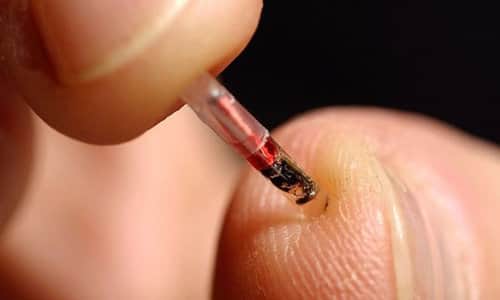
This account recently published by Mail Onlines John Hutchinson explains that the Swedish Airport has installed Near Field Communication (NFC) readers that can scan data from a chip. The chips can be bought for as little as £50 ($72), and in this case, could be inserted underneath the skin by syringe, as it was the size of a grain of rice.
Speaking to Mic, Andreas Sjöström, vice president of digital for technology consulting company Sogeti, said:
The system reacts as if you have the ordinary NFC sticker from the airline, so you're eligible to pass through and it recognizes who you are... The biggest surprise was the feeling of being able to identify myself without anything other than my body.
I didn't have to pull out anything. It gave me a new sensation, sort of a pre-notion of what it will be like in the future when we don't have to reach out with physical objects to accomplish things
.
The choice of airports as a testing ground may be new but the system itself isn't. According to Max Plenke of mic.com, the technology is similar to that used last October by tech developer Patric Lanhed to make digital payments. Plenke explains that the chip Sjöström uses is an xNT implant from an American company called Dangerous Things, which produces biohacking and citizen science equipment. It's also what Patric Lanhed used for a Bitcoin payment experiment.
Issues identified so far with this wrist-boarding process include the need for more detailed security checks, especially in these days of terrorist threats. Theres also the fact that many travelers are not likely to be enthusiastic about being cyborg-chipped merely for the convenience of a faster and easier plane-boarding process.
As Amal Graafstra, CEO of Dangerous Things elaborated to mic.com: "The big issue with the states is that we're much more invested in security theater and the whole idea behind NFC is that you go through the process of getting interviewed and validating who you are.
There's simplicity. But in the U.S., it's big, bulky imposing machinery that does all kinds of bio-scans. Without that big display of pseudo-security, I don't think it'll work in the U.S".
Maybe not as well at airports, but many other alternative applications abound. Take for instance Anthony E., who assented to an RFID microchip implant at a Dallas Tattoo shop, merely for the convenience of being able to activate his android phone.
Joe Pappalardo of the dallasobserver.com explains that Anthony and his wife Janal have been clients of Ryan Mills, who has performed more than 50 implants in 2015 at the Skin Art Gallery tattoo parlor in Addison.
Pappalardo cites one of many bizarre procedures that Anthony and Janal have undergone under the minor surgical processes conducted by Mills: "A small incision in their right index fingers, a pea-sized magnet implant and a suture is all they needed to gain a new sensation. Janal and Anthony said they could feel nearby motors activate by the tingling sensation caused by the magnets stirring in their digits".
"It makes you more aware of things turning on around you," Anthony said. "I kept thinking, if machines took over like in The Terminator, I could tell them apart from humans just by shaking hands."
Now Mills is offering his clients a new experience: implantable electronics. And he is in friendly territory too. As Pappalardo explains, Dallas is at the center of two movements that are each trying to bring implants to the mainstream. Tattoo artists and technophiles head one, and well-heeled university neurologists and medical device engineers form the vanguard of the other.
The fringe commercial types, who design and inject mail-order devices into their bodies, call themselves "grinders." The high-end researchers, with advanced degrees and government contracts, call themselves "bioengineers."
They have radically different approaches, but they're actually pulling humanity in the same direction - toward a fusion of hardware and wetware by incorporating technology into the body. The prime driver of both of these movements is the shrinking size of wireless electronics.
Pets were the earlier beneficiaries of implants containing information about the animals owners. The bio-chipping process in pets is now generally accepted in the U.S.
All this has been around for a while but is clearly gaining traction fast. Julianne Pepitone for Nbcnews.com in mid-2014 reported the case of cyborg Zoe Quinn, a well-known developer in the independent video game world. The magnet and chip in her hand have become inseparable from her body and her identity.
"Being a cyborg is just who I am now," Quinn told NBC News. "To get [the magnet or chip] removed would be like losing a sense at this point, losing part of me."
Another such example is Neil Harbisson, of the Cyborg Foundation. Harbisson, a colorblind artist who had an "eyeborg" antenna implanted directly in his skull in 2003. The antenna converts color into sound waves that allow him to "hear" the hues.
Last February, zdnet.com writer Charlie Osborne quoted biohacker Hannes Sjoblad from BioNyfiken, leader of a group of biohackers in Sweden who took the first step in experimenting with embedded NFC chips - by having them implanted into their own hands.
The biohacker believes that the future of implants can be found in ways to de-clutter your daily life. Keys, credit cards and smartphones are all things we carry around to identify ourselves, but one day, simply swiping your hand could replace these items.
Other uses for embedded NFC chips could be used to access buildings, activate devices such as guns locked to one owner, authenticate a bank or financial account. According to Sjoblad, biotechnology and embedded NFC chips will eventually become a quick digital identification process used for everyday purposes.
Learn more about the biochip revolution and other technological advances that are impacting our society with Tom Horn's newest DVD Release: Inhuman: The Next And Final Phase Of Man Is Here.