On The Path To Totalitarianism: Rewriting History & Erasing Images
 By David C. Stolinsky/Gatestone Institute September 10, 2018
Share this article:

We learn both from what we see and from what we do not see: this is especially true if we do not see something because it was intentionally deleted. This tells us something about those who deleted it. They considered it so important that they went to the trouble of trying to erase it from our national consciousness.
Why? What was so contrary to their value system that they found it intolerable?
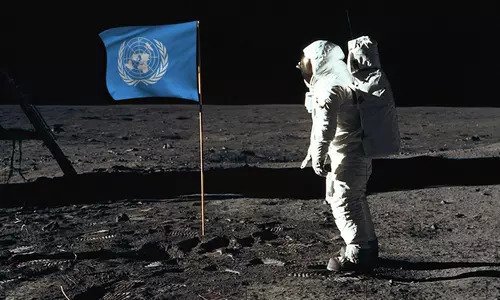
The photo of the flag on the moon is one of the most famous images in history. In 1969, Neil Armstrong and Buzz Aldrin were the first humans to set foot on the moon: planting the American flag on the moon was an iconic event. I would bet serious money that the great majority of people in the world can identify that photo. But not Hollywood. The scene was omitted from the movie "The First Man".
Ryan Gosling, who plays Armstrong, claims that Armstrong did not see himself as an American hero. Like Medal of Honor recipients, he did not see himself as a hero, but he surely saw himself as an American. As 95-year-old Chuck Yeager says, "That's not the Neil Armstrong I knew."
Gosling admits he sees things as a Canadian. So it is all right for Gosling to see himself as a Canadian, but it is not all right for Neil Armstrong to see himself an American?
The missing prayer
Todd Beamer was a passenger on United Flight 93 on Sept. 11, 2001. What happened was verified by the telephone company supervisor with whom he spoke. They recited the Lord's Prayer together, and he made her promise to tell his wife and sons he loved them. He then said his timeless words:
"God help me. Jesus help me. Are you ready? Let's roll!"
Beamer played a key role in the passengers' revolt against the terrorists. As a result, the airliner crashed into a field in Pennsylvania, and not into the Capitol Building or the White House. It was an act that saved many lives. Revealingly, his timeless words were omitted from the film "United 93." Hollywood does not like to say anything positive about Christians, even if it is historically accurate.
The missing phrase
In the film "Pearl Harbor," Jon Voigt gives a fine performance as President Roosevelt asking Congress for a declaration of war against Japan in the "Day of Infamy" speech. The screen version follows the actual speech, but with a major omission. Roosevelt declared:
"With confidence in our armed forces -- with the unbounded determination of our people -- we will gain the inevitable triumph − so help us God."
The film version omitted "so help us God." What was the problem with those four words? Or rather, what was the problem with that one word? When people are frightened of dying, or of their loved ones dying, many pray to God. The screenwriters apparently would not. But why pretend that others would not?
Why construct an artificial world where nobody is religious? Why not depict the real world as dramatically as possible? Is a romantic ideological agenda more important than an accurate and dramatic film?
The missing couple
The 1997 film "Titanic" includes many dramatic scenes. But one verified scene was omitted.
Among the passengers were Isidor and Ida Straus. Straus was co-owner of Macy's Department Store. Once it was clear the ship was sinking, the Strauses went to the lifeboat deck with their newly hired English maid. Mrs. Straus refused to get into the lifeboat without her husband, saying, "I will not be separated from my husband; as we have lived, so will we die, together."
Mrs. Straus gave her fur coat to her maid as the maid boarded the lifeboat, explaining that she would not be needing it. The couple was last seen on the boat deck, together. Mr. Straus's body was recovered later; his wife's was not.
The 1953 film "Titanic," does include a moving scene of Mr. and Mrs. Straus. But the makers of the 1997 film just could not find the time in 3 hours 15 minutes to show this touching and verified event. In fact, the scene was filmed, then cut out, even though it lasted only 24 seconds. Was this latent anti-Semitism? Was it a simple oversight? Or was it that marital devotion was thought to be passé? Who knows?
In the 1953 film, when the lookouts sighted the iceberg, one crossed himself and said, "Jesus, Mary!" In the 1997 film, one said, "Bugger me!" No one is sure what the lookouts really said. But can upgrading special effects make up for a deteriorating invocation?
The missing guns
In the film "Schindler's List," Liam Neeson gives an outstanding performance as Oskar Schindler, a womanizing, hard-drinking German who was a Nazi Party member. Yet during World War II, he saved about 1,200 Jews.
Schindler escaped the clutches of the Gestapo by claiming that "his" Jews were doing essential war work. But Schindler did something that could not have been explained away. Had it been discovered, he would have been tortured and executed. He stole guns and gave them to "his" Jews, so that they could defend themselves.
The film ran 3 hours 15 minutes, yet somehow there was no time to include this incident, which would have taken perhaps a minute. An anti-gun agenda was apparently more important to the film makers than the depiction of this dramatic and revealing incident.
To believe that today's Americans should not have guns is illogical. Careful studies show that allowing law-abiding citizens to carry guns reduces the rate of violent crime. But to believe that Jews during the Holocaust should not have had guns borders on being delusional, even genocidal.
The guns were stolen twice -- by Schindler to help the Jews, and by the filmmakers to further their sentimental agenda.
The missing heroes
If you depended on the mainstream media, you never would have heard of even one of the 19 recipients of the Medal of Honor in Afghanistan or Iraq. Abu Ghraib prisoner abuse? On the front page of the New York Times for 32 consecutive days. But courage and sacrifice by our troops? Positive role models for young people? Honoring those who defend our freedoms, including freedom of the press? It may not be interesting to the media. But it is remarkable and motivating to us.
The missing corpses
Whether America should make reparations for slavery is a subject that exacerbates the debate on race. But the question implies something untrue − that no reparations have yet been paid.
The total death toll for both sides in the Civil War was about 624,511. 364,511 men and boys, most of them white, died fighting for the Union.
Approximately one in four Union soldiers who served died in the war. The total population of the Union was about 20 million. One-third of a million deaths was significant.
In addition, all serious arm or leg wounds were treated by amputation. Veterans on crutches or with pinned-up sleeves were likely a common sight on American streets for many decades
If all those severed limbs, and all the blood that soaked into the earth from the dead and wounded do not constitute reparations, nothing ever could. Yet these facts are rarely mentioned when the subject of reparations is raised. Why? Are the dead and wounded unimportant? Or are they merely non-lucrative?
The missing communists
In the Soviet Union, Stalin feared rivals, so he had associates shot or sent to Siberia. He also had them removed from history books and airbrushed out of photographs. In a notorious case, associates were deleted one by one until only Stalin remained.
Rewriting history and erasing images are symptoms of budding totalitarianism. The moon landing was "one giant step for mankind." Omitting the planting of the American flag is another small step away from freedom and toward totalitarianism.
Totalitarians do not really care whether you believe their lies. If you do, you help to maintain their power. If, however, you do not believe the lies, yet are forced to repeat them, you admit that you have sold your mind ‒ and perhaps your soul. We should not sell ours either.
You want to see "The First Man"? Go ahead. Enjoy the popcorn. It is as healthy for your body as the movie is for your mind. I'll stay home and watch "Lone Survivor," "American Sniper," or "The 15:17 to Paris." Maybe I'll watch all three. And then I'll watch the scene from "The Pacific" in which the widow of John Basilone gives "Manila John's" Medal of Honor to his parents. Some memories are too strong to be erased by anyone.
Originally published at Gatestone Institute - reposted with permission.