
Total Catastrophe For U.S. Corn Production Will Impact All Of Us
 By Michael Snyder/Economic Collapse Blog May 17, 2019
Share this article:
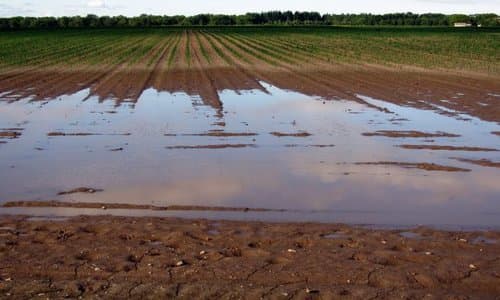
2019 is turning out to be a nightmare that never ends for the agriculture industry. Thanks to endless rain and unprecedented flooding, fields all over the middle part of the country are absolutely soaked right now, and this has prevented many farmers from getting their crops in the ground.
I knew that this was a problem, but when I heard that only 30 percent of U.S. corn fields had been planted as of Sunday, I had a really hard time believing it. But it turns out that number is 100 percent accurate. And at this point corn farmers are up against a wall because crop insurance final planting dates have either already passed or are coming up very quickly.
In addition, for every day after May 15th that corn is not in the ground, farmers lose approximately 2 percent of their yield. Unfortunately, more rain is on the way, and it looks like thousands of corn farmers will not be able to plant corn at all this year. It is no exaggeration to say that what we are facing is a true national catastrophe.
According to the Department of Agriculture, over the past five years an average of 66 percent of all corn fields were already planted by now…
U.S. farmers seeded 30% of the U.S. 2019 corn crop by Sunday, the government said, lagging the five-year average of 66%. The soybean crop was 9% planted, behind the five-year average of 29%.
Soybean farmers have more time to recover, but they are facing a unique problem of their own which we will talk about later in the article.
But first, let’s take a look at the corn planting numbers from some of our most important corn producing states. I think that you will agree that these numbers are almost too crazy to believe…
Iowa: 48 percent planted – 5 year average 76 percent
Minnesota: 21 percent planted – 5 year average 65 percent
North Dakota: 11 percent planted – 5 year average 43 percent
South Dakota: 4 percent planted – 5 year average 54 percent
Yes, you read those numbers correctly.
Can you imagine what this is going to do to food prices?
Many farmers are extremely eager to plant crops, but the wet conditions have made it impossible. The following comes from ABC 7 Chicago…
McNeill grows corn and soybeans on more than 500 acres in Grayslake. But much of his farmland is underwater right now, and all of it is too wet to plant. Rain is a farmer’s friend in the summer but in the spring too much rain keeps farmers from planting.
The unusually wet spring has affected farmers throughout the Midwest, but Illinois has been especially hard hit. Experts say with the soil so wet, heavy and cold, it takes the air out and washes nutrients away, making it difficult if not impossible for seeds to take root.
Right now, soil moisture levels in the state of Illinois “are in the 90th to 99th percentile statewide”. In other words, the entire state is completely and utterly drenched.
As a result, very few Illinois farmers have been able to get corn or soybeans in the ground at this point…
According to the U.S. Department of Agriculture’s crop progress reports, about 11% of Illinois corn has been planted and about 4% of soybeans. Last year at this time, 88% of corn and 56% of soybeans were in the ground.
I would use the word “catastrophe” to describe what Illinois farmers are facing, but the truth is that what they are going through is far beyond that.
Normally, if corn farmers have a problem getting corn in the ground then they just switch to soybeans instead. But thanks to the trade war, soybean exports have plummeted dramatically, and the price of soybeans is the lowest that it has been in a decade.
As a result there is very little profit, if any, in growing soybeans this year…
Farmers in many parts of the corn belt have suffered from a wet and cooler spring, which has prevented them from planting corn. Typically when it becomes too late to plant corn, farmers will instead plant soybeans, which can grow later into the fall before harvest is required.
Yet now, planting soybeans with the overabundance already in bins and scant hope for sales to one of the biggest buyers in China, could raise the risk of a financial disaster.
And if the wet conditions persist, many soybean farms are not going to be able to plant crops at all this year.
Sadly, global weather patterns are continuing to go haywire, and much more rain is coming to the middle of the country starting on Friday…
Any hopes of getting corn and soybean planting back on track in the U.S. may be washed away starting Friday as a pair of storms threaten to deliver a “one-two punch” of soaking rain and tornadoes across the Great Plains and Midwest through next week.
As much as 3 to 5 inches (8 to 13 centimeters) of rain will soak soils from South Dakota and Minnesota south to Texas, Oklahoma and Arkansas, according to the U.S. Weather Prediction Center in College Park, Maryland.
We have never had a year quite like this before, and U.S. food production is going to be substantially below expectations. I very much encourage everyone to get prepared for much higher food prices and a tremendous amount of uncertainty in the months ahead.
Even though I have been regularly documenting the nightmarish agricultural conditions in the middle of the country, the numbers in this article are much worse than I thought they would be at this point in 2019.
This is truly a major national crisis, and it is just getting started.