Has The Iranian Empire Overreached?
 By Shoshana Bryen/Algemeiner.com November 20, 2019
Share this article:
Since December 2017, a sort of "rolling rebellion" has been occurring across Iran. It is bigger, deeper, and stronger than the Green Revolution of 2009, and is taking place in great measure outside Tehran, where the population is more diverse.
There have been strikes of truckers, bazaar shopkeepers, teachers, farmers, and students -- see #WhiteWednesday on Twitter to watch brave Iranian women go into the streets and take off their head coverings.
Sometimes they dance. Sometimes their husbands, fathers, and brothers go with them. Sometimes they are arrested and sometimes they go to jail. Unfortunately, it took the suicide of a young woman facing seven years in prison for attending a soccer match to get the attention of the Western press.
In May of this year, widespread upheaval convulsed the country, and thousands were arrested. This weekend, news of increasing protest in Iran came from the National Council of Resistance of Iran (NCRI) -- an organization with a mixed record of acceptance by the US government, but with indisputable reach inside the country.
According to NCRI's Washington office, at least 65 cities have seen violent demonstrations, with people killed and injured by authorities. Videos, presumably from cell phones, show that pictures of the Ayatollah Khameini have been set on fire and demonstrators are chanting "Death to the Dictator" and "Death to Rouhani."
As Iran spreads its tentacles abroad and builds its illegal nuclear capability, it is clear that the regime cannot fund domestic priorities and international revolution on the same budget -- especially as that budget contracts.
Imperial overreach was the ruin of the Roman Empire, the Byzantines, Egyptians, Ottomans, Nazis, and Soviets. Could it be catching up with Iran?
Wait, you say, Iran isn't an empire. Not in the traditional sense. But it was always the belief of the hegemonic mullahs that instability across large regions, managed with a relatively small group of well-trained Iranian professionals and a lot of proxy fighters, would create a world in which Shiite supremacism held sway.
And it was working.
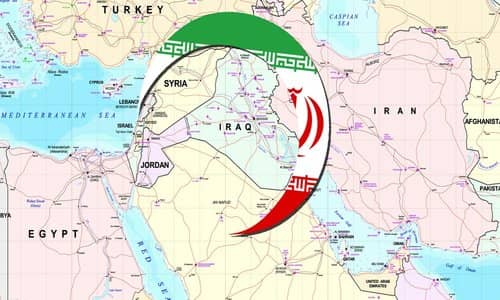
The Shiite Crescent -- from Iran through Iraq, Syria, and Lebanon to the Mediterranean -- was a "lid" over Iran's Sunni enemies Saudi Arabia and Jordan, plus Israel. It was also a wedge between Sunni Turkey and the Sunni countries below -- Saudi Arabia, Jordan, and the Gulf states.
Most of the proxy soldiers were Iraqi militias, Lebanese Hezbollah, and Pakistanis and Afghans brought to Syria under the command of Iran's Islamic Revolutionary Guard Corps. The result was millions of Sunni Syrian refugees in the Middle East and Europe.
Sunni Hamas and Shiite Palestinian Islamic Jihad were both recipients of Iranian funds, weapons, and training to harass Israel.
There is also an underside Crescent, which is less well understood. It encircles the Gulf states and Saudi Arabia in the Gulf of Aden, with a base in Yemen and a Houthi proxy at the bottom of the Red Sea, threatening the Bab el Mandeb Straits and the exit of Israel, Jordan, Egypt, and Saudi Arabia to the Gulf and the Indian Ocean. And the American base in Djibouti.
In Africa, Iran incubated Sunni jihadists in the poor, corrupt, and vulnerable states of the second tier -- Sudan, Chad, Niger, and Mali. The result was waves of migrants headed north.
The North African countries -- Egypt, Libya, Tunisia, Morocco, and Algeria -- were all in the NATO Mediterranean Dialogue group that helped control safety and security in the sea until the Obama administration toppled the Libyan government in 2011. Libya, no longer a member of the Dialogue, has become a hole in the dam through which hundreds of thousands of African migrants reached Europe.
But has the empire reached too far? American-led sanctions have been an enormous financial blow to the mullahs, but sanctions are misunderstood. Not a mechanism for toppling a government, they are a means of forcing a government to make choices -- between, revolution and agriculture, between weapons and water and sewer systems, between Palestinian jihadists and schools, and so forth.
That is what Iran faced in 2011 and that is what led to the Iran/P5+1 negotiations. The fact that President Obama collapsed and paid off the mullahs allowed them to avoid those very choices and set back the operation by years.
The restoration of sanctions means Iran has less to pay off its proxies -- as well as less for its own people. European businesses, and even China, are leaving Iran and taking their money. Iran tried to compensate by stealing Iraqi oil. And that's where empire begins to break down.
There are explicitly anti-Iranian riots in Lebanon and Iraq. Hezbollah fighters have announced they will refuse to return to Syria for Iran. Iraqis have attacked Iranian bases and depots. But most of the mainstream press isn't there.
Eventually, the biggest changes may be coming in Iran itself.
Originally published at Algemeiner.com - reposted with permission.