
Russia & China Prepare To Challenge US Power Worldwide
 By Gordan Chang/Gatestone Institute April 23, 2021
Share this article:

Russian troops are massing on the Ukraine border, Chinese vessels are swarming Whitsun Reef of the Philippines in the South China Sea, and China's air force is flying almost daily through Taiwan's air-defense identification zone. Chinese troops for almost a year have been dug in deep in Indian-controlled Ladakh in the Himalayas. Two large aggressors are threatening to break apart neighbors and absorb them.
The Biden administration has issued warnings to both Moscow and Beijing, but neither looks impressed. American attempts to de-escalate flashpoints are seen in Russian and Chinese circles as failures of resolve.
At least at this moment, those adversaries are right to scoff at the new U.S. leader.
The Chinese are especially bold. They describe their flights near Taiwan as "combat drills." At the same time, they are sending large ships close to Taiwan's waters. The Liaoning, their first aircraft carrier, recently steamed along the east side of the island in an especially provocative gesture.
The Global Times, an unofficial Communist Party tabloid used by Beijing to signal new policies, on April 12 posted a video of Hu Xijin, its editor-in-chief, warning that Beijing would overfly Taiwan -- in other words, fly into Taiwan's sovereign airspace -- to "declare sovereignty."
Threats like that start wars. Chinese leaders speak provocatively because, among other reasons, they do not believe the United States or others will come to Taiwan's rescue.
For decades, Washington has maintained a policy of "strategic ambiguity," not telling either Beijing or Taipei what the U.S. would do in the face of imminent conflict. This approach worked in generally peaceful times with a more cooperative Chinese leadership, but, with far more aggressive rulers in Beijing, that policy is failing.
Beijing is no longer impressed by American power. China's top diplomat, Yang Jiechi, in the infamous Anchorage meeting in the middle of last month, launched into a tirade in which he told Secretary of State Antony Blinken and National Security Advisor Jake Sullivan that the U.S. could no longer talk to China "from a position of strength."
Beijing is openly mocking Washington. Ominously, Global Times on April 14 ran an editorial with this headline: "When Real Determination Is Lacking, the U.S. Should Maintain 'Strategic Ambiguity.'"
In effect, China's leaders are saying they do not believe President Joe Biden would defend Taiwan. The editorial, in support of this view, makes it clear that Beijing thinks the military balance of power is in its favor, even if the U.S. were willing to fight on the island republic's side.
In a propaganda blast on April 8, China's regime said Taiwan "won't stand a chance" if it decides to invade the island. This Chinese self-perception of overwhelming strength is extraordinarily dangerous, of course.
It is, therefore, time to reestablish deterrence. As Joseph Bosco, a Pentagon China desk officer in the George W. Bush administration, told Gatestone this month, "Given the dramatically changed circumstances, different words are needed now."
Unfortunately, Beijing is not hearing them. True, the U.S. and Japan issued a joint leaders' statement mentioning Taiwan -- the first time that has happened since 1969 -- during the visit of Prime Minister Yoshihide Suga to the White House on April 16, but the words were milquetoast. At this moment, the failure to adopt appropriately robust language only adds to the perception of American weakness and underlines concerns expressed by Bosco, now a prominent China analyst, and others.
What to do? Biden should publicly declare the United States is ditching strategic ambiguity and adopting "strategic clarity," in other words, Biden should issue a clear declaration that America will defend Taiwan. Beijing has dared the president to say that; he must respond.
Moreover, we have already passed the point where just declarations and warnings will suffice. The Biden administration has yet to impose costs on China for aggressive actions jeopardizing America's security and that of allies like Japan. Chinese leaders, while hearing the mild warnings from the Biden administration, must be asking one question: "Or what?"
As China threatens Taiwan, Russia threatens Ukraine. Moscow in recent weeks has reportedly massed an estimated 85,000 troops near its border with that former Soviet republic, now an independent state. The concentration of Russian forces there is the highest since 2014, when Moscow annexed Crimea.
That year, Russia-backed soldiers took control of much of the Donetsk and Luhansk portions of Ukraine's Russian-speaking Donbas, and Moscow began issuing passports to a half million people in the Donetsk and Luhansk "People's Republics."
Vladimir Putin in 2019 said that Russia reserved the right to protect ethnic Russians outside Russia. This month, Dmitry Kozak, deputy head of Russia's presidential administration, said his country might intervene to "defend" its citizens. If it did, he suggested, Ukraine would not survive because it would not be "a shot in the leg, but in the face."
The American response has not been adequate. Russians perceive Biden as feeble. "In Putin's game of brinkmanship, Biden blinked first," said journalist Konstantin Eggert to the BBC, referring to the American president proposing a meeting to his Russian counterpart. Biden's "nerves," he said, "had failed him."
That assessment may be correct. In the face of threats directed at Washington by Russian Deputy Foreign Minister Sergei Ryabkov, the U.S. Navy did not, as many had expected, send two destroyers through the Bosporus into the international waters of the Black Sea. Politico reported that "two U.S. officials familiar with the plans" said the cancellation was due to American concerns about inflaming the Russia-Ukraine situation.
Gregory Copley, president of the International Strategic Studies Association, told Gatestone that Turkey announced Washington's intention to sail into the Black Sea before a decision had in fact been made. Especially in light of Ankara's announcement, the ultimate decision to stay away made it look as if the U.S. had backed down. Significantly, Ukraine was disappointed by the decision.
Copley, also editor-in-chief of Defense & Foreign Affairs Strategic Policy, points out China and Russia usually test new American presidents, as do other states. What is different this time is the seriousness of their provocations.
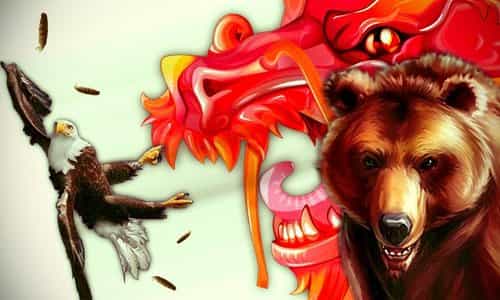
The Dragon and the Bear appear to be coordinating moves, as they have for some time. At the very least, each is acting with an eye to what the other is doing. Once one of these aggressors makes a move, the other large state, taking advantage of the situation, will almost certainly follow. Biden also has to be concerned about Moscow or Beijing acting through proxies Iran and North Korea.
China's communist regime has a history of engaging in belligerent acts -- most notably the 1962 invasion of India during the Cuban missile crisis -- while others are distracted by faraway events. Consequently, war could break out on both ends of the Eurasian landmass at the same time.
All the elements for history's next great conflict are now in place.
Originally published at Gatestone Institute - reposted with permission.





