
Russian And Iranian Footprint Expands Across Middle East
 By PNW Staff August 18, 2016
Share this article:
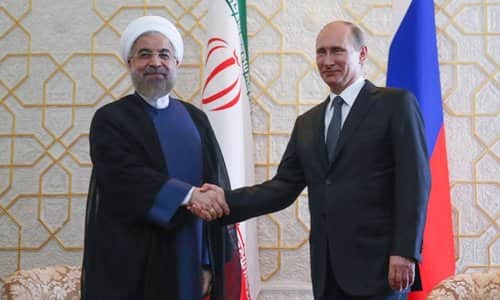
In the wake of US pullbacks and hesitation abroad, both Russia and Iran have made significant moves to expand their military spheres of influence and protect power beyond their borders. Strategic moves into both Syria and Iraq have been seen before, but the recent moves raise concern both for their sheer size and permanent nature.
Following the 2003 invasion of Iraq, there were widespread and well-documented reports of Iranian military units fighting on behalf of the insurgents and waging a dirty war against both the coalition government in Iraq and American troops in particular.
Now that the Shiite government of Iraq is pushing back against the Sunni terrorist group of ISIS, Iran has been gracious enough to lend military aid in the effort to retake Mosul, Iraq's second largest city.
What is shocking is not that two Shiite nations would aid each other against a brutal, terrorist Sunni enemy, nor even that the two nations fought a bloody war with each other from 1980 to 1988 that claimed over a million lives.
Instead, it is the scale of the aid that Iran has chosen to lend to its neighbor, which experts estimate to be between 80,000 and 100,000 troops among militia and mainline Iranian Army units.
The expansion of ISIS can clearly be seen as a threat not only to Iraq but Iran as well, as the terrorist group has shown its desire to expand across the region aggressively.
In this context, Iranian military assistance makes strategic sense, but the size of the force raises questions as to their ultimate agenda. In a classic power vacuum, the US has been replaced by one its regional foes as it dials down its military commitment to Iraq.
Thomas Joscelyn, senior fellow at the Foundation for Defense of Democracies, said in a recent interview, "The effect of the Obama administration's policy has been to replace American boots on the ground with the Iranian's. As Iran advances, one anti-American actor is being replaced with another."
These Iran-backed militias participating in the siege of Mosul have assumed responsibility for more than 6,000 attacks on US forces in Iraq. Iran has also committed its ground forces to supporting the brutal Syrian regime of Bashar al-Assad alongside Russia.
Russia has been waging an air campaign in Syria for the past year but only recently has it raised the stakes by flying warplanes out of Iranian air bases, a first for both countries. For the first time since 1979, a foreign military is taking off from Iranian air bases.
Sorties flown from the Iranian air base Noji by Russian Tu22M3 bombers and Su-34 strike planes were directed at ISIS and Nusra Front terrorist groups within Syria. The base is being fortified with sophisticated Russian anti-aircraft missile defense systems that would harden it and the surrounding area to attack from Israel or the United States.
Russia also announced this week that Syria would grant it a permanent air base near the Mediterranean, giving it the ability to challenge US naval supremacy there.
After the extended air campaign Russia has waged against the Syrian rebels on al-Assad's behalf, few could fault the dictator for granting such a concession that not only shows his gratitude but offers protection against Israeli warplanes that must now contend with the much stronger Russian air defenses when engaging Syria.
The base in Khmeimim, Syria will house the air strike power equivalent of a US carrier battle group and cement an alliance between the two nations against Western influence. The base is reported to host a battalion-size ground force and formidable air defenses and is being upgraded to accommodate the heavy Tu22M3 long range bombers.
On the one hand, the West could choose to celebrate the military will of both Russia and Iran to fight a common enemy such as ISIS and commit such levels of military resources to its destruction. Though not working with the United States or the Western military coalition, the short term goals of containing ISIS certainly align.
But on the other hand, these moves show both a a strengthening of regional anti-Western alliances and a newfound ability to project force that is set to challenge the US and its allies, especially Israel.
Some now see a Russian, Iraqi, Iranian, Syrian (and potentially Turkish) axis of power that is set to rise from the ashes of a declining European and Western hegemony in the Middle East.