
Globalist New World Order Delayed? The Rebalancing Of Power As Trump Returns
 By PNW Staff November 11, 2024
Share this article:
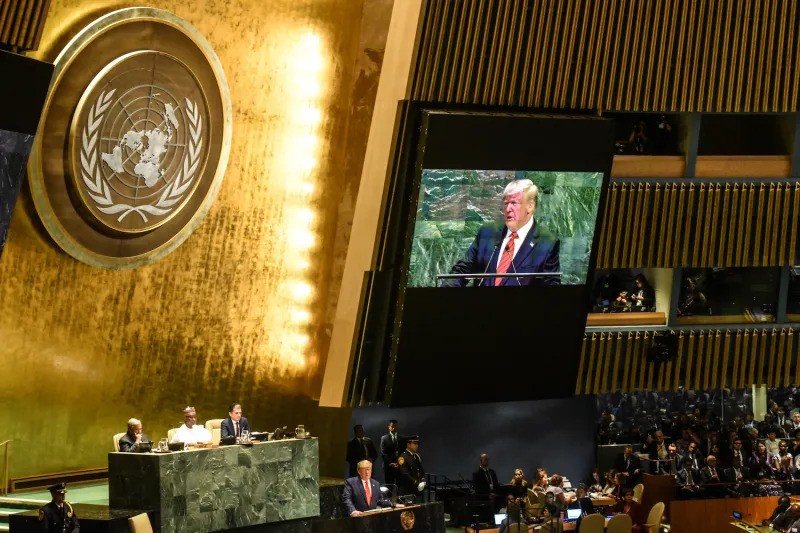
The return of President Donald Trump to the White House in January 2025 has sparked waves of concern and strategic recalibrations among leaders of globalist organizations and the United Nations itself. Trump's anti-globalist stance, already well known from his first term, is expected to impact the direction of international relations, with U.N. leaders and globalist figureheads pondering how to navigate what could be a fundamental shift away from multinational cooperation and centralized global governance.
The U.N.'s Concerned Response
During Trump's initial term, the U.N. witnessed sharp cutbacks in U.S. funding and support. In 2018, Trump's administration withdrew over $25 million in U.S. funding, targeting programs like the U.N. Human Rights Council. for it's bias policies. The impending administration's re-engagement has prompted unease within the U.N., an organization largely reliant on U.S. support. Currently, American taxpayers contribute approximately a third of the U.N. budget, footing $18.1 billion in 2022--an increase from the $11.6 billion paid in 2020 under President Biden. Comparatively, Germany, one of the next highest contributors, pays around $6.8 billion, while Japan contributes roughly $2.7 billion.
Many conservatives argue that the U.N., designed in 1945 with noble aspirations to prevent world wars, has since evolved into an overly bureaucratic entity prone to inefficiency and globalist ideals. U.S. conservatives are particularly wary of the U.N.'s influence in American policy-making, seeing it as a potential threat to national sovereignty.
They argue that Trump's expected pressure on the U.N. to demonstrate "accountability, efficiency, and effectiveness" is long overdue. Hugh Dugan, a U.N. delegate under Trump, claims that the organization has been "sleepwalking" through the past few years, sidestepping accountability with limited U.S. scrutiny.
Globalists and Their Recalibrations
The response from international leaders extends beyond the U.N. Figures like the World Economic Forum's (WEF) Yuval Harari have expressed outright apprehension. In an interview just before the 2024 election, Harari called Trump's victory a "death blow" to the new global order. He warned that Trump's nationalism poses an existential threat to globalism and claimed that leaders pushing for nationalism often present a "false dichotomy" between patriotism and global cooperation. Harari's remarks underscore the ideological divide between globalist visions and the wave of nationalism sweeping across many Western countries.
The WEF, a leading proponent of "global governance," has faced mounting skepticism, particularly among conservative Americans who view the organization's goals as antithetical to American independence. Trump's previous tenure saw an "America First" strategy that significantly downplayed the influence of organizations like the WEF, which are often accused of pushing climate and economic policies that limit national decision-making.
Critics within the conservative sphere argue that a second Trump term would deliver a necessary blow to the WEF's attempts to influence global economic and environmental standards, which they argue infringe on national sovereignty.
NATO and European Security Implications
Concerns are mounting within NATO as well. European allies, particularly in France and Germany, worry about the future of the alliance should Trump re-evaluate American commitments to the organization. During his first term, Trump emphasized that NATO member states must contribute more to their own defense budgets, chastising European nations for relying too heavily on American military spending. This led to fears that Trump's re-election could leave NATO paralyzed, especially as few European countries have increased defense spending to Trump's suggested levels.
According to the Wall Street Journal, the potential withdrawal of U.S. backing for "delinquent" NATO members could force European nations to reconsider their own defense strategies. Bruno Tertrais, deputy director of France's Foundation for Strategic Research, warned that "absent U.S. leadership, NATO could be paralyzed." A European Union that is less dependent on U.S. military support could lead to greater autonomy--but also opens up the continent to geopolitical pressures from an increasingly assertive China and Russia, both of whom might see NATO's weakening as an opportunity.
China and Russia: The New Global Powers?
One of the biggest worries for the U.N. and globalist proponents is that Trump's approach might empower China to become a more dominant player in international affairs. China has been steadily increasing its influence at the U.N., particularly in critical roles within various U.N. agencies. China's growing sway concerns pro-Trump conservatives who argue that weakening the U.N. might inadvertently give China greater control over global policymaking.
Some analysts point to China's investments in Africa and Asia, where it has expanded its Belt and Road Initiative as part of a strategic move to establish dominance across multiple continents. By withdrawing support from the U.N., the U.S. may inadvertently grant China a larger voice on the global stage--a risk that Trump supporters believe can be managed by fostering stronger bilateral alliances rather than relying on multilateral institutions.
Russia, meanwhile, remains a wildcard. While Russian leaders have cautiously supported Trump's critiques of globalist bodies, any retreat by the U.S. from international forums could enable Russia to cement its power in Eastern Europe and the Middle East, further expanding its sphere of influence. Critics warn that any vacuum left by the U.S. in global governance could be quickly filled by leaders less interested in democratic values or human rights.
The Battle Between Nationalism and Globalism
Trump's re-election could symbolize a wider battle between nationalism and globalism, a trend that has found supporters in other leaders such as Hungary's Viktor Orbán, Poland's Mateusz Morawiecki, and Italy's Giorgia Meloni. These leaders have embraced policies that put their nations' interests above transnational organizations, often clashing with European Union leadership over immigration, economic, and security policies. For many in Trump's conservative base, this trend is a beacon of hope that national sovereignty can prevail over globalist policies that may dilute local customs, laws, and identities.
The divide also raises questions about the future of global governance. Conservatives argue that policies advocated by the U.N., WEF, and other global organizations often infringe upon the rights of individual nations to determine their own paths. Policies like international climate mandates, global digital IDs, and transnational economic regulations are seen by many as overreach, a form of control that undermines freedom and autonomy.
The Path Ahead for U.S. Foreign Policy
Trump's return places America's foreign policy at a crossroads. The U.N. and other globalist entities must now contend with the reality that Trump's America may once again be committed to prioritizing national sovereignty over multinational agreements. Some argue that this approach can inspire other nations to stand on their own and resist reliance on global governing bodies that may not always act in their best interests.