
The Future Of Warfare? Drone Vs. Robot Dog
 By PNW Staff
Share this article:
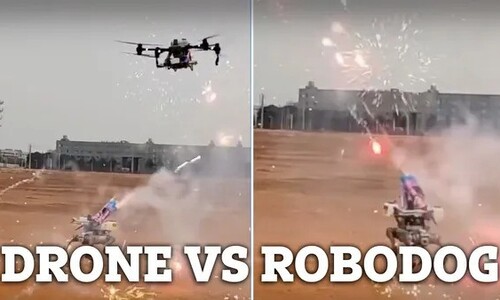
A recent viral spectacle featuring a drone and a robotic quadruped—each armed with fireworks—battling in a dazzling display has sparked curiosity about the future of robotic warfare.
While the showdown was meant for entertainment, it hints at a more serious reality: the growing role of autonomous machines in modern combat. As drones and robotic quadrupeds continue to evolve, the question arises—what happens when these advanced war machines face off on the battlefield?
Drones in Modern Warfare
Drones have become indispensable assets in military operations, providing a range of functionalities from surveillance to direct combat engagement. Their versatility and effectiveness have been demonstrated in various recent conflicts.
Recent Examples of Drone Utilization in Warfare
Ukraine Conflict (2022-Present): Both Ukrainian and Russian forces have extensively employed drones for reconnaissance and offensive operations. Ukrainian forces have adapted consumer drones to drop grenades or carry mortar shells, as well as to surveil enemy troops and direct artillery fire.
Nagorno-Karabakh Conflict (2020): Azerbaijan leveraged drones to gain a strategic advantage over Armenian forces. The deployment of drone technology in this conflict demonstrated the rapid advancement of unmanned aerial systems. First-person view (FPV) drones have emerged as a particularly cost-effective solution, operating effectively in areas with sophisticated air defense systems.
Middle East Operations (2024): The U.S. Army has sent at least one robot dog armed with an AI-enabled gun turret to the Middle East for testing as a fresh counter-drone capability for U.S. service members.
Types of Military Drones and Their Capabilities
Military drones are categorized based on their size, range, and functionality:
Micro and Mini Drones: These small UAVs are primarily used for short-range reconnaissance missions. Their compact size allows for easy deployment and operation in confined spaces.
Tactical Drones: Medium-sized drones designed for intelligence, surveillance, and reconnaissance (ISR) missions. They offer extended flight times and can be equipped with various sensors to gather real-time battlefield data.
Strategic Drones: Large UAVs capable of long-endurance flights at high altitudes. They are used for broad-area surveillance and can be armed for precision strikes.
Loitering Munitions (Kamikaze Drones): Designed to loiter in the airspace until a target is identified, after which they engage by self-destructing on the target. This capability allows for high-precision attacks with minimal collateral damage.
Emergence of Robotic Quadrupeds in Military Applications
Parallel to the rise of drones, quadrupedal robots, colloquially known as "robot dogs," have been developed for various military purposes. These machines offer unique advantages due to their mobility and adaptability.
Recent Developments in Robotic Quadrupeds
China's Rifle-Toting Robot Dogs (2024): China's military showcased a robot dog equipped with an automatic rifle mounted on its back, turning the machine into a potential combat asset.
U.S. Military Testing Armed Robot Dogs (2024): The U.S. Army deployed robot dogs armed with AI-enabled gun turrets to the Middle East for testing as a counter-drone measure, highlighting the integration of robotics and artificial intelligence in modern combat scenarios.
Ukraine's Use of Robot Dogs (2024): Ukrainian forces have utilized robot dogs primarily for scouting and reconnaissance purposes, leveraging their mobility to navigate challenging terrains and gather intelligence.
Capabilities of Robotic Quadrupeds in Warfare
Robotic quadrupeds are designed to navigate complex environments that may be challenging for wheeled or tracked robots. Their capabilities include:
Surveillance and Reconnaissance: Equipped with cameras and sensors, they can gather real-time intelligence without exposing human soldiers to danger.
Logistics Support: Capable of carrying supplies, ammunition, or equipment across difficult terrains, thereby reducing the physical burden on soldiers.
Combat Engagement: When armed, they can engage targets directly, providing a mobile and adaptable firepower platform.
Convergence of Drone and Robotic Quadruped Technologies
The integration of drones and robotic quadrupeds represents a significant evolution in military technology. The recent viral fireworks battle between a drone and a robot dog, though theatrical, highlights the potential for autonomous or semi-autonomous machines to engage in combat with one another. As these technologies advance, real-world scenarios where robotic warfare pits ground-based and aerial systems against each other seem increasingly plausible.
Potential Outcomes of Machine-on-Machine Warfare
As both drones and robotic quadrupeds become more advanced and prevalent on the battlefield, scenarios where these machines confront each other are becoming increasingly plausible. The outcome of such engagements would depend on various factors:
Mobility: Drones possess aerial mobility, allowing them to cover large areas quickly and access vantage points. Robotic quadrupeds, on the other hand, excel in ground mobility, navigating complex terrains that may be inaccessible to wheeled or tracked vehicles.
Armament: The type and sophistication of weapons mounted on these platforms would significantly influence the engagement's outcome. Drones can be equipped with precision-guided munitions, while robotic quadrupeds can carry firearms or other direct-energy weapons.
Autonomy and AI: The level of autonomy and the sophistication of artificial intelligence guiding these machines would play a crucial role in determining their effectiveness in combat.
Who Would Win? Drone vs. Robot Dog
In a direct confrontation between a combat drone and an armed robotic quadruped, the victor would largely depend on the specific battlefield conditions and the capabilities of each machine. However, if we break it down into key tactical advantages, drones likely have the upper hand in most engagements.
Why Drones Would Likely Win
Superior Mobility – Drones operate in three-dimensional space, allowing them to evade ground-based fire, reposition rapidly, and strike from unexpected angles. A robot dog, constrained to land, would struggle to counter an aerial assault effectively.
Precision Strikes – Combat drones can be equipped with precision-guided munitions, long-range weaponry, or even kamikaze capabilities, allowing them to eliminate a target before the robot dog can engage.
Speed and Agility – Even if the quadruped is nimble, a drone’s ability to dart in and out of combat zones quickly gives it a decisive advantage.
When the Robot Dog Might Prevail
Urban or Enclosed Environments – In tight spaces where a drone’s maneuverability is restricted (such as dense forests, buildings, or tunnels), a robotic quadruped could use cover to its advantage and potentially ambush an approaching drone.
Electronic Warfare – If the robotic dog is equipped with jamming or anti-drone technology (such as directed-energy weapons or counter-UAV systems), it could disable or neutralize an incoming drone before being attacked.
Final Verdict
In an open battlefield, the drone is the likely winner due to its speed, aerial maneuverability, and precision-strike capability. However, in environments where drones have limited space to operate or are vulnerable to electronic countermeasures, the robot dog might stand a chance—especially if outfitted with the right defensive and offensive technologies.
Ultimately, the future of machine-on-machine warfare will not just be about one platform versus another, but about how they are integrated into broader military strategies, shaping the next era of automated warfare.