
Pay Attention When The Global Elites Practice For A 'Cyber Pandemic'
 By Patrice Lewis/WND News Center April 04, 2025
Share this article:
The COVID pandemic was, by many peoples' argument, an entirely manufactured crisis. While the disease was serious, the global response was completely over the top.
"Every major element of the official COVID narrative has been proven false: The origins of the virus, the validity of PCR tests, the suppression of early treatments, the denial of natural immunity, the so-called 'safety and effectiveness' of vaccines, and the utility of masks, lockdowns, and vaccine passports. Yet those who questioned any part of it faced unprecedented ostracism and persecution," notes this article.
"The manufactured panic ignored fundamental reality: COVID posed minimal risk to healthy people under 70, but was significantly more dangerous to the elderly and immuno-compromised. Rather than focusing resources on protecting vulnerable populations, we destroyed economies, stole childhoods, and enforced measures that made no epidemiological sense. This wasn't just about control - it was an engineered economic coup, the largest financial consolidation of power in modern history."
The old expression "follow the money" is very apt when looking back at the whole dumpster-fire of 2020 and its aftermath.
In retrospect, many speculate we were warned about the COVID pandemic long before it hit: "Just months before COVID, the Johns Hopkins Center for Health Security in partnership with the World Economic Forum and the Bill and Melinda Gates Foundation hosted Event 201, a high-level pandemic exercise on October 18, 2019, in New York, N.Y.," reports the same article. "An examination of the event reveals that the priority of the exercise centered not on treatment protocols or protecting the vulnerable but rather on how information control could be used to manufacture mass compliance.
Because this drill later became reality, many are now paying grim attention whenever the global elites decide to run another "exercise."
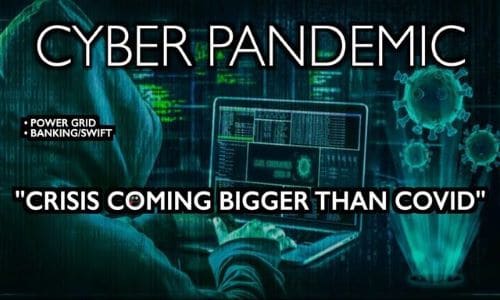
Recently, political commentator Candace Owens released a short video entitled "The WEF Is Running Drills on the Power Grid Going Down."
"What would you do," she says, "if they brought the power grid down? And by 'they,' I mean if the government purposefully brought the power grid down. I'm not asking that question for fun; I'm asking that question because the World Economic Forum is predicting that a cyber-pandemic ... is inevitable. ... First and foremost, the only reason I'm paying attention to the World Economic Forum and their exercises is because they notoriously, in 2019, ran an exercise for a coronavirus pandemic that - oddly - all became true. ...
It was the World Economic Forum in collaboration with the Bill and Melinda Gates Foundation in collaboration with Johns Hopkins University. ... They said the coronavirus is inevitable, and boom! It happened the very next year. ... They made the prediction, they called it inevitable, and then it happened. Immediately. ...
"So that signals to me that I should probably pay attention the next time the World Economic Forum makes a prediction and calls it inevitable. And low and behold, they are predicting that a cyber-pandemic is going to happen, and that it is once again 'inevitable.'
If you look into the exercise that they'll run this year - I believe they'll run it in July - essentially their idea is that they're going to have to 'sanitize' the internet, because a bug - think of it as a 'coronavirus' for your computer - is going to sweep globally, and they only way they're going to be able to stop this bug from infecting everything is to effectively shut down the internet. And they were talking about bringing down the power grid in order to do this."
Think about the repercussions of losing the power grid. It astounds me - absolutely flabbergasts me - how few people understand what life would be like without electricity. It seems too many people are flippant or dismissive of the potential hardships. Most have the attitude of, "We'd go back to the 1800s. Big deal. People lived just fine in the 1800s."
But without power, we wouldn't regress to the 1800s; we would regress to the 1100s or earlier. Life would become a bitter, brutal struggle for survival.
Society thrived in the 1800s for four very simple reasons: 1) a non-electric infrastructure already existed; 2) people had the skills, knowledge, and tools to make do; 3) our population levels were far lower, and most people lived rural and raised a significant portion of their own food; and 4) there were relatively few people who didn't earn their way. To be blunt, if you didn't work, you seldom ate. Those who couldn't work (the disabled, the elderly, etc.) were cared for by family members or charitable institutions. There were no other options.
These conditions no longer exist. Homes do not come equipped with outhouses, hand water pumps and a trained horse stabled in the back. Many people don't have the faintest clue how to cook from scratch, much less grow or raise their own food. Eighty percent of Americans live in cities and are fed by less than 2% of the population, which means farmers must mass-produce food for shipments to urban areas. Additionally, the interconnectivity that exists in today's society is complex beyond belief. It's been proven again and again that a single weak link can bring down the whole chain.
And yet some people claim that a grid-down situation will be a minor oopsy-daisy inconvenience. They think that because they line-dry their clothes and have a few tomatoes on their patio, that they'll be able to survive a situation in which ALL services cease. They think food production and distribution is somehow independent of fuel and electricity. In fact, it's intimately connected. Ever try to till a 3,500-acre wheat field by horse-drawn plow? Shut off power and you shut off food. Period.
It's true that we already possess the know-how for technological and medical advances. We know how to treat or cure illness and injury. We know how to provide electrical power. We know how to make engines. Therefore it will be easy to rebuild America's infrastructure in the event of a grid-down situation, right?
Wrong. While we DO possess the knowledge, what we would lack is the infrastructure to rebuild the infrastructure. We would lack the stop-gap services that would allow engineers and manufacturers to rebuild society without facing starvation first. And if the people with the specialized knowledge to rebuild die off in the interim before the infrastructure gets rebuilt, then where will we be? It's estimated that 90% of Americans would die in the aftermath of a grid-down situation: they're not capable of surviving.
For these reasons and more, it behooves us to take this cyber-pandemic "exercise" by the WEF seriously.
Originally published at WND News Center