
Delaying The Inevitable? Trump Called Off Planned Israeli Strike On Iran
 By David Isaac/JNS.org April 18, 2025
Share this article:
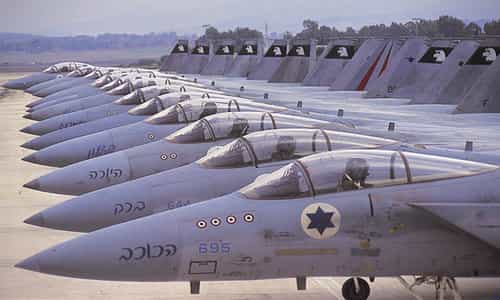
Israel intended to strike Iran's nuclear facilities as early as May, a plan that would have required American assistance. But U.S. President Donald Trump decided against an attack in favor of negotiations, The New York Times reported on Wednesday.
Trump's decision came "after months of internal debate" about whether to pursue a military or diplomatic option. Even hawkish members of Trump's cabinet expressed skepticism that a military strike could destroy Iran's nuclear ambitions, resulting in a "rough consensus" that for the time being negotiation was the better option, the Times reported.
The Times said it had spoken to multiple officials who had been briefed on Israel's plans. Most were interviewed on condition of anonymity.
Israel, which has long been preparing for an attack on Iran, with or without U.S. help, sees the current situation as favorable to a strike on Iran's nuclear sites.
Israel's air force has already eliminated most of Iran's air defenses and has severely damaged Iran's proxy Hezbollah in Lebanon. The fall of Syrian President Bashar al-Assad in December eliminated a key Iranian ally that acted as a conduit for Iranian arms to Hezbollah.
According to the Times, senior Israeli officials pitched a plan to their American counterparts that would have combined an Israeli commando raid on underground Iranian nuclear sites with a bombing effort that would have involved U.S. aircraft.
The goal was to set back Iran's ability to develop a nuclear weapon by a year or more.
However, Israel's military said the commando operation wouldn't be ready until October. As Netanyahu wanted the timeline for an attack sped up, Israeli planners shifted to a proposal for an extended bombing campaign, necessitating U.S. support, the paper reported.
U.S. officials were open to considering Israel's plans. U.S. Gen. Michael E. Kurilla, head of U.S. Central Command, and National Security Adviser Michael Waltz discussed how the United States might support such an attack, according to the Times.
U.S. assistance would have focused on responding to Iranian retaliation against Israel and ensuring the attack itself was successful. (U.S. forces assisted Israel in intercepting Iranian missile attacks in April and October of last year.)
Iran's attacks were ineffective, with most of its missiles and drones failing to reach their targets. Israel's counterattacks against Tehran's anti-aircraft systems left the country naked to attack, something Israel wants to capitalize on, the Times said.
However, during a meeting with Netanyahu in the Oval Office on April 7, Trump announced that he would pursue talks with Iran.
The Israeli prime minister, in a video released by his office the next day, said an agreement would work only if Iran agreed to completely dismantle its nuclear facilities.
"They go in, blow up the installations, dismantle all of the equipment under American supervision and carried out by America--this would be good," he said.
He warned that Iran may try to play for time. "The second possibility--that will not be--is that they drag out the talks, and then there is the military option. Everyone understands this. We spoke about this at length," he said, referring to his discussions with the U.S. president.
Trump agreed on this point, telling the press on Wednesday that he wouldn't allow talks to drag on. "We have a little time, but we don't have much time," he said.
The president also didn't rule out a military option, stating that it "absolutely" remains an option. "With Iran, if it requires military, we're going to have military. Israel will obviously be very much involved in that and be the leader in that," he said.
Trump has signaled readiness to directly attack Iran before.
On March 17, he accused Iran of orchestrating attacks by Yemen's Houthi rebels and warned that any further aggression from the group would result in severe retaliation.
"Let nobody be fooled! The hundreds of attacks being made by Houthi, the sinister mobsters and thugs based in Yemen, who are hated by the Yemeni people, all emanate from, and are created by, IRAN," Trump wrote in a post on Truth Social.
The United States has moved significant military assets into the region, including the USS Carl Vinson and USS Harry S. Truman.
Last month, the United States sent multiple B-2 bombers to a military base on the island of Diego Garcia in the Indian Ocean.
With a range of 6,900 miles, the B-2 is the only stealth aircraft that can carry the GBU-57, a 30,000-pound "bunker-buster" bomb known as the Massive Ordnance Penetrator.
Originally published at JNS.org