
The Rise Of The Mosquito Drone: Warfare Just Got Personal
 By PNW Staff June 28, 2025
Share this article:
When most people think of drones, they imagine the large, missile-laden aircraft patrolling the skies over Ukraine or buzzing across the Middle East. These massive, high-altitude sentinels--like the American MQ-9 Reaper or the Israeli Hermes 900--have become symbols of modern warfare: remote, precise, and often deadly. But a far more disturbing revolution in drone technology is now taking shape--not in the skies, but in our homes, offices, and even pockets.
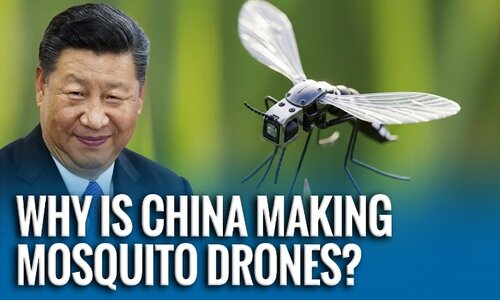
China recently unveiled a mosquito-sized drone so small it could rest on a fingernail. It looks terrifyingly similar to the real insect: spindly legs, tiny wings, and a dark body. But this is no harmless bug. This is a covert surveillance device engineered to spy, track, and possibly assassinate. Welcome to the age of miniaturized warfare.
A Shrinking Threat
Early drone technology was massive. The U.S. military's first drones in the 1990s, like the RQ-1 Predator, were over 27 feet long with a wingspan of 55 feet. Designed for long-endurance surveillance and targeted strikes, they dominated open-air battlefields. But their size made them easy to spot--and impossible to use in civilian or indoor spaces.
Fast-forward three decades, and engineers are creating drones the size of hummingbirds, dragonflies, and now mosquitoes. China's new robo-sting device is perhaps the most chilling to date. It is so small and silent, it could fly into a living room unnoticed, eavesdrop on private conversations, and exit without a trace. The implications for espionage, intelligence gathering, and state surveillance are staggering.
Insect Drones Aren't Science Fiction Anymore
China isn't the only country pushing this boundary. The U.S. Defense Advanced Research Projects Agency (DARPA) has long been developing "micro air vehicles" (MAVs) that mimic insects. One prototype from Harvard's Wyss Institute, called the RoboBee, weighs less than a paperclip and flaps its wings 120 times per second. Researchers have explored swarming behaviors, suggesting future drones may fly in coordinated flocks--overwhelming defenses by sheer volume.
Israel has also been experimenting with micro drones for urban combat, intelligence, and anti-terror missions. Some models are equipped with tiny cameras, microphones, and facial recognition software. In theory, a swarm of such devices could be released into a hostile neighborhood and identify targets within minutes.
But these insect-like drones aren't limited to surveillance. As their sophistication grows, so do concerns about weaponization. Could a micro drone carry a tiny dose of poison or explosives to assassinate a political target? It's not far-fetched. In fact, military analysts have coined the term "murder drones" to describe weaponized UAVs that operate autonomously.
From Battlefields to Living Rooms
The dangers posed by micro drones go beyond wartime scenarios. These devices could be used by authoritarian regimes to suppress dissent, track political opponents, or spy on journalists. Imagine living in a world where any insect buzzing near your window might be a spy--or worse. The line between civilian and combat zones would disappear. Privacy, already under assault by digital surveillance, could be annihilated altogether.
Sam Bresnick, a fellow at Georgetown's Center for Security and Emerging Technology, warns, "These drones could be used to track individuals or listen in on conversations." And with AI integration, they might not even need a human operator to decide who to follow or what data to capture.
An Urgent Need for Regulation
As the miniaturization of drone technology accelerates, the world faces an urgent ethical and legislative crisis. Current international laws governing drones were written for conventional UAVs, not insect-sized assassins. Without clear global norms, the risk of abuse is immense.
Governments must act swiftly to set boundaries for drone deployment--especially in civilian environments. Transparency, accountability, and strict limitations on their use in peacetime must be established before the technology becomes too widespread to control.
A Buzzing Warning
The future of drones is not just about the skies--it's about your kitchen, your office, your bedroom. If drone warfare once meant faceless attacks from 10,000 feet, the next phase could mean silent invasions by something that fits in the palm of your hand.
Today it's a mosquito-shaped drone in China. Tomorrow, it could be one hovering inches from your ear.
The age of invisible war has begun. And we're not ready.