The Transgender Pulpit Is Already Here: Pastor Announces Change During Sermon
 By PNW Staff December 05, 2025
Share this article:
There are moments in church history that feel less like milestones and more like warnings. What took place last Sunday at the North Chili United Methodist Church in Upstate New York was not simply a pastor "coming out." It was the tragic culmination of a denomination long drifting from its biblical anchor--and finally crossing the line into open celebration of self-identity over God's design.
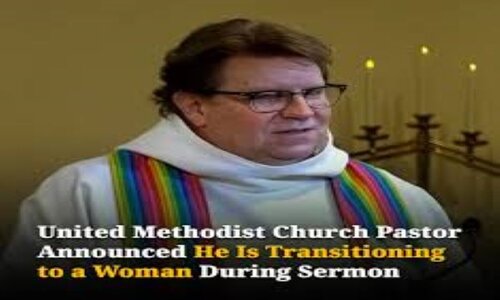
Rev. Phillip Phaneuf, a 51-year-old Methodist pastor, stepped into the pulpit wearing rainbow stoles, stripped of the beard he once displayed proudly on the United Methodist website, and announced to the stunned congregation that he was "transitioning" and would now present himself as a woman named "Phillippa." He spoke of "creative transformation," invoked the Holy Spirit as the engine behind his gender self-reinvention, and warned the congregation about the "fear of the unknown."
But the only unknown here is how much further the denomination can fall.
Because the truth is simple: when a church abandons Scripture as its final authority, there is no bottom. Anything becomes permissible, defendable, and even blessable--so long as it is cloaked in spiritual vocabulary.
A Pastor's Sunday Spectacle
Phaneuf's sermon was not a pastoral confession or even a theological argument. It was a spectacle--a carefully staged rollout of his new identity, complete with makeup, earrings, a wig, and assurances that he wouldn't be the "pronoun police."
He told the church they could still call him "Phil." He announced himself "asexual." He proclaimed that boys' and girls' clothes don't exist. And he insisted that Methodist theology, scripture, his district superintendent, and his bishop all approved of his transition.
He even told the congregation that his parents had rejected his lifestyle, saying they had "chosen their convictions and beliefs over supporting their child."
But in a Christian worldview, this is not rejection--it is love.
Parents do not love their children by affirming anything and everything they choose to become. They love by holding fast to what is true, even when it breaks their hearts. True parental love is not blind endorsement; it is sacrificial fidelity to God's design for their child, even when the culture demands compliance. A mother or father can fully love their child while refusing to cheer them toward spiritual danger. Standing for truth does not cancel compassion--it protects it.
In another context, the remarks would sound like a theater monologue. But this was a pulpit--once a sacred place, now turned into a platform for self-expression rather than self-denial.
The tragedy is not just what Phaneuf did on Sunday. The deeper tragedy is that within the modern United Methodist Church, this announcement was not shocking. It was predictable.
A Denomination That Paved the Road
For decades, the UMC has tolerated and later embraced the sexual revolution, until it grew into full-fledged advocacy. When the 2024 General Conference officially removed the denomination's 40-year ban on non-straight clergy and lifted its prohibition on same-sex weddings, the writing on the wall could not have been clearer.
Once the church blesses what Scripture forbids, it can no longer define sin. And once sin is undefined, holiness becomes impossible.
The same denomination that once debated whether scripture should be authoritative now debates whether biology should be. And in that vacuum of truth, whatever the culture champions becomes the new orthodoxy.
The liberalization was not a slippery slope--it was an escalator, moving steadily downward:
Church leaders openly rejecting biblical sexual ethics
Clergy blessing same-sex unions
Districts installing openly LGBT clergy
Bishops endorsing gender ideology
Committees rewriting doctrine to avoid "harm"
The Methodist church didn't stumble into this moment. It walked into it with eyes wide open.
A Wider Crisis of Authority
Phaneuf's claim that "the scriptures" support his transition reveals the core problem. Once Scripture is reinterpreted through the lens of personal identity, it becomes nothing more than a mirror reflecting ourselves.
This is not love. It is spiritual malpractice.
When pastors proclaim that God designed them to reject the body He created, they preach a different gospel--a gospel of self-creation. But Christianity has always proclaimed something very different:
We are not the potter. We are the clay.
The crisis facing the Methodist church is not primarily about sexuality or gender. It is about authority. Whose voice defines truth--God's or our own?
For thousands of congregations that have already left the UMC, the answer was clear. For the denominational hierarchy that celebrated Phaneuf's transition, the answer is tragically obvious.
A Warning to the Church in America
What happened in North Chili is not an isolated aberration. It is a cautionary tale for every denomination, every congregation, and every Christian who believes compromise will buy cultural peace.
When you trade the Bible for the applause of the age, you will eventually lose both.
The Methodist church once led great revivals, ignited missionary movements, and shaped American Christianity. Today, it stands as a sobering reminder: no amount of good history can save a church that abandons biblical authority.
But there is hope--for individuals, for congregations, and for nations that return to the Word of God.
Because while denominations may falter, the gospel never does.