Trump's Board Of Peace Explained: Many Layers, One Huge Risk For Israel
 By PNW Staff January 19, 2026
Share this article:
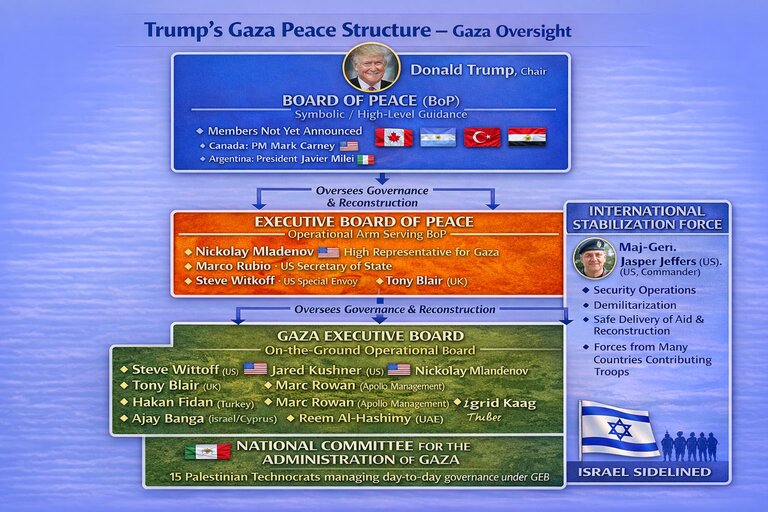
President Donald Trump's Gaza peace initiative has entered a complex new phase, with multiple overlapping boards and committees designed to oversee governance, reconstruction, and security in the Strip. While Trump chairs the symbolic Board of Peace (BoP), operational authority is divided among a formally announced Executive Board of Peace, the Gaza Executive Board (GEB), and the local technocratic government, the National Committee for the Administration of Gaza (NCAG).
The structure is intricate, but understanding the hierarchy is critical to assessing its implications--particularly for Israel, which is effectively sidelined in decisions over Gaza.
Board of Peace (BoP) - Symbolic / Umbrella Body
Trump chairs the BoP, which provides overarching strategic guidance for Gaza's postwar governance. This board is largely symbolic, intended to lend legitimacy and oversight to the US-led peace plan. Its official membership has not yet been fully revealed, but multiple world leaders have hinted acceptance, including Canadian Prime Minister Mark Carney, Argentina's President Javier Milei, Turkey's President Recep Tayyip Erdoğan, and Egypt's President Abdel Fattah al-Sisi.
The BoP is meant to supervise the overall peace initiative, providing high-level direction while leaving day-to-day execution to subordinate boards. According to the White House, BoP will oversee diplomacy, infrastructure, development, and economic strategy across Gaza. Participation reportedly comes with a $1 billion buy-in, signaling the high stakes of influence within this symbolic body.
Executive Board of Peace - Operational Arm Serving BoP
Beneath the BoP sits the Executive Board of Peace, a formally announced operational body that executes the strategic directives of BoP. Its members include:
Nickolay Mladenov – High Representative for Gaza
Marco Rubio – United States Secretary of State
Steve Witkoff – United States Special Envoy to the Middle East
Jared Kushner – Donald Trump's son-in-law
Tony Blair – Former Prime Minister of the United Kingdom
Marc Rowan – CEO of Apollo Global Management
Ajay Banga – President of the World Bank
Robert Gabriel Jr. – American political advisor
This board functions as the executive engine for the BoP, overseeing portfolios critical to Gaza's stabilization, investment, reconstruction, and international coordination. Unlike BoP, the Executive Board of Peace is fully operational, managing the flow of decisions and linking strategic guidance with local governance.
Gaza Executive Board (GEB) - On-the-Ground Operational Board
The Gaza Executive Board is distinct from the Executive Board of Peace. This board operates on the ground in Gaza and manages day-to-day governance, reconstruction, and service delivery. Its members overlap with the Executive Board of Peace but include key international figures from countries historically critical of Israel:
Steve Witkoff – United States Special Envoy to the Middle East
Jared Kushner – Donald Trump's son-in-law
Hakan Fidan – Turkey's Minister of Foreign Affairs
Ali Al Thawadi – Qatar's Minister for Strategic Affairs
Hassan Rashad – Director of Egypt's General Intelligence Directorate
Tony Blair – Former Prime Minister of the United Kingdom
Marc Rowan – CEO of Apollo Global Management
Reem Al-Hashimy – Minister of State for International Cooperation of the United Arab Emirates
Nickolay Mladenov – High Representative for Gaza
Yakir Gabay – Businessperson
Sigrid Kaag – United Nations' Special Coordinator for the Middle East Peace Process
The GEB works directly with the NCAG, coordinating reconstruction, service delivery, and stabilization programs across Gaza. It effectively bridges the High Representative's office and local governance structures.
National Committee for the Administration of Gaza (NCAG) - Local Palestinian Technocrats
At the base of the hierarchy sits the NCAG, a technocratic body led by Dr. Ali Shaath, a seasoned Palestinian administrator. The NCAG includes 15 members (one woman) with clear portfolios: trade, economy, telecom, agriculture, health, education, finance, water, municipal affairs, women's affairs, land, judiciary, and security.
The NCAG is intended to manage Gaza's day-to-day operations once Hamas is rolled back, providing expertise in governance and service delivery. It functions under the guidance of the GEB and the High Representative, making it a critical but subordinate component of the governance framework.
International Stabilization Force (ISF) and Civil-Military Coordination Center (CMCC)
Security in Gaza is managed by the ISF, commanded by Maj.-Gen. Jasper Jeffers (US), responsible for demilitarization and safe delivery of aid. The CMCC, based in Kiryat Gat, Israel, coordinates humanitarian aid with over 50 countries, the IDF, US Central Command, and NGOs. Both entities operate in support of GEB and NCAG, ensuring stability during reconstruction.
Implications for Israel
This structure places Israel at a disadvantage. Countries historically critical of Israel, particularly Turkey and Qatar, have direct influence over Gaza's operational governance through the GEB. The Executive Board of Peace, acting on BoP directives, also includes international members with influence over reconstruction and investment priorities.
Historically, UN agencies such as UNRWA have faced infiltration and operational challenges, raising concerns that international oversight could create similar risks. Israel's strategic control over Gaza is effectively minimized, while foreign actors gain authority over governance, security, and humanitarian aid.
Prophetic Perspective
From a biblical standpoint, these developments echo warnings in Scripture about the nations aligning against Israel. Zechariah 12:3 states: "All the nations of the earth will come against Jerusalem." The layered governance structure of BoP, Executive Board of Peace, GEB, NCAG, ISF, and CMCC illustrates how modern geopolitical structures can formalize international pressure against Israel.
While the initiative is framed as a peace and reconstruction effort, the combination of symbolic, operational, and local boards ensures Israel has limited input, leaving it largely on the sidelines of decisions that directly affect its security and interests.