
War By Instinct: China Is Teaching AI Weapons To Think Like Animals
 By PNW Staff January 26, 2026
Share this article:
In the next great arms race, the battlefield may not be dominated by generals or even by human soldiers, but by algorithms trained to hunt like hawks, scatter like doves, and stalk like wolves.
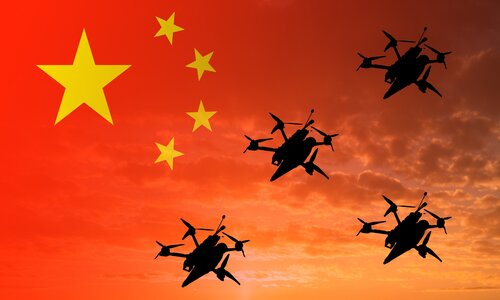
China's rapid advancement in AI-controlled weapons--particularly drone swarms modeled on animal behavior--signals a profound shift in how wars may be fought, decided, and justified in the decades ahead.
At the center of this transformation is a striking idea: nature, refined by millions of years of survival, may offer better combat lessons than any human war college. Engineers at Beihang University, one of China's elite military-linked institutions, recently demonstrated this approach by training defensive drones to attack like hawks selecting vulnerable prey, while offensive drones learned evasive maneuvers inspired by doves.
In simulated five-on-five combat, the result was decisive--the "hawks" eliminated all opponents in just over five seconds. The work earned a patent in 2024 and joined hundreds of similar filings tied to China's push for swarm intelligence.
Chinese military theorists now openly describe future warfare as "algorithm-driven," with unmanned systems serving as the primary fighting force and swarm operations as the dominant mode of combat. In their telling, artificial intelligence will be as revolutionary as gunpowder--another Chinese invention that reshaped warfare globally. The difference this time is that Beijing intends not to lose the advantage.
The strategy plays directly to China's strengths. Chinese factories already produce more than 80 percent of the world's small drones, churning out inexpensive hardware at a scale the United States cannot match. While the U.S. builds drones in the tens of thousands, often at high cost, China can manufacture millions. When paired with AI capable of coordinating large numbers of autonomous systems, that industrial edge becomes a strategic weapon in itself.
State media footage has showcased systems like "Swarm 1," a truck-mounted launcher capable of releasing dozens of drones at once, potentially scaling into coordinated swarms of hundreds. China has also tested a massive "mothership" drone designed to deploy aerial swarms mid-flight and paraded weaponized robot dogs--described as "robot wolves"--with plans to link ground-based packs to aerial formations. The vision is one of total integration: air, land, and algorithm moving as a single organism.
Animal behavior is central to this effort. Chinese researchers have studied ants, sheep, coyotes, whales, hawks, and even fruit flies to improve how autonomous systems collaborate, perceive their environment, and react under pressure. The appeal is obvious. Animals operate without centralized command, adapt quickly to threats, and function effectively even when communication is limited--exactly the conditions of a modern electronic warfare environment where signals are jammed and human operators are cut off.
That lesson has been reinforced by the war in Ukraine, where drones increasingly must operate autonomously because remote control is unreliable. For the People's Liberation Army (PLA), this reality strengthens the case for machines that can identify targets, coordinate attacks, and make tactical decisions with minimal human input.
But this technological leap also intersects with a deeper political reality inside China's military. Beijing has long expressed concern about the competence and initiative of its commanders, a worry encapsulated in President Xi Jinping's repeated warnings about the PLA's "five incapables." In a rigid, top-down system that discourages independent decision-making, AI offers a seductive solution: replace human judgment with engineered certainty. Swarms do not hesitate. They do not disobey. They execute.
The risks, however, are enormous.
Autonomous weapons systems remain fragile, dependent on perception systems that still struggle to reliably understand complex environments. Even experts acknowledge that today's drones often lack accurate awareness of each other's positions, relying on radio communication that is easily disrupted. Advanced AI can mitigate some of these weaknesses, but it introduces others--opaque decision-making, unpredictable behavior, and the ever-present possibility of catastrophic error.
More troubling is the moral and political fog such systems create. If an AI-controlled swarm commits a deadly mistake, who is responsible? Chinese military thinkers themselves have warned that the "algorithmic black box" could become a convenient excuse for leaders to evade accountability. In a future conflict, atrocities may be blamed not on commanders or governments, but on flawed code.
The implications for global stability are stark. In a potential conflict over Taiwan, analysts envision Chinese drone swarms saturating airspace, overwhelming defenses, and hunting targets continuously with relentless efficiency. Such capabilities could compress decision-making timelines, increase the temptation for preemptive strikes, and make escalation harder to control.
Calls for international rules governing AI weapons are growing, but progress remains slow. Both China and the United States appear unwilling to limit a technology whose full battlefield potential is still unfolding. As one retired PLA colonel candidly admitted, the consequences of military AI have yet to be fully discovered.
That uncertainty may be the most dangerous feature of all. When warfare is shaped by instincts borrowed from nature but executed by machines, conflict risks becoming faster, colder, and more detached from human restraint. The age of war by instinct is approaching--and the world may not be ready for what hunts next.