The Collapse Of Legacy Media And The Rise Of Alternative Voices
 By PNW Staff February 17, 2026
Share this article:
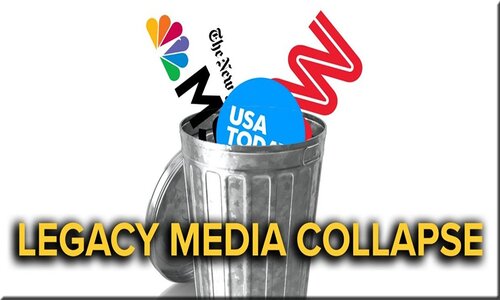
The ground beneath America's information empire is shaking--and this time, the tremor isn't coming from politicians, corporations, or foreign adversaries. It's coming from the public itself. Trust, once the lifeblood of journalism, is draining at a historic pace.
A new survey from the Pew Research Center shows that 57% of Americans now have little or no confidence that journalists act in the public's best interests. Even more striking, just 6% say they have a great deal of confidence. Numbers like these are not merely statistics; they are warning sirens echoing across a crumbling media landscape.
For decades, legacy media institutions held an almost sacred place in American civic life. Anchors were trusted voices. Newspapers were arbiters of truth. But the long arc of public opinion tells a different story. According to Gallup, trust in mass media has plummeted from roughly 70% in 1972 to just 28% today. That is not a dip--it is a collapse. Over fifty years, confidence has fallen by 42 percentage points, a generational unraveling of credibility. When belief disappears, authority soon follows.
The consequences are now visible in newsroom payrolls. Declining readership and digital disruption have hollowed out once-dominant institutions. Online traffic to the top 100 newspapers has dropped 45% in just four years. The impact is no longer theoretical. The The Washington Post recently laid off more than 300 journalists--about 30% of its workforce. NBC News and other major outlets have also slashed staff. These are not routine cost-cutting measures; they are structural contractions of an industry fighting for survival.
Critics of legacy media argue that these layoffs represent the last gasp of a fading empire--proof that audiences are abandoning traditional gatekeepers in favor of faster, rawer, and more independent sources of information. And there is truth to that claim.
The rise of alternative media has reshaped the modern information battlefield. Podcasts, livestream commentators, independent journalists, and social platforms now deliver news in real time, often from the scene itself. They are unfiltered, blunt, and frequently politically incorrect. For audiences weary of scripted talking points and perceived bias, that authenticity feels refreshing--even liberating.
Alternative media's greatest strength is speed and proximity. A citizen with a phone can broadcast breaking news before a satellite truck even starts its engine. A niche analyst can dissect policy within minutes of its release. A whistleblower can reach millions without asking permission from an editor. In an age of instant communication, this decentralized model feels aligned with reality itself: messy, unscripted, and immediate.
But revolutions, especially information revolutions, carry hidden dangers.
The same openness that allows truth to travel freely also allows falsehood to spread unchecked. When anyone can publish, expertise becomes harder to distinguish from confidence. The result is an environment where viral credibility can outweigh factual accuracy. Some alternative voices are courageous truth-tellers. Others are opportunists chasing clicks, influence, or ideology. Without careful discernment, audiences risk replacing one flawed authority with another--only this time without editorial safeguards or professional accountability.
This is the paradox of our moment. Americans distrust traditional media because they believe it is biased or agenda-driven. Yet many turn to alternative sources that may have even fewer standards, less verification, and stronger personal agendas. Trust has not disappeared; it has simply migrated--from institutions to individuals. And individuals, unlike institutions, can vanish, pivot, or mislead without consequence.
The real lesson is not that legacy media is evil or that alternative media is heroic. It is that credibility must be earned, not assumed. Blind trust--whether placed in a famous anchor or a viral commentator--is always dangerous. Information shapes perception. Perception shapes belief. Belief shapes action. Whoever controls what enters our minds holds quiet influence over our decisions, our convictions, and ultimately our society.
Legacy media's decline is real, measurable, and accelerating. But its collapse does not automatically guarantee a wiser public. A fragmented media world can either empower citizens--or confuse them. The difference depends on whether audiences become passive consumers or active evaluators of what they hear.
The age of automatic trust is over. What replaces it will define the next era of public discourse. If we learn to question wisely, verify patiently, and think critically, the media revolution could strengthen democracy. But if we simply trade one unquestioned voice for another, we may discover too late that the loudest microphone is not always the truest one.