
Beaming Defense: Israel’s Laser Weapon Redefines Air Defense Economics
 By PNW Staff March 14, 2026
Share this article:
In a conflict increasingly defined by missile salvos, drone swarms, and relentless asymmetric aerial assaults, Israel has quietly fielded a weapon long believed the stuff of science fiction: a high‑energy laser air defense system that is now operational in the field.
Known as Israel's "Iron Beam," this directed‑energy weapon has already seen combat use -- successfully engaging and shooting down drones and short‑range aerial threats -- and represents a strategic shift in how modern warfare is waged and financed.
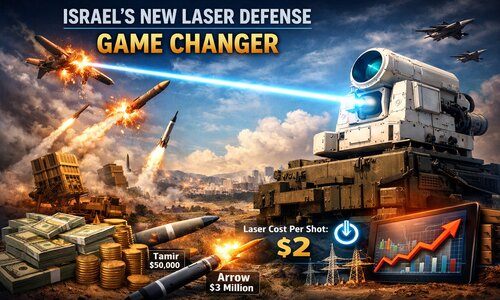
Unlike traditional missile interceptors -- such as the Iron Dome's Tamir missiles or medium‑range Stunner and Arrow interceptors -- which are costly to produce and fire, the Iron Beam operates by focusing a concentrated laser beam on an incoming target, heating it until structural failure occurs. Though limitations remain, particularly in adverse weather conditions and against long‑range ballistic missiles, its performance to date is already reshaping the calculus of air defense economics.
The Economic Imbalance of Missile Defense
For decades, Israel's layered air defense network -- Iron Dome, David's Sling, and the Arrow systems -- has been a cornerstone of national security. They have proven effective in stopping rockets, missiles, and drones launched by hostile actors such as Hezbollah and Iranian proxies, but at a staggering cost.
Analysis of past conflicts shows that Israel's interception efforts against Iranian drones and missiles can easily run into hundreds of millions of dollars in a single barrage, just in interceptor costs and supporting air operations.
To put this in perspective:
A Tamir interceptor missile fired by Iron Dome can cost on the order of tens of thousands of dollars per shot.
Medium‑range interceptors like Stunner missiles may cost around $700,000 or more each.
Arrow interceptors, designed to counter long‑range ballistic threats, can exceed tens of millions per shot.
In contrast, laser systems like Iron Beam are reported to cost only a few dollars per interception, essentially the cost of the electricity needed to fire the beam -- a fraction of a percent of what missiles cost. Even accounting for operational overhead, this disparity is dramatic: potentially a thousand‑to‑one cost advantage in favor of directed‑energy defenses.
This matters because attackers often have the economic advantage. Iran and its allied militias can deploy cheap drones and rockets that cost thousands of dollars or less, forcing Israel to respond with interceptors that cost tens -- or hundreds -- of thousands of dollars each. The result is a negative cost exchange: every $10,000 projectile from the adversary could cost Israel $100,000 or more to neutralize. The Iron Beam flips that math.
Real‑World Performance and Limitations
Over the past week, as war escalates along Israel's northern border with Hezbollah and against Iranian‑aligned forces, multiple reports confirm that Israel has actively used laser systems to counter incoming drones and rockets. Although not all details are publicly released due to operational security, Israeli defense sources have stated that the system has successfully downed scores of small aerial threats.
Yet, the technology is not omnipotent. Recent news analysis acknowledges that lasers are still limited by environmental conditions -- rain, dust, or smoke can degrade effectiveness -- and that they remain primarily a short‑range solution compared with conventional missile systems. Some analysts note that Hezbollah drone swarms have penetrated laser defense coverage, exposing the need for continued refinement and broader deployment.
For now, Iron Beam complements -- rather than replaces -- existing defenses. It is particularly well‑suited to engage drones, low‑flyers, and short‑range projectiles that would otherwise eat into Israel's supply of expensive interceptors.
Strategic and Economic Implications
The arrival of operational laser defenses comes at a pivotal moment, as the broader Middle East conflict sees escalating exchanges with Iran's missile and drone arsenal. Economists and defense strategists alike recognize that cheap, scalable directed‑energy systems could become a global standard for countering aerial threats. Nations from Europe to the United States are watching closely, with several allied militaries expressing interest in similar technology.
Domestically, the shift could ease the financial burden on Israel's defense budget and reduce reliance on foreign aid for interceptors, freeing up funds for other military needs or domestic investment. More broadly, it could alter how future wars are funded -- and fought -- when attackers no longer hold the cost advantage.
But the rollout will take time. Expanding coverage, enhancing power outputs to engage longer‑range threats, and refining targeting software are ongoing efforts that may take years to perfect. Yet even in its nascent phase, the Iron Beam's performance and economics point to a transformational moment in modern defense strategy.
A Beam of Strategic Hope
The operational deployment of Israel's laser defense system -- now proven in live combat -- marks one of the most consequential developments in air defense in decades. Economically unbalancing the attacker‑defender dynamic, it offers a glimpse of a future where wars are won not just by firepower, but by smarter, cheaper, and faster shields of light.
Israel's foes now face a stark reality: the era of costly missile defenses dominating the battlefield economy may be ending -- replaced by beams of light that promise security and sustainability for years to come.