Peter Thiel Brings Antichrist Lectures To Rome - Where Is The Church?
 By PNW Staff March 14, 2026
Share this article:
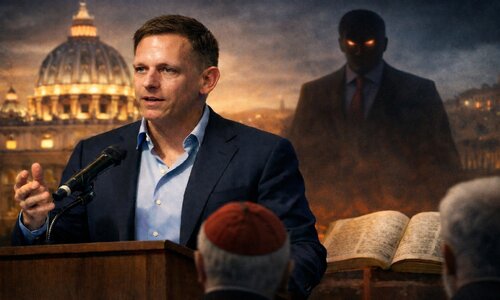
One of the most talked-about events in Rome's intellectual circles this month is the arrival of Silicon Valley billionaire Peter Thiel, delivering his controversial lecture series on the Antichrist. Following a successful run in San Francisco, Thiel has brought his exploration of one of Christianity's most enigmatic and feared figures to the heart of Catholic Europe. The lectures, running from Sunday through Wednesday, have sparked both curiosity and criticism, as Catholic universities and organizations have quickly distanced themselves from any official endorsement.
Thiel is no stranger to controversy. Co-founder of PayPal and Palantir Technologies, the data-mining firm assisting U.S. immigration enforcement, Thiel has long been a figure at the intersection of technology, politics, and culture. He was an early supporter of Vice President JD Vance and has cultivated a public persona that blends libertarian politics, technological futurism, and philosophical curiosity.
Among the topics that draw him most is the Antichrist -- the prophesied figure in Scripture who opposes Christ -- and the broader narrative of Armageddon. In a November essay for the Catholic magazine First Things, Thiel pondered the perennial questions: "Who is the Antichrist? When will he arrive? What will he preach?"
A Fascination That Draws Crowds
Thiel's lecture series first premiered in San Francisco last September to packed halls and fervent attention from tech and intellectual circles. Attendees were drawn not just by the sensational topic but also by Thiel's unique approach: combining theology, literature, philosophy, and contemporary politics with insights from historical thinkers like René Girard, Francis Bacon, Jonathan Swift, Carl Schmitt, and John Henry Newman. One promotional note from San Francisco promised discussions "anchored on science and technology" yet steeped in theological and historical reflection.
The Rome iteration follows the same blueprint. Though organized independently by the Vincenzo Gioberti Cultural Association and the Cluny Institute at the Catholic University of America, it retains the invitation-only format and a focus on deep intellectual engagement. The lectures are expected to touch on the Antichrist's role in human history, the moral and technological dangers of the modern age, and the implications of global political shifts.
Thiel and the Antichrist: Biblical Accuracy or Modern Curiosity?
While Thiel's interest in the Antichrist is intense, it raises questions about alignment with Biblical teaching. Scripturally, the Antichrist is a figure who will deny Christ, oppose God's law, and lead many astray in the end times (1 John 2:18, 2 Thessalonians 2:3-4, Revelation 13). Thiel's concerns about deception, moral decay, and the rise of global powers that act against Christian values resonate with Biblical warnings.
Yet there is an irony that Thiel, an openly gay man whose personal life does not conform to traditional Biblical teaching, has become a public promoter of understanding the Antichrist. Some critics argue this tension underscores the need for discernment: the messenger may not always model the moral clarity of the message.
Adding to the contemporary relevance, speculation about the Antichrist has surged worldwide. In certain Shiite Muslim circles, former President Donald Trump has been the subject of conjecture as a potential end-times figure. For Christians, such speculation underscores the importance of understanding Scripture rather than relying on rumor or political projection.
Catholic vs. Evangelical Perspectives
Thiel's decision to lecture in Rome is particularly intriguing given the Catholic understanding of the Antichrist. Catholic theology views the Antichrist as both a present and future reality, often emphasizing a more symbolic and spiritual interpretation. Some Catholic scholars see the Antichrist not necessarily as one literal person but as a manifestation of systemic evil and opposition to Christ throughout history.
Evangelical and Protestant traditions, in contrast, generally emphasize a literal, end-times figure whose arrival is imminent and whose actions will be dramatic and unmistakable. According to Revelation 13 and 2 Thessalonians 2, the Antichrist will consolidate political and economic power, perform signs and wonders, and deceive many with persuasive lies. Evangelicals also stress the importance of prophecy and Scripture as a guide to recognizing this figure when he appears.
Key Biblical characteristics of the Antichrist include:
Denial of Christ and opposition to God (1 John 2:22)
Deception of the masses (Matthew 24:24)
Political and economic control (Revelation 13:7-8)
Blasphemy and self-exaltation (2 Thessalonians 2:4)
By these standards, the evangelical lens emphasizes vigilance, scriptural literacy, and a personal faith anchored in Christ as the antidote to deception.
Understanding the Times
The timing of Thiel's lectures may be more than coincidental. Global unrest, political polarization, and religious speculation have created fertile ground for interest in end-times prophecy. While Thiel's approach is unorthodox and sometimes ironic given his personal life, it underscores a broader point: Christians must study Scripture diligently to discern truth from conjecture. The Antichrist, according to the Bible, will seek to deceive, and only by knowing God's Word can believers recognize the signs and remain steadfast.
In a world increasingly dominated by technology, globalist politics, and cultural shifts, the lessons of Thiel's lectures -- whether fully aligned with Scripture or not -- serve as a reminder: the battle between good and evil is not merely theoretical. Awareness, discernment, and knowledge of God's Word remain the essential defense against deception. The arrival of the Antichrist, whether near or distant, is a clarion call for Christians to be vigilant, grounded, and spiritually prepared.
Equally important is the role of churches and pastors in this conversation. The teaching of end-times prophecy is not just a niche topic for intellectuals or commentators -- it is a vital aspect of biblical instruction. Christian leaders must courageously speak up, guide their congregations with scriptural truth, and ensure that the narrative of the Antichrist and the last days is taught according to the Bible rather than being shaped primarily by outsiders, political figures, or sensational speculation.
When the platform is left open to popular voices with their own agendas, believers risk confusion and deception; faithful shepherds have a duty to illuminate the path with God's Word. In light of today's current events people are hungry and looking for answers. Will the church answer the call?
Recommended resource for further study on the Antichrist and the End Time: