
A Church Chasing Relevance Has Lost Its Reason To Exist
 By PNW Staff March 28, 2026
Share this article:
The installation of Sarah Mullally as Archbishop of Canterbury was supposed to project dignity, history, and hope. Instead, it exposed, once again, just how far the Church of England has drifted from biblical Christianity -- and why so many believers now view the institution less as a church and more as a fading religious bureaucracy desperately trying to keep up with the age.
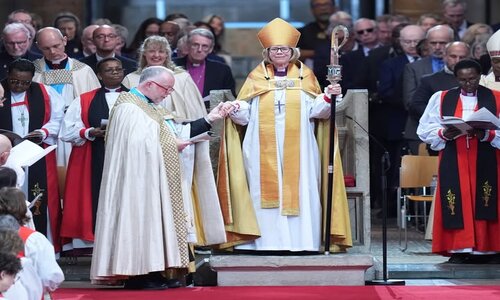
Sarah Mullally became the 106th Archbishop of Canterbury and the first woman ever to hold the office, in a ceremony staged with all the grandeur of Anglican tradition and all the theological confusion of modern liberal Protestantism.
That contradiction lies at the heart of the problem. The Church of England still dresses itself in the robes of historic Christianity, still speaks in the language of apostolic continuity, still places its leaders in ancient chairs and surrounds them with centuries-old ritual -- yet increasingly empties those symbols of their original meaning. It wants the authority of tradition while simultaneously rejecting the authority that tradition was supposed to preserve: the Word of God.
Dame Sarah Mullally's supporters will frame this as a triumph of progress, inclusion, and "representation." That is precisely the issue. In Scripture, the Church is never told to organise itself around representation politics or cultural symbolism. It is told to order itself according to God's revealed will. For many Bible-believing Christians, this installation was not a breakthrough but a public declaration that the Church of England now believes cultural validation matters more than biblical fidelity.
And if anyone doubted the direction of travel, the ceremony itself made it unmistakably clear.
Reports from the service noted a carefully choreographed display of multicultural and ecumenical inclusivity: prayers in Urdu, music in Xhosa, and broad gestures toward the Church's global and interfaith-facing identity. Even a Bible reading was delivered by the Roman Catholic Archbishop of Westminster, while Mullally wore the episcopal ring once given to Michael Ramsey by Pope Paul VI -- a deeply symbolic gesture for anyone who understands the theological fault lines of the Reformation.
To some, those details will seem harmless, even beautiful. But to many evangelicals and Protestants who still care about doctrinal clarity, they signal something far more troubling: a church more interested in theatrical unity and institutional image than in truth. Biblical unity is not built on shared ceremonies, symbolic accessories, or carefully managed optics. It is built on shared submission to the truth of God. When a church begins to confuse pageantry with faithfulness, decline is not far behind.
Then there was the ceremony's internal symbolism -- arguably even more revealing than its ecumenical flourishes.
A particularly striking feature of the day was the prominent role played by the Dean of Canterbury, the Very Rev. David Monteith, who formally helped lead the cathedral proceedings surrounding the archbishop's transition and installation. Canterbury Cathedral itself has openly noted his senior role in the cathedral's governance and ceremonial life, and it was Monteith who previously oversaw the formal election process that moved Mullally toward this office.
Why does that matter? Because Monteith's own appointment was controversial among orthodox Anglicans precisely because he is in a same-sex civil partnership, something publicly acknowledged by Canterbury Cathedral at the time of his appointment.
That fact should not be mentioned as a cheap personal jab, but it is profoundly relevant to the theological symbolism of the moment. For conservative Christians, the ceremony was not merely about a woman being installed as Archbishop of Canterbury. It was also another visible reminder that the Church of England's senior leadership culture has become increasingly detached from historic Christian sexual ethics and increasingly comfortable showcasing that detachment at the very center of Anglican life.
That is why so many believers no longer see these events as isolated controversies. They see a pattern.
A female archbishop. A cathedral establishment comfortable elevating leaders in same-sex partnerships. An institution that has spent years bending over backward to signal modernity while simultaneously collapsing in moral authority. This is not about one personality or one ceremony. It is about a church hierarchy that appears far more concerned with elite approval than with repentance, holiness, and the proclamation of the Gospel.
And while all of this was unfolding, the shadow of scandal still hung over the day.
Mullally's inaugural message included solemn words about abuse, victims, and the Church's failures -- words that, in themselves, were necessary and right. She spoke of truth, compassion, justice, and action. But those phrases now land in a church environment where trust has already been badly shattered. Her predecessor, Justin Welby, resigned under heavy criticism over his handling of abuse-related failures, and Mullally now inherits an institution still deeply damaged by its safeguarding crisis.
That is another reason why the triumphalism surrounding this installation rings hollow. The Church of England is not in a season that calls for self-congratulation. It is in a season that calls for sackcloth and ashes. It does not need another carefully branded "historic first." It needs repentance, courage, and a willingness to stop lying to itself about why it has become so spiritually anemic.
And that brings us to the larger issue: relevance.
The modern Church of England elite keeps behaving as if the great crisis of our age is that Christianity might appear too narrow, too traditional, too doctrinal, too male, too old, too Western, or too certain. So it keeps remodeling itself to look more palatable to a post-Christian culture. But that strategy has failed for decades. It has not produced renewal. It has produced collapse.
Britain is not starving for a more fashionable church. Britain is starving for truth.
Young people are not ultimately searching for a more curated liturgy or a more "inclusive" ecclesiastical brand. They are asking the deepest questions human beings can ask: Why am I here? What is truth? What is wrong with the world? Is there judgment? Is there forgiveness? Is there hope beyond death? The answer to those questions will never be found in institutional reinvention. They will only be found in Jesus Christ and the unchanging authority of His Word.
That is why this ceremony felt so empty to so many Christians watching from the outside. It had grandeur, symbolism, and history. But it lacked the one thing that could have made it matter: unmistakable submission to Christ above the spirit of the age.
If the Church of England truly wanted to be relevant, it would stop chasing relevance.
It would preach repentance instead of self-expression. Holiness instead of accommodation. Obedience instead of aspiration. Christ instead of cultural applause.
Until then, ceremonies like this will continue to make headlines -- and continue to prove just how spiritually irrelevant the Anglican establishment has become.