'American Idol' And Songs Of Faith
 By PNW Staff April 04, 2026
Share this article:
There was something undeniably striking about hearing the name of Jesus proclaimed so boldly on the popular TV show American Idol.
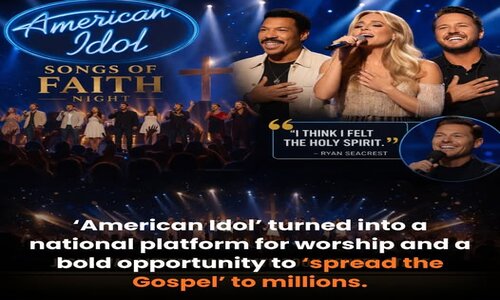
On a stage built to create stars, where dreams of fame, applause, and celebrity often take center stage, Monday night's "Songs of Faith" episode offered a very different sound. It was worshipful. It was emotional. At moments, it seemed to break through the usual polished machinery of entertainment and point, however briefly, to something far greater than fame.
And that matters.
Because for all the concerns Christians may rightly have about Hollywood, celebrity culture, and the spiritual dangers that often accompany both, we should not be too cynical to recognize a genuine moment when the name of Christ is lifted before millions.
That does not mean we abandon discernment. It does mean we should not despise what God may choose to use.
There is an irony in all of this that is hard to miss. The very title American Idol carries a tension Christians should not ignore. It is, of course, a play on words. The show is about singing and competition, not literal worship. And yet in a culture obsessed with platform, influence, image, and personal elevation, "idol" is not just a clever brand name -- it can become a spiritual warning.
Scripture has always cautioned humanity about the temptation to exalt created things above the Creator. In our time, one of the most common idols is celebrity itself. We idolize fame. We idolize visibility. We idolize talent. We idolize approval. And in many cases, people are not simply trying to steward a gift -- they are chasing a spotlight powerful enough to consume them.
That is why Christians should approach a night like this with both gratitude and sobriety.
Gratitude, because it was genuinely refreshing to hear songs like Nothing But the Blood of Jesus, Gratitude, I Can Only Imagine, and At the Cross sung on national television without embarrassment or apology. In a media environment where biblical conviction is often marginalized or mocked, there was something quietly powerful about seeing contestants, judges, and even audience members visibly moved by lyrics centered on God's mercy, faithfulness, and saving grace. American Idol, host Ryan Seacrest even stated he felt the Holy Spirit moving in the studio, describing the atmosphere as a "full-on worship service".
For many viewers, this was not just another themed performance night. It was a reminder.
A reminder that there is still power in the old hymns.
A reminder that gospel truth still resonates, even in places where we may least expect it.
A reminder that behind the smoke, lights, and celebrity machinery of modern entertainment, there are still human hearts hungry for something real.
And perhaps most encouraging of all, this night was not merely about vague spirituality. The name of Jesus was actually spoken. Not hidden behind generic references to "faith." Not diluted into empty inspiration. Jesus was named. Worship songs were sung. Prayer was offered. Testimonies were shared. In an age when so much public religion is carefully softened to avoid offense, that kind of clarity is no small thing.
Christians should be thankful for that.
We should also recognize that God has often used unexpected platforms to stir spiritual curiosity in people who might never step into a church. A teenager flipping channels. A discouraged adult sitting alone after work. A family watching together ahead of Easter. It is not hard to imagine someone hearing one of those songs and feeling something awaken -- a memory of childhood faith, a question they have been suppressing, a longing they cannot quite explain.
And that is where this moment becomes most important.
Because singing about God is not the same thing as knowing Him.
Feeling moved by worship music is not the same thing as being born again.
Admiring Jesus-themed performances is not the same thing as surrendering your life to Christ.
That is the caution Christians should carry into moments like this. We can celebrate the beauty of faith-filled music without confusing emotional resonance for spiritual transformation. America has long had a fascination with Christian imagery, Christian language, and Christian music -- while often remaining spiritually distant from the Christ those things proclaim.
That danger is real not only for viewers, but for performers too.
Some of those contestants may indeed be sincere believers. Some clearly gave heartfelt testimony about what God has done in their lives. That should be received with charity and encouragement, not suspicion. But the entertainment industry is also a place where authenticity can be pressured, commodified, and eventually swallowed by ambition.
That is why young believers pursuing music or public platforms need to hear this clearly: there is nothing wrong with using your gift, but there is grave danger in building your identity on being seen.
Fame is a cruel master. It promises affirmation but often produces emptiness. It can make a person famous to millions while leaving them spiritually unknown to the God who made them.
And yet, even there, God can still work.
That may be the most hopeful takeaway from this unusual night on American Idol. Even in a place associated more with stardom than sanctification, the Gospel still found its way onto the stage. Even in a culture trained to glorify self, there were moments that pointed upward instead. Even in an industry not known for exalting Christ, His name was heard.
That should move us to prayer more than critique.
Prayer that those who sang about Jesus would truly walk with Him.
Prayer that those who heard these songs would not stop at inspiration, but press into truth.
Prayer that what began as a television theme night might become, for some, the beginning of a real spiritual hunger.
Because the goal is not merely that America would sing songs of faith.
The goal is that hearts would be awakened to the God those songs are about -- and that many would come not just to admire Jesus from a stage, but to know Him personally as Savior, Lord, and King.
For one night at least, American Idol did not just celebrate voices.
It gave millions of people a reason to listen for eternity.