The Debate Over "Just War"
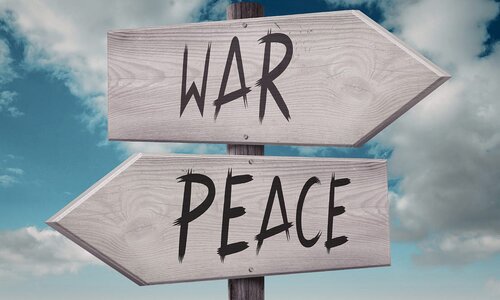 By Stephen Flatow/JNS.org April 23, 2026
Share this article:
The latest clash between Pope Leo XIV and U.S. President Donald Trump follows a familiar script: A religious leader warns against the moral dangers of war, and a political figure responds with characteristic bluntness, if not outright derision.
This is not a new dynamic. From Pope John Paul II's opposition to the Iraq War, to Pope Francis's clashes with Trump during his first term, religious leaders have often warned against the moral dangers of conflict--only to be brushed aside or openly challenged by political leaders focused on security and power.
But beneath the predictable exchange lies a far more serious question--one that neither side seems willing to confront with precision:
What, exactly, is a "just war"?
Pope Leo, echoing a long tradition of Catholic teaching, has expressed deep skepticism that modern conflicts--particularly, those involving Iran and Israel--can meet the moral threshold required to justify war. Trump, for his part, dismissed the critique in typically offhand fashion, reducing a complex moral framework to something closer to a punchline.
One leans heavily on moral caution. The other brushes it aside. Neither approach is sufficient.
The concept of "just war" traces back to thinkers like St. Augustine and St. Thomas Aquinas, who sought to impose moral limits on the use of force. Their framework was demanding: A just war must have a legitimate cause; be declared by proper authority; be fought as a last resort; and be conducted with proportionality and discrimination.
By those standards, "just war" is not a slogan. It is a burden.
Yet in modern discourse, it is too often treated as a rhetorical device--invoked to oppose war in the abstract or to justify it in the moment, but rarely applied with rigor.
Even those arguing for military action are not always making the case clearly. A recent Wall Street Journal editorial argued that there are "excellent reasons" to take military action against Iran--citing the regime's record of repression, terrorism and regional aggression--yet faulted Trump for failing to articulate a sustained case to the American public.
That gap matters. If a war is to be justified--not only strategically, but morally--it cannot rest on instinct, impulse or implication. It requires explanation. It requires standards. It requires a framework the public can understand and evaluate.
The Christian tradition is not alone in grappling with these questions. And here, the conversation becomes more pointed.
Jewish law approaches the issue differently. Rather than asking whether war can ever be "just," it distinguishes between wars that are discretionary and those that are obligatory. A war of self-defense--a milchemet mitzvah--is not merely permitted, but required.
That distinction shifts the moral burden. The question is no longer simply whether force can be justified, but whether failing to act in the face of mortal danger constitutes a moral failure of its own.
This is not theoretical. It has shaped the thinking of Israeli leaders across generations. Figures like Israeli premiers Golda Meir and Benjamin Netanyahu have long argued that when a nation faces enemies openly committed to its destruction, the duty to defend its citizens is not optional.
And that brings us back to the present.
When a state confronts adversaries--whether terrorist organizations or state sponsors like Iran--who openly declare their intention to destroy it, the luxury of abstraction disappears. The debate over "just war" is no longer philosophical. It becomes existential.
Does a nation have the right to defend its citizens from annihilation?
If the answer is no, then the doctrine of "just war" collapses into a form of pacifism that few would accept when confronted with real danger. If the answer is yes, then we must acknowledge an uncomfortable truth: Some wars, however tragic, are not only justified. They are necessary.
That does not make them clean. It does not remove their moral cost. It does not absolve those who wage them of responsibility.
But it does mean that restraint, in certain circumstances, is not a virtue. It is a failure.
This is where the current debate falls short. Pope Leo gestures toward a moral ideal without fully confronting the realities that make war unavoidable. Meanwhile, Trump dismisses moral scrutiny without offering any coherent standard of his own.
One offers principle without application. The other offers instinct without principle.
Both miss the harder truth.
The real test of moral seriousness is not whether one can denounce war in the abstract or defend it in the heat of the moment. It is whether one can recognize the moment when the defense of innocent life is no longer a choice, but an obligation.
That is the clarity Jewish law provides--and one too often absent from contemporary debate. Because when moral language is reduced to a talking point, it ceases to restrain power. But when it is stripped of the willingness to act, it ceases to defend life.
And a moral framework that cannot defend life is not moral at all.
Originally published at JNS.org