
Buried Beneath the Mountains: Are We Closer Than Ever to Finding Noah’s Ark?
 By PNW Staff April 23, 2026
Share this article:
For centuries, skeptics have dismissed the account of Noah's Ark as allegory--an ancient story meant to convey moral truth rather than historical reality. But today, high in the rugged terrain of eastern Mount Ararat, a growing body of evidence is once again challenging that assumption. What was once the domain of speculation is now being probed by ground-penetrating radar, soil chemistry, and emerging technology. And the results, while still debated, are difficult to ignore.
At the center of renewed interest is the so-called Durupinar formation, a boat-shaped geological structure first identified in 1959. For decades, it has fascinated researchers due to its striking resemblance to the vessel described in the Book of Genesis. Now, new findings reported by outlets like the New York Post and GB News suggest that what lies beneath the surface may be far more than a natural curiosity.
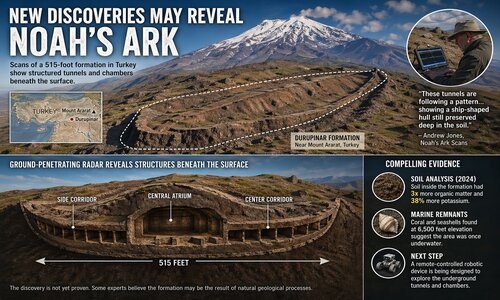
According to researcher Andrew Jones, recent scans using ground-penetrating radar have revealed what appear to be structured voids beneath the formation--corridor-like tunnels running along the interior and a larger central chamber resembling an atrium. These are not random anomalies, he argues, but patterns that suggest intentional design.
The dimensions are also striking. The formation measures close to 515 feet in length--remarkably consistent with the Ark's biblical description of 300 cubits. For proponents, this alignment is more than coincidence; it is confirmation that the ancient text may have preserved a real-world blueprint.
But perhaps even more intriguing are the soil findings. In 2024, researchers collected dozens of samples from inside and outside the formation. The results showed that soil within the "ship-shaped" boundary contained significantly higher levels of organic material--three times as much, in fact--as well as elevated potassium levels. These chemical markers could point to the long-term decomposition of organic matter, potentially consistent with a massive wooden structure.
Even the landscape itself raises questions. At an elevation of roughly 6,500 feet, researchers have uncovered marine remnants--coral fragments and seashells--embedded in the surrounding area. For believers, this echoes the catastrophic flood described in Genesis. Critics, however, point to well-established geological explanations, such as tectonic uplift, which could have raised ancient seabeds to their current heights over millennia.
And therein lies the tension.
Because for every claim that this discovery could rewrite history, there is an equally forceful counterargument urging caution. Many geologists maintain that the Durupinar formation is a natural result of erosion, sediment layering, and tectonic forces. Similar formations, they note, can occur without human involvement. Science, after all, demands repeatable evidence and verifiable proof--not just compelling patterns.
Yet what makes this moment different is not just the evidence--but the tools. Researchers are now planning to deploy a remote-controlled robotic device capable of entering the underground cavities. If successful, it could provide the first direct visual confirmation of what lies beneath--whether it be hollow rock formations or something far more structured.
This is not the first time claims about Noah's Ark have surfaced. Over the decades, explorers have reported everything from wooden beams to large anomalies on satellite imagery in the Ararat region. Most of these claims have either been debunked or remain unverified. But each wave of discovery has pushed the conversation forward, forcing both skeptics and believers to grapple with the same question: what if there is something there?
Beyond the science, the significance of such a discovery would be profound.
If credible evidence were ever found to confirm the existence of Noah's Ark, it would not merely validate an ancient story--it would reshape the modern understanding of history, faith, and the reliability of biblical texts. For millions, it would serve as a tangible link between scripture and reality, reinforcing the idea that the Bible is not just spiritually true, but historically grounded.
At the same time, it would challenge a culture that often separates faith from fact. In an age dominated by technological certainty and scientific authority, the possibility that an ancient biblical account could be corroborated through modern methods is both disruptive and deeply compelling.
Still, caution is warranted. The leap from intriguing data to definitive proof is a large one. Structured voids are not the same as preserved wood. Chemical anomalies are not the same as identifiable artifacts. And until physical evidence can be directly observed and verified, the mystery remains just that--a mystery.
But it is a mystery that refuses to fade.
High on the slopes of Mount Ararat, beneath layers of earth and centuries of skepticism, something is there. Whether it is the fossilized remains of an ancient vessel or simply a geological coincidence shaped by time, the search itself speaks to something deeper--a human longing to connect the past with the present, and the seen with the unseen.
And perhaps that is why this story continues to capture the world's attention.
Because if Noah's Ark is ever found, it won't just answer a question. It will ignite a reckoning--between belief and doubt, science and scripture, history and faith. Until then, the mountain keeps its secret. But the evidence, slowly and steadily, is beginning to whisper.