Distorted Christian Theology Pushed With Progressive Politics
 By PNW Staff April 27, 2026
Share this article:
There is a growing and increasingly visible trend in American politics--one that goes far beyond policy debates and enters into something far more foundational: theology itself. A number of Democratic politicians and candidates are not merely expressing personal faith; they are actively reshaping Christian language and doctrine to align with modern progressive ideology.
The result is not a simple difference in interpretation, but what many orthodox Christians would recognize as a fundamental distortion of biblical teaching.
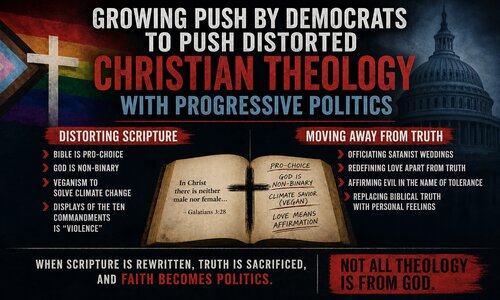
At the center of this debate is James Talarico, a Texas Democrat and self-identified progressive Christian who has built a platform around blending faith with left-wing activism. Talarico has argued that the Bible supports abortion rights, has promoted veganism as a moral imperative tied to climate change, and has even described God as "non-binary." His theological reasoning often leans on selective readings of scripture, such as his use of Galatians 3:28--"there is neither male nor female"--to support modern gender ideology.
But this interpretation is widely disputed across historic Christian teaching. The Apostle Paul's message in Galatians speaks to spiritual equality before God, not the erasure of biological or created distinctions. To reinterpret that passage as a statement about gender identity--especially when applied to the nature of God--represents a leap that many theologians argue is disconnected from both context and tradition. Christianity has consistently affirmed God as Father and Christ as Son, not as reflections of human gender fluidity but as revealed truths central to the faith.
Talarico's broader approach reflects a pattern: scripture is not treated as authoritative, but as adaptable--something to be reshaped in service of contemporary cultural priorities. Whether it is reframing biblical ethics around abortion or redefining theological language to mirror modern social movements, the concern among critics is that the faith itself becomes secondary to the political agenda.
A similar controversy surrounds Sarah Trone Garriott, a Lutheran pastor and Democratic political figure who recently recounted officiating a wedding for a Satanist couple. She described the ceremony as a meaningful spiritual experience, emphasizing the emotional connection between the individuals rather than the theological implications of the act.
For many Christians, this raises serious concerns about the role and responsibility of a pastor. Scripture, particularly in passages like 1 Corinthians 13, defines love not merely as emotional sincerity but as something that "rejoices with the truth" and "does not delight in evil."
The tension here is not about compassion toward individuals--something Christianity clearly commands--but about whether a spiritual leader can affirm or participate in what the faith traditionally considers incompatible with its teachings.
Trone Garriott's story highlights a broader shift in how some progressive leaders interpret Christian love: less as alignment with truth, and more as affirmation of personal experience. Critics argue that this redefinition risks hollowing out the moral framework that gives the concept of love its meaning in the first place.
These are not isolated cases. Figures like Raphael Warnock, a pastor who has preached sermons suggesting that repentance is not central to salvation, and Pete Buttigieg, who frequently invokes Christian language to defend positions on sexuality that diverge from traditional doctrine, further illustrate this trend. In each case, Christian terminology is retained--but often detached from its historical and theological roots.
This movement has been described by some scholars as a form of "progressive Christianity," but even that label can be misleading. Historically, Christianity has certainly engaged with social issues and adapted to cultural contexts. But adaptation has limits. When core doctrines--such as the nature of God, the authority of scripture, or the definition of sin--are reinterpreted to align with prevailing political ideologies, the faith itself begins to change in substance, not just in emphasis.
What makes this trend particularly significant is its strategic nature. By framing progressive policies in explicitly Christian terms, these politicians are not only advocating for legislation--they are attempting to reshape the moral and spiritual lens through which millions of Americans view those issues. It is a powerful rhetorical approach, especially in a nation where religious identity still carries weight.
Yet it also raises a pressing question: at what point does reinterpretation become replacement?
For many believers, the concern is not political disagreement but theological integrity. Christianity, at its core, claims to be rooted in divine revelation, not human innovation. Its teachings are meant to challenge cultures, not simply mirror them. When faith becomes a tool to justify whatever a particular political moment demands, it risks losing the very authority that makes it meaningful.
The growing intersection of progressive politics and reimagined theology is likely to remain a defining issue in the years ahead. And as more candidates step forward presenting themselves as both spiritual leaders and political advocates, voters--especially those of faith--will be forced to wrestle with a deeper question than party affiliation:
Not just what do these leaders believe--but what version of Christianity are they asking the nation to embrace?