
Palestinian Textbooks Are Fueling Next Generation Of Conflict
 By PNW Staff May 05, 2026
Share this article:
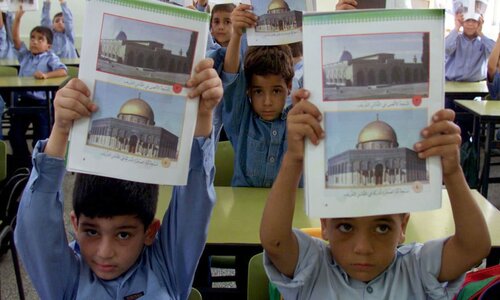
It doesn’t start on the battlefield. It starts in the classroom.
While diplomats debate ceasefires and world leaders search for a “path to peace,” something far more decisive is happening quietly, daily, and almost entirely unchecked: the shaping of the next generation’s beliefs. And right now, that shaping is helping ensure that the conflict will not end—but continue.
At the center of this problem is the Palestinian Authority’s education system.
For years, Western governments—especially in Europe—have poured billions into Palestinian institutions under one core assumption: that building schools, funding teachers, and modernizing curriculum would create a generation more open to coexistence. The theory was simple. Educate for peace, and peace becomes possible.
But that theory is colliding with a much harder reality.
Repeated reviews of Palestinian textbooks continue to show that meaningful reform hasn’t happened. Not stalled. Not delayed. Not partially implemented. Simply not done. Despite public promises, international agreements, and mounting pressure, the curriculum shaping Palestinian children today looks strikingly similar to the one used years ago.
And that matters far more than most policymakers are willing to admit.
Because education is not neutral. It never has been. What children are taught about history, identity, and their enemies doesn’t just inform their worldview—it defines it.
Imagine growing up in a system where maps erase your neighbor entirely. Where conflict is not presented as tragedy, but as destiny. Where violence is framed not as failure, but as honor. Where the “other side” is not humanized, but reduced to a permanent adversary.
That kind of education doesn’t just reflect conflict—it sustains it.
This is the uncomfortable truth many in the international community have avoided: you cannot fund peace while simultaneously funding the narratives that make peace impossible.
European officials are beginning to show signs of recognizing this contradiction. After years of warnings, there is now growing pressure to tie financial aid directly to real, measurable curriculum reform. Not symbolic edits. Not reworded passages. Actual change.
That shift is long overdue.
Because without accountability, there is no incentive to change. And without change, the cycle continues.
Children become teenagers. Teenagers become adults. And adults, shaped by years of reinforced narratives, carry those beliefs into society, politics, and—inevitably—conflict.
It becomes a loop that feeds itself.
A future built on mutual recognition requires that both sides, at a minimum, acknowledge the other’s existence and humanity. Without that foundation, every negotiation becomes hollow—because one side is being asked to make peace with something it has been taught should not exist.
That is not a diplomatic problem. It’s a generational one.
And generational problems require generational solutions.
If Western governments are serious about peace—not just managing conflict, but actually ending it—then education reform cannot remain a side issue. It must become central. Non-negotiable. Verified.
That means independent oversight. Transparent standards. And a willingness to say what has long gone unsaid: funding without reform is not neutral—it is enabling.
There are, of course, risks in taking a harder stance. Political backlash. Accusations of interference. Even the possibility of short-term instability.
But the alternative is far worse.
Because continuing on the current path guarantees something far more dangerous than instability: permanence. A conflict that doesn’t explode dramatically—but endures quietly, endlessly, passed down from one generation to the next like an inheritance no one can escape.
Peace is not just negotiated at tables. It is taught in classrooms.
And right now, those classrooms are not preparing for peace. They are preparing for continuation.
Until that changes, everything else—summits, agreements, diplomatic breakthroughs—will remain what they have too often been:
Temporary pauses in a conflict that has already been scheduled to continue.