Germany Rearms, Spain Demands EU Army: Is Europe Entering A New Strategic Era?
 By PNW Staff May 13, 2026
Share this article:
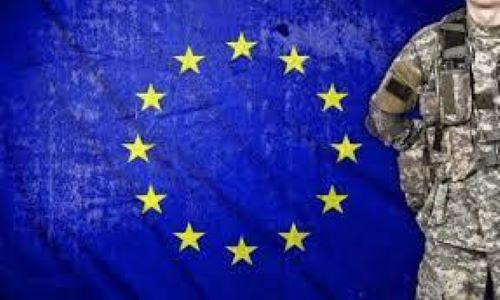
Spain's renewed push for a European Union army has reopened one of Brussels' most persistent--and unresolved--strategic debates: whether Europe can, or should, transform its economic bloc into a unified military power capable of acting independently from both NATO and the United States.
Speaking recently, Spanish Foreign Minister José Manuel Albares called for the creation of an EU army that would eventually replace reliance on NATO for core security guarantees. His argument reflects a growing unease in parts of Europe that transatlantic security can no longer be assumed, particularly with Washington's shifting priorities under Donald Trump. Madrid has even found itself directly in the political crossfire, with threats of tariffs and reduced military cooperation tied to Spain's resistance to higher defense spending targets and alignment with broader U.S. strategic positions.
Albares framed the issue in stark terms: Europe, he argued, should not wake up "wondering what the U.S. will do next." His comments capture a wider sentiment gaining traction inside the European Union--one that sees Europe as economically powerful but strategically dependent, and increasingly vulnerable to decisions made outside its control.
Over the past two decades, proposals for an EU army or a deeper "European Defense Union" have surfaced repeatedly. France has long advocated strategic autonomy, particularly under Emmanuel Macron. Germany has periodically supported stronger EU defense coordination.
Even smaller member states have backed the idea in principle after crises such as Russia's annexation of Crimea in 2014 exposed Europe's reliance on U.S. military capability. Yet despite these recurring calls, institutional progress has remained limited. The European Union still lacks unified command structures, defense procurement remains fragmented, and national militaries remain politically sensitive symbols of sovereignty.
The Ukraine war, however, has fundamentally altered the tone of the debate. Russia's invasion has forced European governments to confront the return of large-scale conventional warfare on the continent. Defense spending is rising across Europe, though unevenly, and the focus has shifted toward artillery stockpiles, air defense systems, and long-range strike capabilities that had been neglected for decades.
Nowhere is this shift more visible than in Germany. After decades of chronic underinvestment in defense, Chancellor Friedrich Merz has pledged to build Europe's "strongest conventional army." Berlin has launched a historic expansion of the Bundeswehr, targeting the recruitment of roughly 80,000 additional soldiers by 2035. Germany is also accelerating procurement of modern air defense systems, expanding cyber warfare capabilities, and investing in rapid deployment infrastructure designed to strengthen NATO's eastern flank.
This shift is not only military but psychological. For a country historically defined by post-war restraint, Germany's rearmament signals a broader European acceptance that deterrence now requires scale, industrial depth, and sustained military readiness.
Yet Europe's defense debate is driven by more than Russia alone. A growing factor is the widening divergence between European foreign policy and that of the United States. The Iran question is one example: while Washington has often pursued a more confrontational approach, several European governments have favored diplomacy and nuclear agreement frameworks. These differences have reinforced the perception in Brussels that Europe is often reactive--adjusting to U.S. decisions rather than shaping global outcomes independently.
That sense of dependency is precisely what Spain and others are now challenging. But the push for autonomy collides with a structural reality: Europe's military fragmentation. Even though 24 EU member states belong to NATO, there is still no single European command capable of replacing it. The EU does maintain a mutual defense clause--Article 42.7--but most analysts acknowledge it lacks the operational depth to function as a true deterrent against a major military power.
As a result, many European leaders continue to favor strengthening defense within NATO rather than replacing it outright. NATO provides integrated command structures, logistics, intelligence-sharing, and above all, U.S. military capacity that Europe cannot yet match. Still, political momentum toward "strategic autonomy" continues to grow, even if institutional reality lags behind rhetoric.
The Prophetic Interpretation: A Revived Roman Order
Beyond geopolitics, some observers interpret Europe's gradual integration through a theological and symbolic lens rooted in biblical prophecy. In this framework, references in the books of Daniel and Revelation are often cited as the foundation for the idea of a "revived Roman Empire."
In Daniel 2, the prophet interprets King Nebuchadnezzar's vision of a great statue composed of successive materials--gold, silver, bronze, iron, and finally iron mixed with clay. The final stage is commonly understood by prophecy scholars as a divided but enduring political order following the ancient Roman Empire. The iron is frequently associated with Rome's historical strength, while the clay symbolizes fragmentation and instability.
This imagery is expanded in Daniel 7, where a fourth beast represents a dominant empire unlike the others in strength and reach. Many interpreters identify this fourth kingdom as Rome due to its historical dominance over the Mediterranean world and its lasting institutional influence on Western civilization.
From this interpretive tradition emerges the concept of a "revived" Roman system--not a literal restoration of ancient Rome, but a modern continuation of its political and cultural legacy. Because the European continent inherited Roman legal traditions, governance structures, and geographic centrality, it is often viewed by prophecy scholars as the most plausible setting for such a continuation.
The symbolism becomes more specific in the book of Revelation, where a coalition of ten kings is described as receiving authority for a short period alongside a central governing figure often referred to as "the beast." Many interpreters link this imagery to the "ten toes" of Daniel 2's statue--iron mixed with clay--representing a final configuration of power - with some believing the mixture of clay and iron symbolizing strong and weak nations with the alliance.
Within this framework, modern European integration--particularly moves toward deeper fiscal coordination, foreign policy alignment, and potential defense integration--is sometimes seen as a reflection of this long-anticipated pattern. Not as fulfillment, but as convergence with a recurring historical structure: fragmented nations gradually bound together under a supranational system of governance.
The persistence of the "revived Roman Empire" interpretation reflects a deeper fascination with Europe's evolving identity. The European Union has consistently expanded its scope--from trade bloc to political union, and now increasingly toward strategic and defense cooperation. Each stage naturally invites renewed reflection on what kind of power structure Europe is becoming.
The central irony is that Europe may achieve the very thing it has long struggled to define: strategic independence in a fragmented global order. But whether that results in stability and balance--or the concentration of power into a system of unprecedented centralized authority--remains an open question.
For now, Spain's call for an EU army is less a finished blueprint than a symptom of a continent reassessing its place between Washington, Moscow, and its own internal ambitions. The debate is no longer theoretical. It is unfolding in real time, shaped by war, shifting alliances, and a renewed conviction in parts of Europe that the continent can no longer assume others will secure its future.