
The Taiwan Countdown Is Ticking - And America May Not Be Ready
 By PNW Staff May 18, 2026
Share this article:
After the latest Trump-Xi summit in Beijing, one warning is becoming harder to dismiss: Taiwan may no longer be a distant crisis. It may be the next great test of American power.
According to Axios, some advisers close to President Donald Trump now fear China could move against Taiwan within the next five years, after Xi Jinping used the summit to project China not as a rising power, but as America's equal -- and Taiwan as something Beijing ultimately intends to take. One adviser reportedly summarized Xi's posture bluntly: "Taiwan is mine."
That matters because Taiwan is not just another island on the map. It is the center of one of the most dangerous military, economic, and technological flashpoints in the world.
China has long claimed Taiwan as its own, while Taiwan has operated as a self-governing democracy for decades. But the language coming from Beijing has grown sharper, the military exercises more aggressive, and the timeline more alarming.
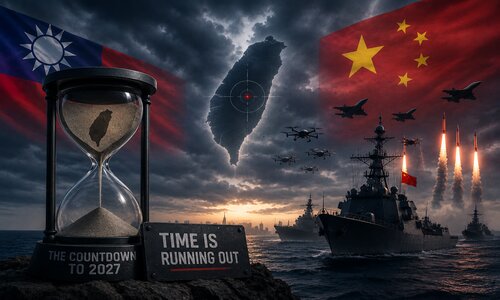
Former CIA Director William Burns said in 2023 that U.S. intelligence believed Xi had ordered the People's Liberation Army to be ready by 2027 to conduct a successful invasion of Taiwan -- while stressing that readiness does not mean a final decision has been made.
That is the key distinction. China may not have decided to invade. But it is preparing for the option.
And preparation is exactly what should concern Washington.
China's navy is already the largest in the world by number of ships, and that matters enormously in any Taiwan scenario. A fight over Taiwan would not begin as a conventional land war. It would likely begin with control of the sea and air: blockades, missile strikes, cyberattacks, drone swarms, satellite targeting, and attempts to isolate the island before America and its allies could respond.
The Pentagon's latest China military report describes how Chinese forces have already practiced encircling Taiwan, including simulated blockade operations. In 2024, China's Joint Sword exercises involved aircraft, naval vessels, and Coast Guard ships surrounding Taiwan and its outer islands. The report notes that China's Coast Guard became more integrated with PLA operations and, during one exercise, encircled Taiwan for the first time.
That is not symbolism. That is rehearsal.
China's military strategy around Taiwan is increasingly built around overwhelming pressure from multiple directions. Its missiles could target airfields, ports, command centers, and U.S. bases in the region. Its cyberwarfare units could attempt to blind Taiwan's communications and disrupt American logistics. Its satellites could help track U.S. ships and aircraft. Its drones could be used for surveillance, targeting, electronic warfare, and attacks against both military and civilian infrastructure.
This is the danger of looking at Taiwan through yesterday's lens. A future conflict may not begin with landing craft rolling onto beaches. It may begin with Taiwan's internet failing, ports being mined, power grids disrupted, drones filling the skies, and Chinese naval forces cutting off the island's lifelines.
That is why the size and reach of China's navy is so critical. Taiwan is an island. Its survival depends on access to the sea. If China can blockade Taiwan, it may not need to conquer every inch immediately. It could strangle the island economically, test America's willingness to break the blockade, and force the world into a brutal choice: risk a major-power war or watch Taiwan be slowly coerced into submission.
Then there is the semiconductor nightmare.
Taiwan is home to TSMC, the company that dominates production of the world's most advanced chips. These chips power smartphones, cars, weapons systems, artificial intelligence, data centers, and nearly every major sector of the modern economy.
The United States is trying to rebuild domestic chip manufacturing through the CHIPS Act and new facilities, including TSMC's Arizona investment, but experts warn the supply chain remains deeply dependent on Asia and still has major weak points. Harvard Business Review recently noted that even as advanced fabs rise in the U.S., America still lacks enough back-end chip packaging capacity.
That means America is trying to bring the industry home -- but slowly. China may be moving on a faster clock.
This is the central problem: Washington is trying to rebuild industrial strength on a timeline measured in years and decades. Beijing may be preparing military options on a timeline measured in months and a few short years.
If China moved against Taiwan before America had secured enough domestic chip capacity, the economic shock would be staggering. It would not simply be a military crisis. It could become a supply-chain crisis, an inflation crisis, an AI crisis, a defense-industrial crisis, and a global recession trigger all at once.
The uncomfortable question is whether America is ready.
Is the U.S. Navy large enough and positioned well enough to break a blockade? Are American missile stockpiles deep enough for a prolonged Pacific conflict? Are U.S. bases hardened against Chinese missile strikes? Is the defense industry capable of replacing weapons quickly? Are American companies prepared for a sudden loss of Taiwanese chips? Are voters prepared for what a Taiwan war would actually mean?
These are not theoretical questions anymore.
Xi's 2027 military readiness goal is approaching fast. China's navy is expanding. Its missile forces are growing. Its cyber and space capabilities are becoming central to its war planning. Its military exercises around Taiwan increasingly look like practice for the real thing.
The Beijing summit may have ended with diplomacy and ceremony. But beneath the handshakes was a colder reality: China is no longer merely talking about Taiwan as a future ambition. It is building the tools to take it.
And the clock is ticking.