
The Palestinians Don't Want Mandela, They Want Another Arafat
 By Jonathan S. Tobin/JNS.org April 25, 2017
Share this article:
Palestinian internal politics and liberal hostility to Israel came together at The New York Times this month.
The newspaper provoked a firestorm of criticism through its decision to publish an article on the eve of Passover authored by Marwan Barghouti, the imprisoned mastermind of a second intifada terror campaign, without mentioning that he is currently serving five life terms for the murder of civilians.
But a more important discussion got lost amid the outrage about media bias.
The question to be asked about this episode is not whether terrorism is significant enough to be worthy of mention, but why Barghouti is a likely candidate to succeed Mahmoud Abbas as head of the Palestinian Authority (PA).
Barghouti is currently leading a hunger strike by Palestinian security prisoners in Israel jails. But the real motive for this gesture is promoting Barghouti's desire to replace the 81-year-old Abbas.
Given that Israel has as little interest in releasing Barghouti as Abbas does in having a new election--the current PA leader is serving the 12th year of the four-year presidential term to which he was elected--it's not clear how he'll pull off that trick.
But the real issue here is the reason for Barghouti's popularity among supporters of the peace process is very different from the reason for his high standing among Palestinians.
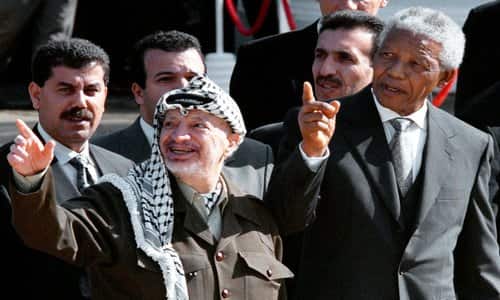
The New York Times promoted Barghouti on its pages because editors of that newspaper have bought into the notion that he is the Palestinian Nelson Mandela. While a narrative that paints Israel as an "apartheid state" is a lie, the Mandela analogy is equally false.
Mandela did support violence against the apartheid regime in South Africa, but only because all democratic and non-violent avenues to promote change were blocked.
The same point applies to comparisons between Barghouti and others who were terrorists before leading countries to independence, such as Kenya's Jomo Kenyatta, and even Israel's Menachem Begin, who commanded the pre-state Irgun Zvai Leumi underground forces before signing a peace treaty with Egypt. (The Irgun directed terror activities at the British and their facilities, not civilians as Barghouti did.)
By contrast, acting on Palestinian leader Yasser Arafat's orders, Barghouti undertook his terror rampage that contributed to a death toll of more than 1,000 Jews years after peace had supposedly been agreed upon in the Oslo Accords.
It was also an answer to former Israeli Prime Minister Ehud Barak's offer of an independent Palestinian state. Rather than an attempt to force negotiations, Barghouti's terror was part of an effort to destroy hope for peace and coexistence.
Of course, it is possible--at least in theory--for Barghouti to become the man Jewish liberals would like him to be were he ever put in power. But the problem with that exercise in wishful thinking also collides with the reason why he is so popular among Palestinians.
Part of his appeal lies in the fact that he's been in prison for the last 15 years, while the rest of his Fatah party's corrupt leadership has been running the West Bank like mafia chieftains.
Even though there's no reason to think a former Arafat aide like Barghouti will be different, like the equally corrupt and more fanatical Hamas rulers of Gaza, the current PA leadership is entirely discredited.
But Barghouti's popularity rests on more than just the fact that he isn't Abbas.
Throughout the century-long Palestinian Arab war on Zionism, the political bona fides of that movement's leaders have always rested on a resume including violence against Jews, not good government or a vision of independence and peace.
Barghouti's credentials rest solely on the fact that he is responsible for the deaths of Jewish men, women and children during the intifada.
The political culture of the Palestinians--which is reinforced by a media and an education system promoting hatred of Jews and glorifying terrorism--is what makes Barghouti look good to the Arab street, not the hope he will rise above a record of wanton slaughter.
The reason why Abbas has been incapable of making peace, even if he really is a moderate, is that he understands Palestinians see any recognition of the legitimacy of a Jewish state--no matter where its borders are drawn--as a betrayal.
The same factor argues that a man with Barghouti's record will be expected to pursue more violence rather than become a Mandela.
If the last quarter century has taught us anything, it is that the Palestinians don't want a Mandela in the person of a transformed Barghouti. What they want is another Arafat.
Originally published at JNS.org - reposted with permission.