Being Pro-Life At Google: The Case for Life Is Strong
 By John Stonestreet/Breakpoint.org July 04, 2017
Share this article:
Is it possible to argue effectively for the rights of the unborn to a secular audience? Just Google it!
Many were surprised when Tim Keller was invited to give a Google Talk back in 2008 about his book, "The Reason for God."
The tech giant, like most denizens of Silicon Valley, has a reputation for being socially progressive and devoted to a set of values that are, shall we say, different than those of conservative Christians.
By inviting him to talk to its staff, Google signaled an openness, not only to Christian ideas, but to real and healthy dialogue.
Keller was even invited to speak a second time at Google. But recently, an even more surprising Google Talk speaker than Keller visited their headquarters.
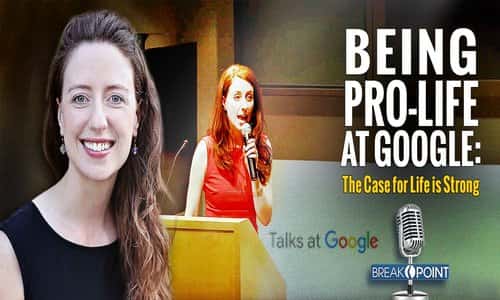
Stephanie Gray is a Canadian pro-life apologist. She travels the world making the case for the humanity and personhood of the unborn.
She's co-founder of the Canadian Centre for Bio-Ethical Reform and now leads a ministry called Love Unleashes Life.
Her talk at Google just a few days ago wasn't just unprecedented, it was amazing. In fact, within 24 hours, it surpassed the popularity of another talk by Planned Parenthood president, Cecile Richards.
Stephanie opened by comparing the story of Captain Sully Sullenberger, the man who successfully landed a disabled airliner on the Hudson River in 2009, refusing to evacuate until all his passengers were safe, with the captain of the Italian Costa Concordia ship who quickly jumped ship after it wrecked.
We rightly admire people like "Sully," Stephanie said, because of three qualities. First, their willingness to sacrifice for others, their perspective when faced with hardship, and their commitment to do the right thing, even when it means being the last one out of a sinking airplane.
But abortion flies in the face of these admirable and heroic qualities. It promises an easy way out--erasing the consequences of sex as if nothing--or no one--ever happened.
Stephanie thinks we all know better at a deep level. And she challenged her audience with story after story of women who chose life, even in the toughest of circumstances, and who don't regret it.
Like my friend, Scott Klusendorf at the Life Training Institute, Stephanie knows that the arguments about choice, bodily autonomy, financial hardship, or special cases are just distractions from the central question that matters the most: Is the unborn human?
At Google, she marshaled scientific evidence to show that our humanity and individuality are fully present from the earliest stages of gestation. She showed that an unborn baby's moral value is determined solely by the type of thing it is, not its size, level of development, environment, or degree of dependency.
And most importantly, she appealed to her audience's moral imagination, demonstrating why the others-centered love required to choose life is the kind of thing we admire, the kind of thing we know is right, and the kind of choice no one regrets.
We can learn a thing or two from Stephanie. First, the case for life is strong. Her message was one that even an overwhelmingly secular and progressive audience could understand.
She made non-religious arguments--what Chuck Colson would call prudential arguments--for the rights of the unborn.
And then she employed an arsenal of stories that reinforce life in a way philosophical reasoning by itself never could.
She even appealed to Google's corporate motto, "Do the right thing," adding: "even when it's hard."
And the second thing we can learn is that the moral realities that Christians believe aren't just true and defensible.
They're better! So many in our culture these days are wondering not only if Christian truth claims are true, but if they're good.
We can and should know how to make the case for life just like Stephanie.
Originally published at Breakpoint.org - reposted with permission.