
Saving NATO From Turkey
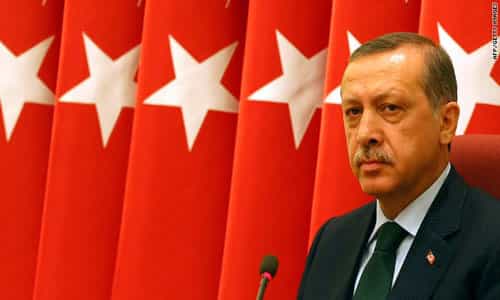 By Daniel Pipes/Algemeiner.com October 26, 2017
Share this article:
The North Atlantic Treaty Organization, known as NATO, faces an existential problem.
No -- it's not about getting member states to fulfill agreed-upon spending on defense projects, nor finding a role after the Soviet collapse, or standing up to Russia's Vladimir Putin.
Rather, it's Recep Tayyip Erdoğan, the Islamist, dictatorial ruler of Turkey whose policies threaten to undermine this unique alliance of 29 states, which has lasted nearly 70 years.
Created in 1949, NATO's founding principles ambitiously set out the alliance's goal "to safeguard the freedom, common heritage and civilization of [member states'] peoples, founded on the principles of democracy, individual liberty and the rule of law." In other words, the alliance exists to defend Western civilization.
For its first 42 years, until the USSR collapsed in 1991, this meant containing and defeating the countries of the Warsaw Pact. Today, it means containing and defeating Russia and Islamism.
Of these latter two, Islamism is the deeper and longer-lasting threat -- because it's based not on a single leader's personality but on a highly potent ideology, one that effectively succeeded fascism and communism as the great radical utopian challenge to the West.
Some major figures in NATO appreciated this shift soon after the Soviet collapse. Already in 1995, Secretary-General Willy Claes noted with prescience that, "fundamentalism is at least as dangerous as communism was." With the Cold War over, he said, "Islamic militancy has emerged as perhaps the single gravest threat to the NATO alliance and to Western security."
In 2004, José María Aznar, Spain's former prime minister, warned that "Islamist terrorism is a new shared threat of a global nature that places the very existence of NATO's members at risk." He advocated that NATO focus on combating "Islamic jihadism and the proliferation of weapons of mass destruction," and called for "placing the war against Islamic jihadism at the center of the Allied strategy."
But, instead of a robust NATO leading the battle against Islamism, it was internally hobbled by Erdoğan's opposition. Rather than assert the fight against Islamism, the other 28 members of NATO dismayingly deferred to the Islamist within their ranks.
The 28 stay countries mum about the near-civil war that the Turkish regime waged in southeastern Anatolia against its own Kurdish citizens -- and the emergence of a private army (called SADAT) under Erdoğan's exclusive control seemed not to bother them.
Likewise, they also appear oblivious to Ankara's unpredictably limiting access to the NATO base at Incirlik; obstructed relations with friendly states such as Austria, Cyprus and Israel; and the vicious anti-Americanism symbolized by the mayor of Ankara hoping for more storm damage to be inflicted on the United States.
Similarly, Turkish mistreatment of citizens in other NATO countries goes unchallenged -- not the arrest of 12 Germans in Turkey, (such as Deniz Yücel and Peter Steudtner) nor the attempted assassination of Turks in Germany (such as Yüksel Koç).
This also applies to the seizure of Americans in Turkey as hostages (such as Andrew Brunson and Serkan Gölge), and repeated physical violence against Americans in the United States (such as at the Brookings Institute and at Sheridan Circle).
NATO seems unfazed that Ankara helps Iran's nuclear program, develops Iranian oil fields and transfers Iranian arms to Hezbollah. Erdoğan's talk of joining the Moscow-Beijing dominated Shanghai Cooperation Organisation ruffles few feathers, as do joint exercises with the Russian and Chinese militaries.
A Turkish purchase of a Russian missile defense system, the S-400, appears to be more an irritant than a deal-breaker. A mutual US-Turkish ban on visas fazed no one.
NATO faces a choice. It can -- hoping that Erdoğan is no more than a colicky episode and that Turkey will return to the West 00 continue with the present policy. Or it can deem NATO's utility too important to sacrifice to this speculative possibility, and take assertive steps to freeze the Republic of Turkey out of NATO activities until it again behaves like an ally. Those steps might include:
Removing nuclear weapons from Incirlik
Closing NATO's operations at Incirlik
Canceling arms sales, such as the F-35 aircraft
Excluding Turkish participation from weapons development
Not sharing intelligence
Not training Turkish soldiers or sailors
Rejecting Turkish personnel for NATO positions
A unified stance against Erdoğan's hostile dictatorship permits the grand NATO alliance to rediscover its noble purpose -- "to safeguard the freedom, common heritage and civilization" of its peoples.
By confronting Islamism, NATO will again take up the mantle that it has let down of late, which is nothing less than defending Western civilization.
Originally published at Algemeiner.com - reposted with permission.