
Israel Unveils Its Weapons Of The Future
 By PNW Staff December 29, 2017
Share this article:

Those interested in weapons of the future need look no further than the latest release by Israel's Administration for the Development of Weapons and Technological Infrastructure (MAFAT for its name in Hebrew).
Israel has been in the vanguard of military drone technology, urban combat and cyber-warfare, a fact highlighted by several of the recent weapons platforms shown to the public.
Now facing increasing threats from enemies intent on fighting asymmetric and urban battles, the current theme is for greater armored agility and militarized autonomy on the field of battle.
"Brigadier General Dr. Danny Gold spoke to reporters at the Kirya army headquarters in Tel Aviv, explaining that "MAFAT is trying to predict the future battlefield, both in terms of threat and technologically." So often a military is prepared for the last foe they faced, not the next.
It is MAFAT's mission, and that of its thousands military and civilian researchers, that Israel is absolutely prepared for the next threat. "What do we need to have in order to be ahead of our enemy?
It's very complicated to think ahead of time how each solution will fit everything," he went on to say. He emphasized the need for flexibility and the ability to stand up to the harsh conditions of battle as key aspects of any new military technology in order to adapt to new threats.
MAFAT, which operates a bit like a venture capital firm, has an estimated 1,500 projects in various stages of development at any one time.
Here are a few of the projects close to hitting the battlefield soon.
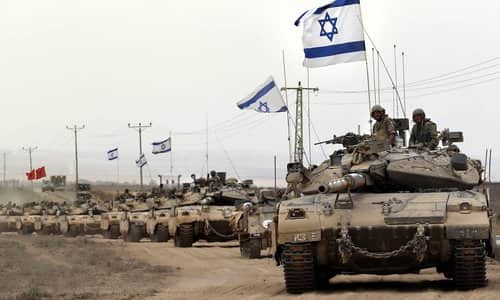
The Merkava main battle tank is one of the world's tops fighting vehicles, but its size and crew requirements are a hindrance in close, urban combat. Enter the Carmel armored vehicle.
Able to be crewed by two soldiers rather than four, the Carmel is powered by a hybrid power system that allows it to run more quietly, efficiently and with greater power in short sprints. It is being developed in several variations ranging from armored personal carrier to main battle tank and even to mine clearing.
The Carmel will have similar defensive capabilities to the Merkava in its ability to shoot down incoming rockets but will also employ a new form of active optical camouflage. Its lighter size will allow it better to engage targets in dense urban environments than the Merkava and there is even an autonomous version in development. It is expected to enter service in three years.
Two unmanned submarines were also presented, the larger Caesaron and a smaller craft dedicated to undersea searching and mapping. Intended for intelligence gathering, both subs will be equipped with a host of advanced sensors and allow the Israeli navies to guard against undersea threats such as mines and enemy attack subs. Developed in conjunction with Bar Ilan university, the nimble subs are expected to cost just a third of what similarly classed subs cost.
Aerial drones are another focus for the MAFAT with two new classes of drones being unveiled this year. The first is a light cargo drone capable of carrying a cargo of 150 liters and weighing between 60 kilograms in one model and 180 kilograms and flying up to 8 km at a speed in excess of 90 miles per hour.
Two models were presented for this role that can be expected to support troops in difficult to reach combat zones by air dropping supplies when intense fighting would make approaches by larger craft impossible.
The other class of drone is unique in that it is equipped with an assault rifle that it is capable of aiming and firing towards the ground in support of infantry operations.
Unlike high-flying military drones that use laser guided bombs, the TIKAD will hover several meters above the enemy's head and direct small arms fire at them from close range, hovering and swooping between buildings, providing extremely close infantry support.
This unique drone will allow IDF infantry soldiers to remain safely behind cover while engaging enemy forces.
The third class of weaponry continues the trend of automation with robotically controlled trucks, D-9 bulldozers and front-end loaders. Allowing these vehicles to be operated remotely protects more soldiers from direct attack and frees up more manpower for other roles.
Israel is increasingly facing threats not only from large nation states such as Iran, but their extremely well-armed proxy armies, such as Hezbollah.
Armed with rockets and guerrilla tactics, the old weapons of war and tactics need to evolve to combat such terrorist forces. Agility, connection and automation are the watchwords of the day and the MAFAT advances will give the IDF the edge in the wars to come.