
Palestinians Ramp Up Feud With The US
 By Israel Kasnett/JNS.org January 26, 2018
Share this article:

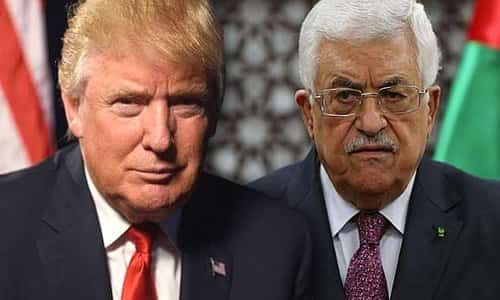
While the Trump administration believes the Middle East is "at the dawn of a new era" marked by progress towards "a peaceful resolution" to the Arab-Israeli conflict, the Palestinians are singing a different tune.
On Jan. 23, the White House revealed that there has been no contact between the Palestinians and President Donald Trump's Middle East negotiating team since the Dec. 6 announcement of U.S. policy changes on Jerusalem.
In line with the ongoing Palestinian boycott of the Trump administration, Palestinian Authority President Mahmoud Abbas snubbed Vice President Mike Pence during the American leader's visit to Israel this week and instead flew to Europe, where he implored the European Union to recognize a Palestinian state.
Israeli Member of Knesset Michael Oren (Kulanu), deputy minister in the Prime Minister's Office, scoffed at the Palestinians' current feud with the U.S.
"The Palestinians have zero to complain about. They spent eight years with the most pro-Palestinian president ever," Oren told JNS, referring to Barack Obama. "But they spat in his eye and went to U.N. agencies like UNESCO. They wasted that period and they are wasting it now."
Speaking at Israel's parliament on Jan. 22, Pence expressed his appreciation for "the great honor to address this Knesset, the first vice president of the United States to be afforded that privilege here in Jerusalem, the capital of the state of Israel."
Pence drew loud applause and standing ovations from Israeli legislators--with the exception of Arab lawmakers, who staged a protest at the beginning of the speech and were promptly escorted out of the plenum by Knesset ushers. Even before Pence arrived in Israel, MK Ayman Odeh, head of the Joint Arab List party, called Pence a "dangerous man with a messianic vision."
Palestine Liberation Organization negotiator Saeb Erekat similarly tweeted, "The messianic discourse of Pence is a gift to extremists & has proven that the US Administration is part of the problem rather than the solution."
Amid the anger of Palestinian and Arab leaders, Prof. Efraim Inbar, president of the Jerusalem Institute for Strategic Studies, argued that the Israeli-Palestinian conflict is not the main concern in the region.
"The U.S. administration, like the Israeli government and moderate Arab countries in the region, such as Saudi Arabia, Egypt and Jordan, all see Iranian encroachment and the regime's effort to achieve regional hegemony as the main problem," he told JNS. "Jordan pays lip service to the Palestinian cause, but what they are doing is not what they are saying."
Even though the Trump administration has apparently taken a clear stance on Iran and the Arab-Israeli conflict, U.S. policy in the rest of the Middle East, such as in Syria or Lebanon, still seems hazy to some experts like Inbar.
"The Americans need to make up their minds on what their Middle East policy actually is," Inbar stated. "The Palestinian issue is only a minor part of it. We are not seeing a clear policy at this point."
Oren agreed that the Palestinian issue is not the primary concern in the Middle East, even though part of the international community is still focused heavily on the Palestinians.
"What the Europeans fail to get," Oren said, "is that by encouraging Abbas not to enter negotiations with Israel and the U.S., they are harming the Palestinians themselves. It creates a situation where Abbas cannot enter negotiations. People are giving the Palestinians terrible advice."
The U.S., however, has been advising the Palestinians to resume negotiations with Israel. By recognizing Jerusalem, Pence said, the U.S. chose "fact over fiction. And fact is the only true foundation for a just and lasting peace." He urged the Palestinian leadership to "return to the table."
Oren, too, said that it would be in the best interests of the Palestinians to return to negotiations, and suggested that the Trump administration would conduct diplomacy the way business is conducted. "The president and his staff come from the world of business," noted Oren, a former Israeli ambassador to the U.S.
"My sense is that the U.S. will wait for the Palestinians" to agree to negotiate, Oren surmised.
As the Palestinians continue to lament the U.S. recognition of Jerusalem as well as the planned embassy move and the establishment of the modern state of Israel to begin with, Oren said, "It's their tragedy. The tragedy that keeps playing over and over."
Originally published at JNS.org - reposted with permission.