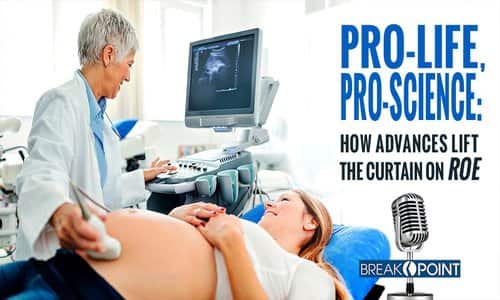
Pro-Life, Pro-Science: How Advances Lift the Curtain On Roe
 By John Stonestreet/Breakpoint.org February 16, 2018
Share this article:
One side of the political aisle likes to paint itself as pro-science. But when it comes to this most controversial social issue, science won't toe their party line.
Writing at The Atlantic, Emma Green chronicles how breakthroughs in medical technology and advances in our understanding of pregnancy have fueled the movement to end abortion.
Forty-five years after Roe v. Wade legalized abortion nationwide, it's become clear that this Supreme Court decision and the sexual revolution that spawned it were both based on ignorance--ignorance of what really happens inside the womb, and of what unborn human beings really are.
Since that time, a curtain has lifted. So-called "fetuses," once shrouded in mystery, their forms hidden in what the psalmist poetically calls, "the depths of the earth," have became visible to the world. Thanks to ultrasound technology, three-dimensional imaging, better neonatal care, and even fetal surgery, we're able to look inside the womb.
Pro-life activist and mom Ashley McGuire tells The Atlantic that her fellow millennials grew up in "an entirely different world of science and technology than the Roe generation." In 1973, it seemed plausible that the unborn, especially during early development, were nothing more than "blobs of tissue.
In 2018, seeing babies on ultrasound and celebrating them as babies has become a matter of course for parents.
Courtesy of science, images and even videos of children curled up, thumbs in their mouths, have been imprinted on our cultural consciousness. And no one who seriously reckons with these images or is not willfully blind can call what they depict as mere "blobs of tissue."
And therein lies the problem for pro-choice activists. You see, the reasoning of the abortion rights movement in general and Roe v. Wade in particular, depends on two assumptions. First, that unborn babies are meaningfully different from born ones.
Several decades of science have demolished this idea. We can see into the womb now and observe a baby hiccupping, sucking its thumb, clapping, practicing breathing, and even playing. The obvious question when confronted with such a spectacle is how this child differs from the one in the cradle.
Second, the reasoning of Roe specifically invoked viability--the stage at which an unborn baby can survive outside its mother's womb. But science has changed all of that too. Advances in neonatal intensive care have pushed the point of viability back from 28 weeks to around 22, and it continues to move earlier and earlier with each year.
All of this has left the American medical system in a state of schizophrenia. Doctors and nurses will work around the clock heroically to save the life of a baby born prematurely. And yet in some cases those very same doctors and nurses will be called upon to end the life of another baby the same age or even older.
Ultimately, writes Green, the reason science has been such a powerful ally to the pro-life cause is because it resonates with the "common sense of fetal heartbeats and swelling stomachs." It gives us permission to voice something we already know at an intuitive level: The unborn are babies, and should be treated as such.
Former Bush bioethics appointee and Notre Dame professor, O. Carter Snead, explains that science serves as a "bridge to our moral imagination."
By itself, science isn't enough. But it can lift the curtain that made it so easy to claim ignorance of what and who the unborn really are. And in that sense, those who still refuse to admit the humanity of the littlest humans are the true "science-deniers."
Originally published at Breakpoint.org - reposted with permission.