
The Saudi Solution
 By Daniel Pipes/Middle East Forum May 25, 2016
Share this article:
As European governments slam the gates shut on illegal Middle Eastern immigrants, where can Syrians and others go to, not far from their homelands, for safety and employment? The answer is obvious but surprisingly neglected: to Saudi Arabia and the other rich Arab sheikhdoms.
The more than one million migrants who boated, trained, bussed, and walked to northern Europe in the past year overwhelmed the continent's capabilities and good will. Those large numbers were then exacerbated by crime and disease, an unwillingness to assimilate, a drive to impose Islamic laws, and such outrages as the Cologne taharrush (mass sexual assault) and the attacks in Paris and Brussels.
In reaction, populist and fascist parties (such as, respectively, the National Front in France and Jobbik in Hungary) gained strength. The European mood has so deeply shifted as shown by the March elections in Germany that much reduced numbers of illegals are likely to get in, no matter what new routes they try, such as via Italy.
This leaves huge numbers of would-be migrants wanting to enter Europe. A European Union (EU) commissioner, Johannes Hahn, counts "20 million refugees waiting at the doorstep of Europe. ... Ten to 12 million in Syria, 5 million Palestinians, 2 million Ukrainians and about 1 million in the southern Caucasus." Yes, but that's just a start; I also add vast numbers of Libyans, Egyptians, Yemenis, Iraqis, Iranians, Afghans, and Pakistanis and not just political refugees but also economic migrants. In all, the numbers of Muslim peoples ready to emigrate could potentially match the 510 million EU residents.
To where, then, are they to go? One nearby, desirable alternative to Europe exists; indeed, it's a destination so attractive that foreigners already constitute half the population: that would be the six Gulf Cooperation Council states of Bahrain, Kuwait, Oman, Qatar, Saudi Arabia, and the United Arab Emirates. Let's focus on the Kingdom of Saudi Arabia (KSA), the largest of them in land size, population, and economy.
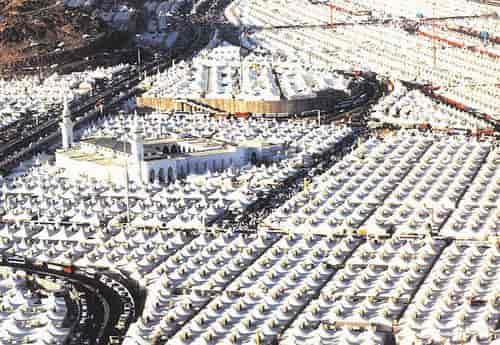
The KSA has many unique attractions for Sunni Muslims. To begin with, it has 100,000 high-quality, empty fiberglass tents that can house about 3 million people in Mina, just east of Mecca. Fireproof and air-conditioned, complete with toilets and kitchens, this unique resource is occupied a mere five days a year by pilgrims on the hajj.
Comparing the KSA to the states of northern Europe, shows its many other advantages:
Geography: Much closer.
Climate: Hot.
Language: Arabic.
Economics: An insatiable need for labor.
Legal system: Reassuringly familiar.
Religion: Islam, Islam, Islam.
Culturally, many Sunnis find Saudi's severe strictures more congenial than the West's secular environment. In the KSA, Muslims can exult in a society that permits polygamy, child marriages, wife-beating, female genital mutilation, and beheadings, while only lightly punishing slaveholding and honor killings.
Saudi also permits Muslims effortlessly to avoid such haram (forbidden) features as pet dogs; pork and alcohol; interest payments on loans; lotteries and casinos; Valentine's Day, women in revealing clothes, dating, and gentlemen's clubs; gay bars and gay marriage; the drug subculture; and the public expression of anti-Islamic views.
The Persian Gulf countries have been berated for not taking in "a single" Syrian refugee. Yet the Saudi authorities claim to have taken in 2½ million Syrians. How to explain this discrepancy?
In part, the Saudis are lying. But also, in part, the GCC and other Arabic-speaking states such as Iraq, Jordan, Lebanon, and Syria never signed the 1951 Refugee Convention (because they reject the convention's goal of resettlement as applied to Palestinians). Accordingly, they avoid using the term refugee, with its implication of permanence, and refer instead to guests, who stay only temporarily until they return home.
How many Syrians have been allowed into Saudi? One study, by Lori Plotkin Boghardt of the Washington Institute for Near Eastern Policy, estimates they number in the "low hundreds of thousands," say 150,000. That's a small fraction of the over four million in Turkey, Lebanon, and Jordan and just 5 percent of the migrants who could be housed just in Mina's splendid tents.
That wealthy Arab states are so miserly in opening their arms to Sunni Muslims in stress reveals currents of selfishness and hypocrisy. Their unhelpfulness should not be rewarded; it's high time that governments and refugee organizations stop focusing on Europe and instead turn to those Arab countries capable, with relative ease, to take in, house, and employ their desperate brethren.
Originally published at DanielPipes.org - reposted with permission.