
Cell Phone Addiction Consuming A Generation
 By PNW Staff July 06, 2016
Share this article:
In the age where the dinner table is more like a Wi-Fi hub, taking away the bright screen from a child or yourself is a difficult task.
Emails, messages, and updates keep our eyes glued, and our fingers tap-tap-tapping on the screen even as we grudgingly admit how unhealthy it is.
The word addiction is thrown around when it comes to nearly every aspect of our lives, but the need to hold that contact with the world in the palm of our hand has indeed become a dangerous one.
Motor vehicle wrecks, walking into traffic and railway crossings, etc. are mere warning signs of how deeply the mind can sink into an electronic swamp while the physical body and our relationships suffer the consequences.
The statistics are startling:
- The average user checks their cellphone 110 times throughout the day, which translates into spending 3.6 hours on their cellphone at least each day (some college studies have shown this to be double for college age students) That means we spend over an entire day (25.2 hours to be exact) each week on our phones.
- 40% Check their cell phones on the toilet
- 12% Check their cell phones in the shower
- 26% of car accidents are related to cell phone usage
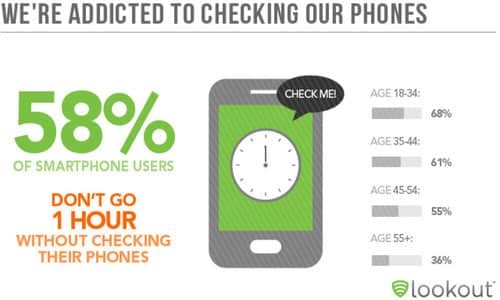
- 75% of smartphone users check their phone within an hour of getting up in the morning
- 56% of users check their phone within an hour of "going to sleep"
- 61% of users admit to sleeping with their phone turned on under their pillow or next to their bed
- 51% of users check their phone constantly while on "vacation"
- 50% of users feel uncomfortable when they don't have their cell phone with them or have no service
- 58% of children aged 3 to 5 can operate a smartphone, but only one to six percent know how to make their own breakfast.
These stats speak even more to the generation we are raising, now. Earbuds dangling from one or both ears and a palm full of phone and your child cannot, and will not, hear anything outside of what they are being fed through their electronic device.
Music, games, or videos, their smartphones are how they soak in information, both right or wrong. We all seem to have a compulsion to checking our phones, but not all have that nagging obsession to keep it 'in hand'. There is an anxiety to being separated from our electronics.
But the umbilical cord needs to be cut, if for no other reason than that we might remember how to have a conversation.
The days of summer-long physical activities has become history with only forty percent of all children even knowing how to ride a bike. This evolution of child-rearing comes with extra stress.
Parents must monitor and have conversations that otherwise would not happen until much later, while staying on top of any new technologies.
As with any addiction, damage can be done through the overuse of a smartphone and parents lack of knowledge.
Even posting children's pictures online can lead to danger but everyone does so without a second thought. Addiction is rarely given a thought before a problem does arise.
There are steps we can all take to move away from the constant connection with people outside of our home in order to connect with those that live within it.
Sleep specialists have already found that the sooner we put away our phones at night, the easier we fall asleep. However, waking up and immediately having to check the screen does the same damage.
Whether 3 or 103, that first thirty minutes to an hour should be for waking up slowly with a routine that does not include a cellphone.
Regardless of what it is used for, it can wait while the mind has time to unravel and stretch along with the body. Retraining the brain-muscle not to instantly react to a lit screen is hard but beneficial.
Making family functions, even dinner, a device-free zone is a step a family can take as one. Even if for half an hour everyone is groaning from the withdrawals, at least it is conversation.
Slowly but surely, "How was your day?" will fall from someone's lips and the benefit from laying our phones aside will become obvious. Because instead of an inattentive, "Uh-huh", a real conversation will start.
Bridges are rarely built in a day. It is the small steps that break the chain of routine and addiction. And as in all things, be the example.
Show maturity to the younger generation rather than tell them. Being the first person to put the phone down and the last to pick it up will build the frame work for new family habits and, hopefully, a tradition or two.